

Kansas Municipal News
Wichita police chief says WPD has been searching for more protective gear
Wichita Police Chief Gordon Ramsay says his officers are showing up for work now more than ever during this time of COVID-19.
“Our sick leave as of (Friday) yesterday when I looked at it, we are lower than the average throughout the year,” said Ramsay. “And that speaks volumes about our workforce and the people that we have policing our community.”
Ramsay also addressed the need for protective gear for officers.
“There is a significant supply issue with N95 masks and protective gear right now,” said Ramsay.
He says they have been working on the issue for some time.
(Read more: KSN-TV)
Gov. Laura Kelly orders expansion of telemedicine; 65 confirmed cases
Gov. Laura Kelly on Sunday announced she had issued executive orders to expand the use of telemedicine and waive restrictions on motor carriers who are delivering relief for COVID-19.
At least 65 residents have tested positive for the coronavirus, and two have died. Local health officials in the state’s most populous areas have accelerated restrictions on social activity in hopes of halting the rapid spread of COVID-19.
The governor’s orders, signed on Friday, take effect immediately and are in place for as long as Kansas remains under a state of emergency.
(Read more: Local – The Hutchinson News)
AG Derek Schmidt: New guidance now available to keep meetings open to the public during COVID-19 ‘social distancing’ limitations
The attorney general’s office has proposed formal rules for state and local governments to ensure their meetings remain open to the public during ‘social distancing’ emergency restrictions on gathering in person, Attorney General Derek Schmidt announced today.
“During a time of declared emergency when lives are disrupted, many people are apprehensive, and rumors can run rampant, the importance of ensuring openness and transparency in the government decision-making process is even greater than usual,” Schmidt said. “An important way for public bodies to provide reassurance is to go the extra mile to ensure their actions are transparent during the time of emergency. This new guidance will help state and local government bodies throughout Kansas operate transparently even when the public cannot gather in person for meetings.”
The Kansas Open Meetings Act (KOMA) requires public bodies to be “open to the public.” Ordinarily, that requirement is met by allowing members of the public to enter the room where the meeting is taking place so they can listen and observe. But public-health requirements to slow the spread of COVID-19, including the Centers for Disease Control recommendation not to gather in groups of more than 10 people, makes many in-person gatherings impossible or inadvisable.
The new regulation for complying with the KOMA during an emergency provides as follows:
- The KOMA remains in full force and effect unless explicitly suspended by emergency order of the governor. The governor has not currently suspended any requirement of the KOMA.
- If the members of the public body themselves are not physically gathered in one place – for example, if the meeting itself is conducted by telephone or videoconferencing – then members of the public must be able to join in the electronic conferencing in order to listen to or observe the meeting.
- If the members of the public body are physically gathered for a meeting but cannot allow members of the public to be present because of emergency limitations, then the public body must take steps to allow members of the public to listen to or observe the meeting by telephone, videoconferencing, television broadcast, or similar method.
- When the public is participating in a public meeting by telephone or other medium of interactive communication, members of the body must take steps to help the public understand the proceedings despite not being physically present. For example, each speaker in the meeting should identify herself by name before speaking or voting so remote listeners or observers can more readily know who is speaking; likewise, each motion should be clearly stated and each vote tally clearly announced.
- The procedure for any executive session must be clearly explained at the outset of a meeting.
- There must be no cost for the public to participate.
- There must be a method for distributing any agenda or other written materials that ordinarily could be picked up in person by members of the public attending the meeting. Those procedures must be explained to the public before the meeting begins.
In addition to the regulation itself, which will be legally binding, the attorney general also has issued a Best Practices document with additional actions that are strongly recommended. These recommendations include:
- Before shifting to new meeting procedures that do not allow in-person public attendance, produce and widely disseminate to the general public through news media, social media, email and other means a notice explaining why and how the ordinary meeting procedures will change, how the public may receive notice of meetings, and how the public may continue to participate in meetings.
- Audio or video record the meeting and post to the public body’s website so members of the public who could not participate later can review what occurred.
- Post to a public website any materials that will be distributed during the meeting, such as any agenda, agenda packet, or presentation.
Overall, the new guidance advises public bodies to keep the need for transparency prominently in mind when adapting to social-distancing requirements during the COVID-19 response. Public bodies subject to the KOMA should “take any actions as may be necessary and reasonable under the circumstances of the emergency declaration to advance the state policy that ‘meetings for the conduct of governmental affairs and the transaction of governmental business be open to the public.’”
Schmidt advised public bodies and agencies immediately to begin following the new guidance, although the regulation will not be legally binding until approved by the State Rules and Regulation Board and filed with the Secretary of State. The proposed new regulation today was submitted for approval as a temporary regulation and will become legally binding once that approval process is completed. After that occurs, Schmidt said he will propose the regulation be permanently adopted, which will start a process that will allow for public input and comment on the regulation.
“We need to get this in place to provide immediate guidance for state and local governing bodies throughout the state,” Schmidt said. “But we know there may be other good ideas or suggestions from public comment, and we are certainly willing to refine the regulation in the future.”
A copy of the proposed regulation, K.A.R. 16-20-1, and the Best Practices document are available on the attorney general’s website at www.ag.ks.gov/open-government.
(Read more: Kansas Attorney General News Releases)
Kansas small businesses eligible for disaster loans from the Small Business Administration
Governor Laura Kelly announced today that the U.S. Small Business Administration approved her request to make loans of up to $2 million available to small businesses disrupted by coronavirus. The disaster declaration extends to all 105 Kansas counties, making low-interest federal disaster loans for working capital available for Kansas small businesses suffering substantial economic injury.
“The COVID-19 outbreak and the uncertainty around its spread has had, and continues to have, a significant impact on Kansas businesses,” Governor Kelly said. “I’m grateful for the combined efforts of businesses, the Department of Commerce and the Kansas Division of Emergency Management to quickly pull together the data that made it possible for Kansas to receive this designation and begin getting support to the small Kansas businesses that need it during this emergency situation.”
Kansas small businesses can begin applying for disaster loan assistance through the SBA at https://disasterloan.sba.gov/ela. SBA customer service representatives will be available to answer questions about SBA’s Economic Injury Disaster Loan program and explain the application process.
“SBA’s disaster loans are a powerful tool to help our state’s small businesses weather this temporary storm,” Secretary of Commerce David Toland said. “The Department of Commerce is grateful for the SBA’s quick action to make these resources available and for their commitment to keeping Kansas businesses strong.”
SBA loans may be used to pay fixed debts, payroll, accounts payable and other bills because of the disaster’s impact.
Eligibility for Economic Injury Disaster Loans is based on the financial impact of the novel coronavirus, COVID-19. The interest rate is 3.75 percent for small businesses and 2.75 percent for private non-profit organizations.
Businesses may apply online, receive additional disaster assistance information and download applications at https://disasterloan.sba.gov/ela.
For more information about the Kansas response to COVID-19, please visit: https://govstatus.egov.com/coronavirus.
(Read more: Kansas Department of Commerce)
Officials ban gatherings of 10 or more in Reno County
The director of the Reno County Health Department has issued an official order banning all gatherings of 10 or more people within the county, effective 12:01 a.m. Sunday. There are exemptions to the order that allow businesses to stay open, but it requires they establish distances to allow at least 6 feet of social distancing. The order also mandates anyone traveling to Johnson or Wyandotte counties in Kansas or Jackson County in Missouri, or the Kansas City area, go into a mandatory 14-day quarantine.
(Read more: Local – The Hutchinson News)
Muni market wrestles with COVID-19 disclosure
Regulatory relief may not be in sight for issuers as they grapple with how to deal with late filings because of the pandemic.
Ahmed Abonamah, deputy director of the Securities and Exchange Commission’s Office of Municipal Securities discussed his views on disclosure and COVID-19 during a Thursday webinar hosted by the Municipal Securities Rulemaking Board.
Participants asked if the SEC would provide regulatory relief for late financial filings because of the difficulty to access materials since many people have begun working remotely. Abonamah noted that disclosures issuers make pursuant to their continuing disclosure agreements are governed by contractual obligations between the issuer and investors.
(Read more: The Latest)
Moody’s says COVID-19 makes muni marketplace a riskier place
While munis are holding up better than most asset classes amid the COVID-19 crisis, don’t be surprised to see a few defaults along the way, says Dan White, head of fiscal policy research at Moody’s Analytics.
“Aside from the immediate increase in demand for many government services during this national emergency, the most visible impact to most municipal issuers will come via lower revenues,” White said in a report released Friday. “If the downturn increases in magnitude or duration, expect the impact on the muni market to be much more severe.”
He said that when the COVID-19 crisis is finally over, municipal defaults and bankruptcies among at-risk issuers will likely rise.
(Read more: The Latest)
Coronavirus hits rural Kansas, Missouri towns. Many don’t have a single hospital bed
The first novel coronavirus case in Jackson County, Kansas, about 30 miles north of Topeka, was confirmed Thursday.
Though the news came with few details about the patient or how the person contracted it, one thing was certain:
Coronavirus has arrived in rural Kansas, which has been depleted of the crucial resources that will be needed if the outbreak spirals.
After decades of declining population, many parts of Kansas and Missouri are left with few or no hospitals to treat patients suffering from COVID-19.
(Read more: KC Star Local News)
AG offers “open meeting” guidance during coronavirus
The attorney general’s office proposed formal rules for state and local governments to ensure their meetings remain open to the public during ‘social distancing’ emergency restrictions on gathering in person, Attorney General Derek Schmidt announced today.
The new regulation for complying with the Kansas Open Meetings Act (KOMA) during an emergency includes:
If the members of the public body are not physically gathered in one place – for example, if the meeting is conducted by telephone or videoconferencing – then members of the public must be able to join in the electronic conferencing in order to listen to or observe. …
(Read more: Local – The Hutchinson News)
Kansas liquor stores and bars can now sell curbside amid COVID-19 concerns
Liquor stores and drinking establishments across Kansas are being permitted to sell curbside as the state fights the spread of coronavirus.
State Alcoholic Beverage Control Director Debbi Beavers said in a news release that many in the industry have expressed concern about the virus and its effect on businesses, including potential closures due to social distancing requirements.
Beavers said that during the duration of this temporary policy only, “the payment and the delivery of the alcoholic liquor may occur on or off of the licensed premises” and are subject to specific guidelines.
(Read more: KAKE – News)
Kansas National Guard plans delivery of supplies; 35 residents have tested positive
Members of the Kansas National Guard are busy planning the distribution of medical supplies recently received from the Strategic National Stockpile and other logistics for aiding in the campaign against COVID-19.
They aren’t contemplating martial law, quarantine enforcement or other draconian measures outside “the realm of possibility,” said Maj. Gen. Lee Tafanelli, the state’s adjutant general.
“There’s all kinds of social media saying the National Guard is taking over, they’re on the streets, they’re going to do this or that,” Tafanelli said.
In reality, he said, the Guard is working to relieve pressure on local communities in the same way they would after a tornado, floor or other natural disaster. That could mean the transport of medical supplies from a clandestine location to hospitals all over the state, as well as the collection and delivery of test samples.
So far, at least 35 residents and two out-of-state visitors have tested positive for the coronavirus in Kansas. Schools and universities have closed their doors, mass gatherings are prohibited, and restaurants and bars have shut down at the direction of local health officials.
Read more: CJOnline.com.
Bond-Market Strains Keep Traders on Edge
The global scramble for cash is putting immense pressure on bond markets, raising concern about whether they are functioning well enough to effectively distribute funds to communities and businesses.
In recent days, long-term Treasury securities have suffered significant price declines alongside large stock-market retreats, an unusual dual downturn that has raised alarm among traders. A stampede into dollars is pushing up the U.S. currency’s value overseas, adding to repayment woes for companies and governments that borrowed in dollars.
In the U.S., corporate issuance has been largely off limits to all but the bluest chips. State and local governments are facing sticker shock as steep declines in demand for their securities force rates much higher in some instances, while the market for short-term corporate loans has become surprisingly fragile, some market participants said.
(Read more: WSJ.com: Markets)
First Sedgwick County presumptive-positive coronavirus patient is in home isolation
The first presumptive-positive case of the novel coronavirus disease, COVID-19, has been confirmed in Sedgwick County. Officials said Thursday evening that the Kansas Department of Health and Environment has confirmed the test results.
“We knew that eventually we were going to have a positive case,” said Sedgwick County Commission Chairman Pete Meitzner. “… It has been a blessing that it has not happened earlier.”
In a news release, county officials said the patient is following Centers for Disease Control and Prevention guidelines and is quarantined at home. The patient is a Wichita woman over the age of 60.
(Read more: Local News |)
Johnson County removes exemption for weddings, funerals, religious activities on 10-person attendance limit
As the number of Johnson County COVID-19 cases climbs, county officials have removed an exemption for weddings, funerals and religious activities from the attendance limit of up to ten people. Meanwhile the county’s top public health officer urged residents to limit their public exposure.
“We recognize that it’s quite difficult for people to maintain,” said Dr. Joseph LeMaster, chief public health officer. “We’re hoping, praying that we will not have to go to more draconian measures such as sheltering in place.”
“I will not promise you that we will not come back to you and make that sort of order even as early as next week. So I want to really encourage people to do their very best to stick with this,” he said during an update to the county commission Thursday.
(Read more: Shawnee Mission Post – Community news and events for northeast Johnson County)
With ‘community transmission’ established in Johnson County, KDHE says it will allocate testing resources elsewhere
With 11 presumptive positive cases as of Wednesday, Johnson County accounts for more than half of the COVID-19 infections in the state. And the fact that a number of those cases have been attributed to local transmission — that is, people who contracted the virus from someone in the county who already had it as opposed to during travel elsewhere — has prompted the Kansas Department of Health and Environment to limit the number of tests it will deploy here.
In a series of new directives issues Wednesday, KDHE set guidelines for how the state will use the limited number of tests currently at its disposal. In areas without established community transmission, KDHE says, catching early cases through testing is more likely to stem the spread of the virus.
(Read more: Shawnee Mission Post)
SEK counties teaming up to get grant funding
Labette County is partnering with a neighboring county for a grant that could lead to healthy projects in their communities.
Labette County is partnering with Montgomery County in applying for a Blue Cross Blue Shield Pathways To A Healthy Kansas Community Grant.
The $200,000 administrative grant would span four years with $50,000 being paid to the counties each year.
The program has several healthy pathways to choose from and could incorporate everything from healthy foods in schools to building trails and recreational opportunities in the community.
(Read more: KSNF/KODE – FourStatesHomepage.com)
City of Topeka closes all city buildings, including Topeka Zoo
The City of Topeka closed all city buildings, including the Topeka Zoo, Thursday afternoon. In a statement, city leaders said their decision is in response to the Emergency Public Health Order issued by the Shawnee County Health Department Wednesday.
The Topeka Zoo remained open to visitors until Thursday, but buildings were closed to guests. Zoo staff will continue to go to work and take care of animals during this time. Dr. Shirley Lizzo, the zoo veterinarian, said they are working hard to keep animals and staff healthy.
(Read more: KSNT News)
Shawnee County commission meetings no longer open to public because of coronavirus
Shawnee County officials are changing the way their meetings are held to help limit the spread of germs during the coronavirus pandemic.
All department heads called in to Thursday morning’s county commission meeting at the courthouse unless they had a presentation to show in person.
They did this to keep the number of people in the room limited and allow for 6 feet between each person.
The public is no longer allowed at meetings and will have to address commissioners through letters.
(Read more: KSNT News)
Topeka police limit public interaction amidst coronavirus concerns ‘until further notice’
Police officers in the capital city won’t go to the scene of non-injury crashes during the coronavirus outbreak, and changed their interaction procedures at their headquarters, the Topeka Police Department said Thursday.
Topeka police spokeswoman Gretchen Koenen has now asked the public to call 785-368-9551 to make non-emergency reports, including non-injury crashes. They will still allow public visits to the Law Enforcement Center, but visitors will make a report to officers behind the front desk glass in accordance with social distancing guidelines.
(Read more: KSNT News)
Municipal Bond Trends for March 19, 2020
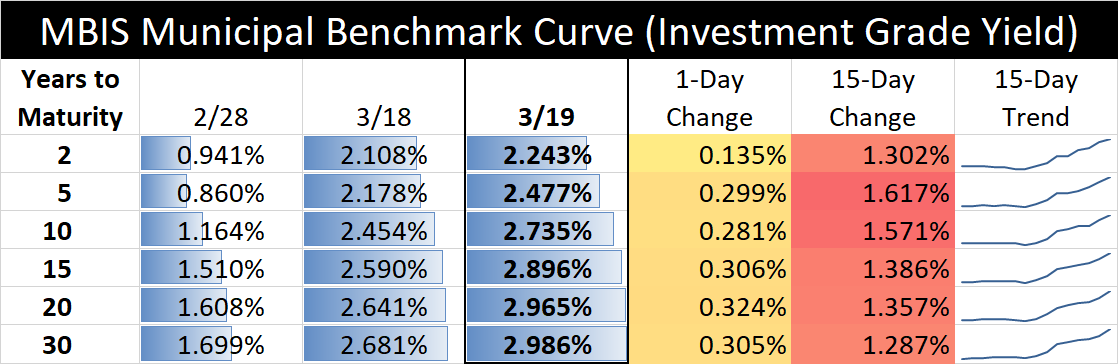
The interest rate table above illustrates recent changes in a sample of MBIS “investment grade” yields. Every issuer’s credit is different. For rates that may be applicable to your municipality, contact our Municipal Bond Advisors, Larry Kleeman and Beth Warren.