

Kansas Municipal News
Emporia Main Street part of nationwide contest
On Feb. 24, Independent We Stand, a national small business movement, kicked-off its fifth annual America’s Main Streets contest to help consumers, small business owners and Main Street organizations reward a deserving Main Street with $25,000 in cash and sponsor-related prizes.
Emporia Main Street is among this year’s nominees.
“Our Independent We Stand America’s Main Streets contest gives small business owners the opportunity to share their Main Street stories nationwide,” Independent We Stand co-Founder Bill Brunelle said. “But we know it takes a community to make that possible, so we’re inviting consumers to help recognize their favorite indie businesses.”
(Read more: Emporia Gazette)
KDHE launches ‘online resource center’ for coronavirus
The Kansas Department of Health and Environment (KDHE) formally announced Tuesday the launch of the agency’s online resource center for Kansans to learn more about COVID-19, the novel coronavirus, get answers to commonly asked questions about the virus and review other helpful information. The site is part of KDHE’s ongoing efforts to inform Kansans about the latest COVID-19 news and to address misinformation about the virus.
“The best thing Kansans can do is be informed,” Dr. Lee Norman, KDHE Secretary, said. “COVID-19 is a new virus and, as a result, many people have questions about it and how to keep their families safe. The COVID-19 resource center will provide a centralized location for Kansans to go to learn the most up-to-date information.”
The public can visit www.kdheks.gov/coronavirus to learn more about the virus. The site contains detailed information, answers to frequently asked questions and updated videos from Secretary Norman. Information will also be shared on KDHE’s social media channels.
(Read more: KSN-TV)
Planning board recommends zoning Reno County’s southeast corner
The Reno County Planning Commission voted unanimously Tuesday night to recommend that the county commission implement zoning in the southeast corner of the county, which a number of the area’s residents petitioned for some nine months ago.
About 30 people turned out for a 4:30 p.m. public hearing on the issue at the County Public Works building, and half of them spoke.
Only one resident voiced opposition to the change, concerned that it would limit future expansion of her growing vehicle repair and salvage business.
(Read more: Local – The Hutchinson News)
Hutchinson will stay neutral on bill on State Fair open alcohol sales
Although it would mean about a $24,000 annual hit to the city’s budget, the Hutchinson City Council on Tuesday agreed to stay neutral on a bill pending in the Kansas Legislature that would allow alcohol to be carried anywhere on the grounds during the Kansas State Fair.
The impact for the city comes from a clause in proposed Senate Bill 408 that would allow the fair to keep all liquor tax proceeds from alcohol sales at the fair. It currently receives only about 16% of that money.
Currently, those revenues are divided between the city and county, with most of that going to the city, city manager John Deardoff explained to the city council on Tuesday.
(Read more: Local – The Hutchinson News)
Greensburg survivors learn hard lessons about coping with distaster
March 2 to 6 is Severe Weather Awareness Week in Kansas. Two Marion residents learned more than they ever wanted to know about severe weather in 2007, and offered tips to be prepared.
Marion residents Chelsi and Javan Koehn lived in Greensburg on May 4, 2007 when the town was devastated by an F5 tornado that flattened 95% of the town and killed 11 people at 9:47 p.m.
It pretty well wiped the town off the map,” Chelsi Koehn said.
The Koehns purchased their home one month to the day before the deadly storm hit. Chelsi was nine months pregnant at the time.
(Read more: Marion County RECORD)
Shawnee city leaders propose new solution for electing council president, giving mayor power to chair and vote in council committee
After nearly three hours of deliberations Tuesday, the Shawnee city council has come up with a plan for self-electing its president.
The main outcome of last night’s council committee meeting: The city councilmembers unanimously agreed that they want the mayor to be a participating and voting member at future council committee meetings. They would also like to see her chair those meetings as well.
If the city council officially adopts this change, then the council president would no longer chair council committee meetings. However, the council president would still serve as acting mayor in the absence or disability of the mayor.
(Read more: Prairie Village Post)
Shawnee Mission administration, teachers bring on federal mediator for lingering issues from 2019-20 contract process
Shawnee Mission School District Superintendent Mike Fulton and National Education Association-Shawnee Mission President Linda Sieck on Tuesday issued a joint announcement that the parties had retained a federal mediator “in order to resolve issues related to the 2019-20 contract for certified staff.”
“The parties have reached an agreement to use a federal mediator to facilitate the process,” read the announcement, which was sent to district staff Tuesday morning. “Mediation is scheduled for Thursday, March 5, 2020. This meeting is not open to the public. Out of respect for the collaborative discussions that are occurring, this is the extent of any update at this time.”
It’s unclear what issues, specifically, the parties will be discussing. The timing of the Department of Labor’s decision rendering the second and third years of the three-year unilateral contract approved by the board unenforceable added complexity to the process for adoption of a unilateral contract laid out by the state.
(Read more: Prairie Village Post)
Federal loans and grants available to bring high-speed broadband to rural areas
The Kansas State Department of Commerce announces today that applications are being accepted for the second round of the U.S. Department of Agriculture’s ReConnect Program. ReConnect is a USDA program that furnishes loans and grants to fund the costs of construction, improvement or acquisition of facilities and equipment needed to provide broadband service in eligible rural areas.
As with the first funding round, USDA scoring includes points for states which have a broadband plan, and commit to expediting certain processes. Commerce is working with the USDA to ensure Kansas applicants are as competitive as possible.
Applications will be accepted until 6:00PM EST on March 16, 2020. Applications are made through the USDA, but Kansas applicants must obtain a state certification letter from the Kansas Department of Commerce to submit with their USDA application. The state certification letter can be obtained at www.kansascommerce.gov/sign-up/.
(Read more: Kansas Department of Commerce)
Boot Hill to receive loan from city
Despite concerns raised by Dodge City commissioners, a memorandum of understanding was approved Monday during the city commission meeting with Boot Hill Museum.
According to city officials, the agreement would assist Boot Hill Museum with funding for its expansion project in a loan amount not to exceed $850,000, an amount that will need to be paid back within three years once temporary notes are issued.
“Normally the city does not do this with a nonprofit organization, however, it is tied back to the STAR bonds project to complete the building,” assistant city manager Melissa McCoy said. “Interior exhibits weren’t covered under STAR bonds due to the statutes in place. Boot Hill Museum has had to raise funds and have been doing so the past few years.”
(Read more: News – Dodge City Daily Globe – Dodge City, KS)
Emporia approves Cargill tax abatement
The Emporia City Commission approved an ordinance granting a 10-year property tax abatement to Cargill Animal Nutrition Wednesday afternoon.
The abatement, which exempts Cargill from tax liability on its property, was previously discussed during a May 2, 2018, action session during which commissions approved an incentive compliance agreement with the dog food manufacturer in relation to its $4.5 million warehouse expansion project. At the time, Cargill had invested more than $5 million in new equipment and upgrades at its Emporia Facility.
David Belpedio, a partner with MarksNelson accounting firm out of Kansas City, said Cargill was excited to continue its commitment to Emporia with projected investments of $1.6 million to be made in 2021 and $2.5 million by 2022 at the local facility.
(Read more: Emporia Gazette)
Municipal Bond Trends for March 3, 2020
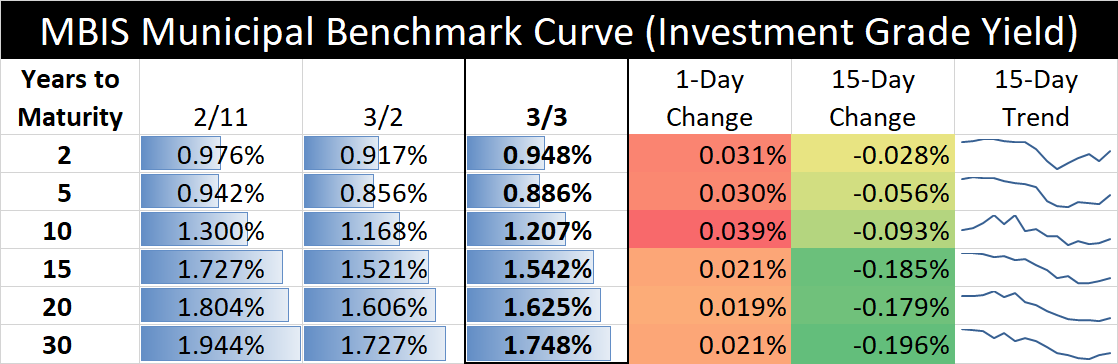
The interest rate table above illustrates recent changes in a sample of MBIS “investment grade” yields. Every issuer’s credit is different. For rates that may be applicable to your municipality, contact our Municipal Bond Advisors, Larry Kleeman and Beth Warren.
Fed cuts rates 50bps to offset coronavirus risks
The Federal Open Market Committee cut the fed funds rate target 50 basis points to a range between 1% and 1.25%, it announced Tuesday.
While economic fundamentals “remain strong,” the panel said in a statement, “the coronavirus poses evolving risks to economic activity.”
As a result, and “in support of achieving its maximum employment and price stability goals,” the panel took the action two weeks before its next scheduled meeting.
“The Committee is closely monitoring developments and their implications for the economic outlook and will use its tools and act as appropriate to support the economy,” the statement said.
(Read more: The Bond Buyer)
Sedgwick County home property values increase ahead of transparency bill decision
Most Wichita-area homes increased in tax value again this year during a push by state lawmakers to make property taxes more transparent.
About 81% of residential properties in Sedgwick County increased in value. The increases averaged 6% compared to last year, according to the county appraiser’s office. Those values, combined with local levy rates approved by local elected leaders, help determine what residents pay in property taxes.
Sedgwick County Appraiser Mark Clark said the reason for the increases is that homes are selling faster and for more money than in the past, citing “a very strong imbalance between supply and demand in the residential market.”
(Read more: Local News |)
Washington County consider ending county intangibles tax
On Monday county treasurer Denae Jueneman told the Board of County Commissioners that she has had several more complaints about the intangibles tax, and because this is an election year, she wondered if the commissioners had thoughts about allowing voters to decide whether or not to get rid of the tax at the county level. The intangibles tax is a local tax levied on gross earnings received from intangible property including savings accounts, stocks and bonds, among other things. Payment of the tax is on the honor system.
“You get penalized for honesty,” commissioner Raleigh Ordoyne said.
Jueneman said the intangibles tax brought in about $47,000 last year.
If the question were to be put in front of voters later this year, it would impact only the county’s portion of the tax; some townships and cities collect the tax too, and a county-wide vote wouldn’t impact those collections.
Read more: Washington County News.
Roeland Park discusses state of city’s glass recycling and exploring a curbside service
The Roeland Park city council earlier this month discussed what the future of glass recycling looks like for the city, including a curbside glass recycling service with Ripple Glass.
Previously, a big, purple Ripple bin sat in the Lowe’s parking lot for residents to drop off their recycled glass. Mayor Mike Kelly said the bin had to be removed due to contracts and policies outside of Roeland Park’s control. Ripple’s Metro Program Manager Morgan Henderson said the company loves servicing Roeland Park and is actively looking for a new spot to place a bin so residents can pick back up where they left off.
(Read more: Shawnee Mission Post)
Connecting incarcerated citizens to the Johnson County Library
For many years, Johnson County Library has provided outreach services for some teens and adults in the Johnson County corrections system. Now, those programs are expanding under the leadership of Incarcerated Services Librarian Melody Kinnamon. Kinnamon chairs a core team of staffers helping to connect incarcerated citizens to the Library, and she praises the entire group’s efforts. She’s especially grateful to long-term team members Kate McNair, Scott Stone and Debbie Frizzell for their commitment to this mission.
Kinnamon has held several positions since she came to Johnson County Library in 2002, including as a reference librarian and community branch manager. But the book “Just Mercy,” about justice and redemption, galvanized her. “I just kind of had a heart for the social justice issues that surround our criminal justice system,” she said, noting that Bryan Stevenson’s 2014 best seller “planted a seed” and sparked her passion to work with this population. Kinnamon co-chaired the incarcerated services team with McNair in 2018 and took the lead in 2019.
(Read more: Shawnee Mission Post)
Merriam discusses moving to LED bulbs in city streetlights
The Merriam city council on Monday discussed purchasing LED bulbs for streetlights in need of replacement, and eventually transitioning entirely to LED bulbs.
A move to LED bulbs is trending among Shawnee Mission cities: Prairie Village its streetlights from Kansas City Power & Light in 2016 and set about installing LED heads. And in November 2019, Overland Park and Lenexa entered a partnership to switch to LED bulbs on some shared streetlights. Recently, Shawnee approved the acquisition of streetlights from Evergy (formerly KCP&L) and a conversion to LED bulbs.
Merriam purchased streetlights from KCP&L in 1996, and all light fixtures installed to date have been high-pressure sodium streetlights, according to city documents. There are 228 lights left to install to complete the Merriam Streetlight Program, and 78 of those are set for installation in 2020. The program could be completed with high-pressure sodium bulbs for $950,000, or with LED bulbs for closer to $1 million, Public Works Director Jim MacDonald said.
(Read more: Shawnee Mission Post)
Coronavirus not here yet, but coming; Sedgwick County gears up, official tells Wichita council
In the first of what will be weekly local updates on the coronavirus, Sedgwick County Health Director Adrienne Byrne told the Wichita City Council that the risk for the virus is currently low, but it is almost certain to come to Kansas sooner or later.
The coronavirus, also known as COVID-19, “is not in our community, it’s not in the state of Kansas, but it is coming and so we are going to be prepared for that when it does come,” she said Tuesday.
Sedgwick County has activated its “internal incident command system,” to gather information on the progress of the virus and distribute it to the health-care community and the general public.(Read more: Local News)
Response to call for volunteers for Overland Park mental health task forces has been ‘overwhelming’
Response has been “overwhelming” to a call for volunteers to serve on an Overland Park task force on mental health, Councilmember Chris Newlin said Monday.
Some 23 applications have come in for five positions on the task force, which was launched about two weeks ago. In fact, Newlin said he would like to add two or three positions to include more people who want to serve. “We want to make sure we have a very robust task force,” Newlin said.
The advisory group is being formed to study the mental health needs of the community and barriers to meeting those needs.
(Read more: Prairie Village Post)
The 10-year Treasury note yield just broke below 1%. Here’s how it happened
The U.S. bond-market’s benchmark yield plunged below 1% on Tuesday, a possibility that few analysts and investors contemplated at the beginning of the year.
Investors have attributed the slide in U.S. Treasury yields to a combination of factors including slower global economic growth, the attraction of a positive return when negative-yielding debt is the alternative in Europe and Japan abroad, and the absence of any inflation threat.
But in the end, the spark for the furious rally in Treasurys on Tuesday came from a less abstract source: a surprise 50 basis point interest rate cut from the Federal Reserve to counteract worries that the spread of the COVID-19 epidemic would deliver a painful blow to consumer and market confidence.
(Read more: MarketWatch.com)