

Kansas Municipal News
Fort Scott residents create fundraiser to help laid off workers
Southeast Kansas residents are getting creative in an effort to support local businesses during the coronavirus pandemic.
Fort Scott residents have created a fundraiser on Facebook to help keep local workers who’ve been laid off, paid.
Anyone can donate then, organizers purchase gift cards from businesses that have been closed.
(Read more: KSNF/KODE – FourStatesHomepage.com)
Municipal Bond Trends for April 20, 2020
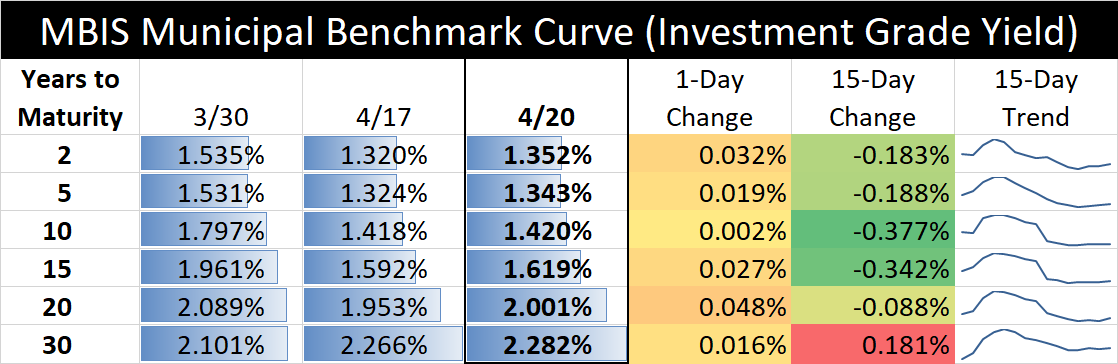
The interest rate table above illustrates recent changes in a sample of MBIS “investment grade” yields. Every issuer’s credit is different. For rates that may be applicable to your municipality, contact our Municipal Bond Advisors, Larry Kleeman and Beth Warren.
New LED streetlights coming to east Lenexa
A pair of streetlight improvement projects will bring brighter, more efficient lighting to areas of east Lenexa.
The City of Lenexa has begun replacing some of the streetlights in Old Town and in the area around Rosehill Road and 103rd Street. See maps of the Old Town project and the Rosehill Road/103rd Street project for impacted streets.
The City currently leases streetlights on the wood power poles from Every, while the remaining streetlights were purchased from KCP&L (Evergy) in 2009. All of these lights will be replaced with City-owned streetlight poles with energy-efficient LED fixtures.
(Read more: Lenexa)
Peabody Foundation activates community relief fund
Donors in Peabody have committed over $5000 to the Peabody Community Foundation (PCF) Community Relief Fund in support of the COVID-19 relief efforts. As a result of incoming donations and anticipated needs, the PCF board took action to open The Peabody Community Relief Fund.
“I was contacted two weeks ago by a supporter of PCF wondering what we were going to do in the face of economic hardship brought on by the pandemic,” said Becky Nickel, PCF Director. “The board took action so that funds can be granted locally.”
The Peabody Community Relief Fund is not a traditional endowment, but rather a pass-through fund. This type of fund maintains liquidity and allows the PCF review committee to mobilize grants to charities very quickly.
(Read more: Hillsboro Free Press)
Wichita USD 259 moving forward with graduation plans
Wichita USD 259 is moving forward with plans for in-person graduation ceremonies, if COVID-19 restrictions are lifted. USD 259 Superintendent Alicia Thompson updated school board members during a meeting Monday.
Members of the Student Advisory Council told administrators they wanted to have events where they could wear their caps and gowns. Dr. Thompson said events like this could take place before the end of July if restrictions on large gatherings are lifted.
Dr. Thompson said plans are underway for televised graduation-style events for each USD 259 high school. Those events are expected in May.
(Read more: KAKE – News)
Contact Tracing happening on “limited basis” in Sedgwick County.
Contact tracing is a research method used to find most or all contacts a COVID19 positive person has before, during and after a diagnosis.
It is happening on a limited basis in Sedgwick County.
KU School of Medicine-Wichita says Dr. Garold Minns has been doing contact tracing by himself and with current county staff.
Dr. Minns is the Sedgwick County health officer.
(Read more: KSN-TV)
Kansas beefs up testing at infection clusters linked to meat processing plants
The state rushed newly acquired testing supplies and personal protection gear into southwest Kansas to bolster the response to expanding clusters of coronavirus infection linked to the region’s large meat processing facilities, officials said Monday.
Mike Beam, secretary of the Kansas Department of Agriculture, said Ford, Seward and Finney counties in southwest Kansas and Lyon County all host processing facilities that have been challenged by spread of the virus. COVID-19 has killed 100 Kansans and infected nearly 2,000 people during the past two months.
“This is not a food safety issue,” Beam said. “There is no evidence of food-to-food packaging being associated with transmission of COVID-19.
(Read more: Local – The Hutchinson News)
Ascension Via Christi talks with city about providing ER service
The Wellington City Council voted unanimously to enter into a non-disclosure agreement with Ascension Via Christi, of Wichita, which has expressed an interest in providing emergency room services in the closed Sumner Community Hospital building.
“The city has been contacted by a couple of other groups with an interest in providing health care services,” City Manager Shane Shields told the council, during the Tuesday meeting. “The interest by Via Christi in providing full emergency room services appears to be the most positive possibility at this time.”
Ascension Via Christi reopened emergency services at the Fort Scott Hospital after it closed a year ago. Shields said he talked to the Fort Scott City Manager, who had spoken highly of Ascension and what it had accomplished in continuing emergency care for the city.
(Read more: Local – The Topeka Capital-Journal)
Clearwater nursing home has 42 COVID-19 cases, 2 deaths as coronavirus testing continues
A Wichita-area nursing home with an outbreak of the novel coronavirus now has 42 confirmed cases of COVID-19 and two deaths as testing continues.
The Clearwater Nursing and Rehabilitation Center coronavirus cluster had 29 additional residents test positive as of Monday, the Sedgwick County Health Department said in a news release.
All 53 residents of the nursing home have been tested for COVID-19, though not all test results have been returned. An undisclosed number of staff who have worked at the facility members have also tested positive and some have quit.
(Read more: Local News |)
Oil price goes negative as demand collapses; stocks dip
Oil futures plunged below zero on Monday, the latest never-before-seen number to come out of the economic coma caused by the coronavirus pandemic.
Stocks and Treasury yields also dropped on Wall Street, with the S&P 500 down 1.8%, but the market’s most dramatic action by far was in oil, where the cost to have a barrel of U.S. crude delivered in May plummeted to negative $37.63. It was at roughly $60 at the start of the year.
Traders are still paying $20.43 for a barrel of U.S. oil to be delivered in June, which analysts consider to be closer to the “true” price of oil. Crude to be delivered next month, meanwhile, is running up against a stark problem: traders are running out of places to keep it, with storage tanks close to full amid a collapse in demand as factories, automobiles and airplanes sit idled around the world
(Read more: McPherson Sentinel)
Pandemic costs are ‘blowing massive holes’ in cities’ budgets
The U.S. Conference of Mayors (USCM) and the National League of Cities (NLC) conducted a survey of more than 2,400 local officials, of which 88% of respondents said they anticipate the novel coronavirus pandemic will lead to “painful reductions in revenue this year.” Of these respondents, 1,968 represent cities with populations of less than 500,000, which did not receive support from the recent Coronavirus Aid, Relief and Economic Security Act (CARES Act) stimulus package.
(Read more: Smart Cities Dive – Latest News)
Municipal bonds settle into steady after whirlwind weeks
The municipal market was mostly quiet Friday as participants came off a week of a strong rally, an awakened new-issue market and the first fund inflows since February as they cautiously await another week with more deals on tap and continued questions of support out of Washington.
Triple A benchmarks showed slight weakness with most off a basis point or two.
While many new-issues are still on the day-to-day calendar for next week, more are being slated to price on specific days, signaling that dealers and issuers are ready to again test the primary.
(Read more: The Bond Buyer)
The Case for Rental Assistance: Why It is Necessary and How Cities Can Fund It
Housing instability plagued many Americans long before the COVID-19 pandemic, but the global health crisis has recently pushed it to the forefront of many policymakers’ minds as more families are urged to shelter in place. With orders to stay-at-home to help curb the spread of the virus, the question of who has a home to stay in, and how long they can afford it, is increasingly pertinent in light of the millions of individuals filing for unemployment or having their work hours significantly reduced. Given that nearly half of renters spend more than 30 percent of their income on rent and utilities and almost 11 million are severely cost burdened by spending more than half their income on rent, the housing affordability crisis is threatening to quickly become a public health crisis.
(Read more: CitiesSpeak)
Derby Public Library becomes temporary manufacturer
Personal Protective Equipment (PPE) has become part of the common vernacular during the coronavirus pandemic, as the need for that gear among medical professionals continues to rise.
Recently, the Derby Public Library jumped in to help address the current PPE needs – starting the 3-D printing of ear guards for health care workers about two weeks ago.
DPL Technology Coordinator Justin Ball said the ear guards are intended to create support/relief in regards to the face masks (with elastic bands) medical personnel are required to wear.
(Read more: Derby News | derbyinformer.com)
Caution advised in buying protective equipment
Reno County’s EMS director offered a warning to participants in a daily conference call on Friday about the purchase of protective equipment during the novel coronavirus outbreak.
“We were contacted by a local vendor who gained access to what he believed was a large quantity of N-95 masks and was wanting to sell those to us,” said Dave Johnston. “They appear to be KN-95s out of China.”
“We’ve done additional follow up and they are nowhere close to the standard we need for N-95 masks,” he said. “They would work fine as a simple mask, but they would not work as a respirator. They do not meet the standards we need.”
(Read more: Local – The Hutchinson News)
Western Kansas records massive spike in COVID-19 cases
The number of confirmed COVID-19 cases rocketed up in western Kansas this week from infection clusters involving at least six private businesses, state health officials said.
The most dramatic increase was in Ford County, where the number shot up from just two cases on April 9 to 84 cases on Friday, accounting for nearly a quarter of all new cases in the state for the past two days.
The increase moved Ford County into the fifth-highest case count in the state, behind Wyandotte, Johnson, Sedgwick, Leavenworth and Shawnee counties.
More than two dozen cases are also now confirmed in Finney and Seward counties, putting them 11th and 12th, respectively, on the state’s case count list.
(Read more: Local – The Hutchinson News)
Shawnee County to take ’step-wise approach’ to eventual easing of COVID-19 restrictions
Shawnee County health officer Gianfranco Pezzino shared several nuggets of good news — at least, relatively speaking — at the health department’s weekly COVID-19 news conference Friday.
But Pezzino added an important backdrop to his hopeful update: Now is not the time to get complacent.
“I want to warn you: I decided to share these somewhat positive numbers with you, but also with some concern that they could be misinterpreted,” Pezzino said, “and could lead to people to lower their guard and think, ‘Oh, we are done. We don’t need to stay home anymore. We can just go out and get with our friends.’ We are not at that point yet. Those numbers can turn around in a matter of hours or a few days. It’s important that we keep monitoring those numbers in the next few weeks.”
Shawnee County announced 90 confirmed cases of COVID-19 among its residents, up eight from Thursday’s total. Of those individuals who tested positive, 43 remain active cases, 42 have recovered and five have died.
(Read more: Local – The Topeka Capital-Journal)
Police, firefighter unions challenge city of Topeka on pay cuts
The unions representing Topeka’s police officers and firefighters are at odds with the city over a 3% pay cut announced last week.
The Fraternal Order of Police Lodge No. 3 and the International Association of Firefighters Local No. 83 sent letters on Wednesday and Thursday, respectively, to city manager Brent Trout requesting additional information about the pay cuts and questioning how the city concluded that action was the most appropriate to address potential budget shortfalls stemming from the coronavirus pandemic.
(Read more: Local – The Topeka Capital-Journal)
Topeka Metro to receive $6.58M in relief funding
Topeka Metro announced Friday it expects to receive millions of dollars in economic relief from the $2 trillion federal coronavirus response bill passed in late March.
Efren Mazas, president of the local transit union group that represents Topeka’s metro workers, announced in a news release Friday morning that Topeka Metro has been allocated $6.58 million in relief funds. Of the $2 trillion accounted for in the relief package, $25 billion had been earmarked for transit agencies across the U.S.
Mazas said he expects Topeka Metro to use some of the funds to offset revenue losses resulting from decreased ridership during the pandemic. Funds will also be used to purchase personal protective equipment, such as masks, for metro workers.
(Read more: Local – The Topeka Capital-Journal)
Ark City commissioners hire new city manager, Randy Frazer (Moundridge city administrator)
A new city manager in Arkansas City will be on the job by the end of May.
Randy Frazer, the city administrator of Moundridge, Kan., accepted an offer from city commissioners and a contract was signed Friday.
“I am excited the city commissioners have selected me to be the next city manager,” Frazer said in an email. “I look forward to joining the Arkansas City team and becoming part of the community.”
(Read more: The Arkansas City Traveler)
Higher education grapples with academic, financial uncertainties
Washburn University president Jerry Farley approaches planning for fall semester classes with optimism about possible return to some form of academic normalcy and with trepidation as financial costs of the coronavirus disruption sink in.
This feeling of excitement and angst is shared by administrators at universities large and small, as well as community and technical colleges across the state serving more than 125,000 students. Campus buildings have been shut down since mid-March in response to the COVID-19 pandemic, and learning from kindergarten through college in Kansas was hastily moved mostly online.
(Read more: Local – The Hutchinson News)
Emporia Zoo welcomes new bison
The David Traylor Zoo announced on Friday the arrival of a 1-year-old female American Bison. Her name is “Beulah.”
She was donated to the zoo by Madison residents, Randall, Kristi and Cliff Schankie.
“Beulah” the bison is doing well in her new surroundings and has a curious personality. She is really small in comparison to the zoo’s 17-year-old bull bison and, in time, they will be introduced to each other.
(Read more: Emporia Gazette)
Topeka’s mayor and city council mull temporarily cutting their pay
Topeka’s mayor and city council on Tuesday will consider temporarily reducing their pay by 3%.
A proposal to make that move is among items on the agenda when the mayor and council meet at 6 p.m. in their chambers at 214 S.E. 8th.
The Shawnee County Commission won’t meet Monday because commissioners voted April 6 to cancel that day’s meeting in an effort to decrease the risk of spreading COVID-19.
(Read more: Local – The Topeka Capital-Journal)
KDHE shows Ford County COVID-19 cases reach 84
COVID-19 cases continued to rise in Ford County as the the Kansas Department of Health and Environment numbers for Friday show 84 people have tested positive for the coronavirus.
According to Ford County administrator J.D. Gilbert, the Ford County Health Department recorded 16 new COVID-19 cases on Friday.
“The increase in cases the last few days is attributed to the health department investigation team identifying close contacts of already confirmed positive cases,” Gilbert said. “We do not have evidence of community spread even though we have seen a lot of positive cases recently.
(Read more: News – Dodge City Daily Globe – Dodge City, KS)
Chase County Sheriff’s Office to issue citations to those breaking stay-at-home orders
Chase County Sheriff Rich Dorneker said his office will start issuing citations to individuals ignoring statewide stay-at-home orders within the county in a Facebook post Saturday evening.
“For all of you that not want to abide by the stay at home order, my office will now start issuing citations to all that [do] not want to follow the orders set forth by the Governor,” the post read. “So if you want to drive to Chase County and illegally go to the lake or other places that have been limited you will get a citation written to you and all that are with you.
“Let’s abide by the order so that we can be done with this pandemic and have some sort of summer. By not following the order all you are doing is prolonging the stay at home order, what does it take for people to get it. Thanks and have a great day!”
(Read more: Emporia Gazette)
No furloughs at Edgerton, Gardner
The fear of COVID-19 has caused a nationwide lock down. Many businesses have been shuttered and the unemployment rate soaring.
Although exact numbers and overall effect of the “stay at home” order on the economy won’t be known for months or years, Johnson County just furloughed more than 250 employees and Overland Park about 200.
At this point, neither Gardner or Edgerton have furloughed any staff.
(Read more: Gardner News)
‘Ghost town’: Weeks into COVID-19 crisis, Overland Park shops work to adapt or wither
Darby Brender’s classes at Fusion Fitness were jammed at the start of March. Business was so good, her three locations around the Kansas City area, with 40 instructors, were pulling in 500 high-energy exercising clients a week.
“Classes were packed,” the owner said. “Everyone was happy.”
So it seemed for her 300 neighboring merchants in downtown Overland Park, where many seemed to reaping the fruits of a fast-paced economy nourished by the lowest unemployment rate, 3.5%, in half a century.
(Read more: Kansas City Breaking News, Crime & Sports |)
Parsons to provide utility bill relief to residents
The city of Parsons is hoping to provide some relief to its residents.
Parsons utility customers could get a little relief on their bills for the next two months.
City Manager Debbie Lamb proposed an idea that would save customers $15 month in May and June by waiving the environmental protection agency compliance fee.
Lamb says because the EPA charge is a flat fee paid by all city utility customers, waiving it is the most fair way to help all residents.
(Read more: KSNF/KODE – FourStatesHomepage.com)
Retail grant is considered in Parsons
A new furniture store may get a retail recruitment grant despite the location not yet being properly zoned.
The Parsons City Commission will consider a $5,000 retail recruitment grant for Milli’s New and Used Furniture, 2106 Crawford Ave., during a regular meeting on Monday evening. The commissioners discussed the proposed grant during a Thursday work session.
(Read more: Parsons Sun)
Kansas receives additional PPE supplies, expands COVID-19 testing in four counties
Governor Laura Kelly announced Sunday that Kansas has received additional supplies and personal protective equipment to expand COVID-19 testing in Finney, Ford, Lyon and Seward counties.
“I want to thank our federal partners for their ongoing efforts to help our state response to the COVID-19 pandemic,” Kelly said. “I particularly appreciate the assistance from Senator Pat Roberts and Senator Jerry Moran.”
The Kansas Department of Health and Environment is working closely with the Centers for Disease Control and Prevention to test and contain recent clusters of positive coronavirus cases in Kansas counties centered around food and meat processing plants.
(Read more: KWCH News)
More coronavirus supplies sent to meat processing clusters in southwest Kansas
Newly acquired testing supplies and personal protective gear is being shipped to Ford, Seward and Finney counties to confront coronavirus infection clusters in a region of western Kansas with large meat processing plants, state officials said Sunday.
Gov. Laura Kelly said testing for COVID-19 would be broadened with the supplies obtained through “federal partners.”
Cargill, Tyson Fresh Meats and National Beef have confirmed plant employees tested positive. Southwest Kansas accounts for at least one-fourth of the country’s beef processing.
(Read more: Local – The Topeka Capital-Journal)
Sedgwick County discusses plans to re-open community
It’s been 25 days of the stay at home order for Sedgwick County and with Governor Laura Kelly extending the statewide quarantine until May 3rd; county commissioners are debating whether or not they should extend the county order past that May 3rd date, since Sedgwick County is one of the state’s top hot spots.
Sedgwick County commissioner, Lacey Cruse said, “I don’t see us extending it unless something changes and we see a lot of spikes. As of things today and how things are looking, I would say that we really want to do what we can to open things back up.”
(Read more: KWCH News)
Russell Approves Energy Rate Decrease
Over the past few years, the city, working with the Kansas Municipal Energy Agency, has secured lower energy costs through new power supply contracts and taking advantage of the integrated power market.
Each month the historical and current operating expenses, plus revenue and expense projections, are reviewed to forecast required energy rates accurately. In October 2019, this monthly review indicated the base energy rate could be lowered. To confirm this indication, a $0.01 energy cost adjustment (ECA) credit began to be applied to customer’s bills, effectively reducing their energy rate and cost. Customers would see the credit on their monthly bill listed as “ECA Credit.”
Following six months of the ECA credit applied to customer’s bills, forecasts indicated a$0.0125 per kWh decrease is sustainable. At their April 7, 2020 meeting, the City Council adopted an ordinance lowering the base energy charge to all customer classes by $0.0125 per kWh. This base rate decrease will provide even lower energy costs to our customers. Beginning with the April 30, 2020 billing, the $0.01 ECA credit customers saw on their bills between October and March, will be replaced with a $0.0125 per kWh reduction in the base energy charge.
In these uncertain times, this action should provide a level of certainty to our customers that their energy rates will remain at the reduced level they’ve seen the past six months, plus an additional quarter-cent reduction.
Source: City of Russell.
Small US towns are neglected from coronavirus relief and it’s a ‘slap in the face’
Just as the $349 billion set aside to help small businesses hurt by the coronavirus shutdown exhausted its funds Thursday, more questions were being raised about how the federal government intends to extend more aid to prevent more jobs from being lost.
Among those most concerned are leaders in small towns across the country staring down massive budget shortfalls due to a drop in tax revenues as unemployment rises and sales of just about anything beyond food fall off a cliff.
According to a recent survey from the United States Conference of Mayors and the National League of Cities, nearly 90% of leaders in cities and towns in the U.S. signaled they expect a revenue shortfall. But with much of the $150 billion in the federal stimulus bill solely set aside for municipalities with more than 500,000 inhabitants and specifically earmarked for efforts tied only to mitigating the spread of coronavirus, small town leaders say they are being hung out to dry.
Read more: Yahoo News.
Does your local government need financial assistance during this public health crisis?
With the possibility of shrinking tax revenues, some Kansas municipalities are wondering what there options are if there is a budget shortfall. There are a number of possibilities, including:
• Refunding or Restructuring Debt – refunding existing debt (even just one maturity) can help ease cash flow problems.
• Public Assistance Grants – Grants may be available through Federal Emergency Management Agency (“FEMA”) for unexpected costs.
• Health Facilities, Library, or Museum Assistance – The CARES act made assistance available to these entities through several different sources.
Call or email us today for assistance in exploring the options available to your community.
Municipal Bonds ~ Grants ~ Rate Reviews ~ City Codes ~ City Websites
Municipal Bond Trends for April 16, 2020
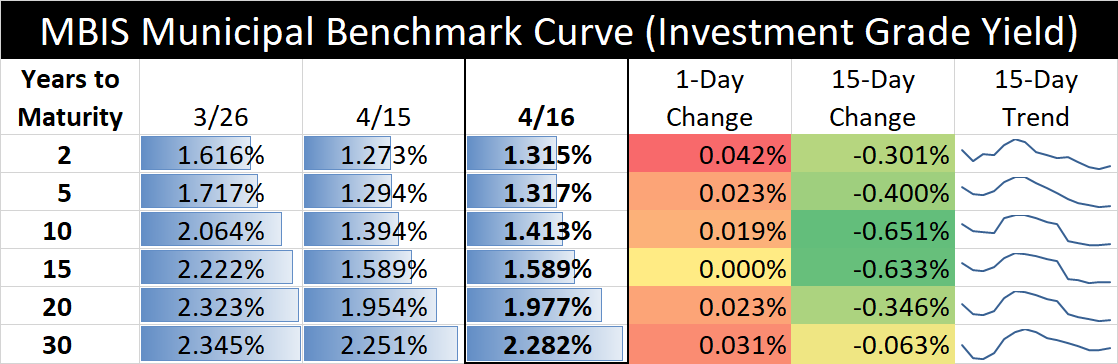
The interest rate table above illustrates recent changes in a sample of MBIS “investment grade” yields. Every issuer’s credit is different. For rates that may be applicable to your municipality, contact our Municipal Bond Advisors, Larry Kleeman and Beth Warren.
National Association of Counties, National League of Cities and U.S. Conference of Mayors Call For $250 Billion Assistance Package for Local Governments
…the National Association of Counties (NACo), National League of Cities (NLC) and United States Conference of Mayors (USCM) combined voices to advocate for and promote the health and well-being of America’s cities, towns, villages and counties.
In a joint letter to the Administration and Congressional leadership, the three local government organizations outlined what is needed from the federal government on the local response and recovery to COVID-19.
(Read more: nlc.org)
BDA, GFOA seek expansion of Fed’s muni lending program
Market participants want more municipalities to be allowed to participate in the Federal Reserve’s short-term municipal lending program.
Groups communicated that in letters sent to the Fed this week. The Fed solicited feedback through April 16 on its Municipal Liquidity Facility program, and sources say the Fed is putting together a frequently asked questions document about the program.
In letters sent to the Fed on Wednesday, the Bond Dealers of America and Government Finance Officers Association made a few recommendations to the Fed — one being to increase the scope of the program. Through the MLF, the Fed will purchase up to $500 billion of short-term notes, with Treasury providing $35 billion of credit protection to the Fed using funds appropriated in the $2 trillion Coronavirus Aid, Relief and Economic Security Act.
“Unfortunately, the cut-off for direct issuer participation is much too high,” wrote Mike Nicholas, BDA CEO. “By our calculation, only 24 local governments nationwide would qualify for direct access to the Fed program. This would leave tens of thousands of local governments and authorities unable to access the facility directly.”
(Read more: The Bond Buyer)
Progress, pitfalls ahead with Fed coronavirus muni aid
Some stability in the municipal market is being marked by less outflows, Federal Reserve and government intervention, and slightly improving primary market volume. The market is not yet on solid ground amid the COVID-19 crisis, though, according to market participants, and caution is warranted.
The coronavirus has shaken the foundation of the municipal market and they said they are attempting to adjust to the sustained volatility.
Some said recent data is not a chief indicator of market tone and noted it is still too early to point to the recent decrease in outflows—relative to the double-digit billions the market experienced in March, for instance—as proof of overall calm. Wednesday’s ICI reports of $2.9 billion of outflows out of municipal bond mutual funds pales in comparison to the $20-plus-billion experienced in March.
In addition, the moves by the Federal Reserve to shore up the short-end of the municipal market through its Municipal Liquidity Facility have received mixed reviews. <
(Read more: The Bond Buyer)
‘Results are promising’: Johnson County to test more residents for COVID-19 next week
Johnson County is planning to test another group of randomly selected residents for the novel coronavirus at a drive-thru location next week, as part of its expanded community testing program.
Last Friday, the county launched the $400,000 program aimed at collecting more data on the outbreak of COVID-19. Out of 369 residents who were tested, 14, or about 3.8%, tested positive, Sanmi Areola, public health director, said at a Johnson County Board of Commissioners meeting on Thursday.
“We are learning about this virus as we go,” Areola said. “Our results are promising, they are. And I think that’s a product of us working together. For us to be successful in curtailing this … we have to do this together. Residents have to be a part of it. Businesses have to be a part of it.”
(Read more: Joco 913 News)
Rural hospitals in Kansas prepared for COVID-19
Rural hospitals in the University of Kansas Medical System have a unexpected boost in the fight against coronavirus: they are behind the curve.
Heather Harris, Medical Director for Hays Medical Center explains that, “we have the advantage of being on the back end of this wave of the virus, so we can see that there has been shortages of needing for preparation.”
Great Bend resident Dawn Johnson has seen this advantage first-hand. Three weeks ago, she went into the hospital for an x-ray after taking a cruise. Johnson says, “they were really, really prepared. They had me wear a mask and be so far back.”
Administrators from three rural Kansas hospitals took part in an online briefing Thursday morning. They say they have been able to learn what they need to do from what is happening in bigger cities, like Wichita. This knowledge has allowed them to prepare rooms for isolation and stock up on personal protective equipment (PPE).
(Read more: KAKE – News)
Sedgwick County health officials urge people with COVID-19 symptoms to get tested
Sedgwick County health officials said since the guidelines for testing relaxed, the number of people being tested has doubled.
As many people are possible are being tested at the county’s central drive-thru coronavirus location.
With the help of a local university, the county has also caught up some on the number of swabs needed for testing kits.
(Read more: KSN-TV)
Here’s how the city of Wichita is helping the homeless during the COVID-19 crisis
Last week, at least two homeless individuals in Wichita were showing signs of COVID-19. Wichita Mayor Brandon Whipple said as of Thursday, they’ve not received any indication that those two people tested positive.
As a city response, the two individuals were put into motel rooms so they could isolate and get the care they needed.
Sedgwick County has now had more than 200 reported cases of COVID-19.
“Even though it seems the hardest, we need people to really buckle down and focus on the stay-in orders, if we’re going to protect not just ourselves but also our neighbors,” said Whipple.
(Read more: KAKE – News)
City of Wichita works to provide shelter for homeless community during the COVID-19 pandemic
Shelters like the union rescue mission and human kind ministries are working to assure the safety of Wichita’s homeless community. Today we spoke with city leaders to see what they are doing to to protect homeless families during the pandemic.
During his press conference today Mayor Whipple mentioned the city is working to fund a 300,000 dollar motel voucher through the United Way of the Plains to keep those homeless men and women who present COVID-19 symptoms off the streets and in a safe place to self-isolate. The plan is to temporarily house symptomatic patients while they await test results or have tested positive. the city first planned to use the old down town library for an emergency shelter.
(Read more: KSN-TV)
Crawford County approves wind farm project
Crawford County Commissioners approve plans for a wind farm project that will help protect the pockets of tax payers.
The Jayhawk Wind Farm Project is 50 wind turbines between Crawford and Bourbon Counties, with about 20 turbines in Crawford County.
Commissioners approved a few agreements between the county and Apex Clean Energy.
The county will now get about $100,000 a year from the project for the general fund.
Also, they made sure the company pays for any road work while transporting materials.
(Read more: KSNF/KODE – FourStatesHomepage.com)