

Kansas Municipal News
City of Russell Extends Utility Disconnection Moratorium to May 31, 2020
The City of Russell suspended utility disconnects for non-payment until May 1, 2020, as customers and the community faced potential hardship from coronavirus.
With the uncertainty of the coronavirus and the financial difficulties some customers may face during this time, the suspension of utility disconnects for non-payment is extended to May 31, 2020. This temporary moratorium ensures that the City of Russell’s utility customers will not be disconnected for non-payment.
Municipal Bond Trends for April 28, 2020
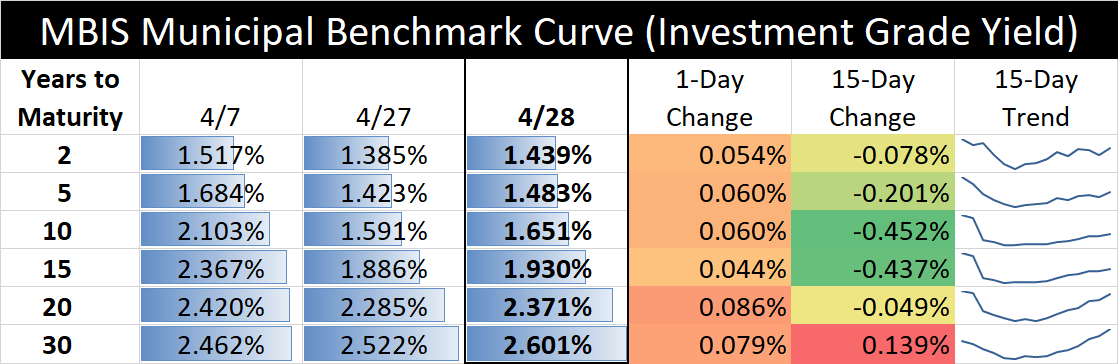
The interest rate table above illustrates recent changes in a sample of MBIS “investment grade” yields. Every issuer’s credit is different. For rates that may be applicable to your municipality, contact our Municipal Bond Advisors, Larry Kleeman and Beth Warren.
JoCo Recovery Planning Task Force approves four-phase approach to reopening local economy
The special committee on reopening Johnson County ended its work Tuesday with a fanfare of self doubt about whether people will follow its recommendations but few major changes to the rough draft on how business should phase back in from the stay-at-home order in place since March 24. The 14-member committee ended an hour-and-a-half session in a somewhat contentious disagreement over what authority government should have in policing business during a major public health crisis, with members saying the rules were either too vague or too restrictive. It was the end of about fifteen hours of discussion over the course of a week.
(Read more: Prairie Village Post)
Jim Schmidt was trailblazer in Kansas emergency management
Mr. Schmidt, 71, who as a Rose Hill paramedic was one of the first to arrive at the devastation in Andover left behind by a massive tornado on April 26, 1991, is being remembered as a trailblazer in Kansas emergency management. He died of cancer on April 14. Services are pending. Mr. Schmidt earned a reputation as a “magnet” for his knack of being close to major events when they happened, and he was on the ground floor of many milestones in Wichita-area emergency services.
(Read more: Local News |)
Economic developers pitch Elon Musk on Wichita area for Tesla Cybertruck Gigafactory
Economic developers and business recruiters in Kansas are pitching billionaire businessman Elon Musk on locating Tesla’s new Cybertruck Gigafactory in the Wichita area.
The Greater Wichita Partnership tagged Tesla and Musk, the company’s CEO, in a tweet on Monday marketing the Wichita area for the electric pickup factory. Musk had announced in a tweet last month that he was scouting locations for the Cybertruck Gigafactory, which he said will be in the central United States. “The most geocentric metro in the nation, 800-acre site with access to two Class I railways and the #1 manufacturing-skilled workforce in the nation. A @Tesla Cybertruck Gigafactory location can’t get any better than this, @Elonmusk. http://CybertruckDreamSite.com #TeslaInWichita”
(Read more: Local News |)
Reno County discusses taskforce’s reopening draft
On Tuesday, the Reno County Commission read over an initial draft of the local plan for a phased reopening of the county. The Economic Recovery Taskforce and the commission will approve a final draft of the plan in coming days. Gov. Laura Kelly’s stay-at-home order expires May 3 with no plans to renew, so the county is approaching how to reopen businesses safely during the novel coronavirus pandemic starting Monday.
(Read more: Local – The Hutchinson News)
Dodge City meatpacking plants beef up protocols; Ford County maintains high recovery rate
With two national meatpacking plants in the county’s jurisdiction, Ford County is increasing its testing and the plants are beefing up COVID-19 protocols. The numbers for Ford County have increased to 544 individuals who have had or still have the coronavirus as of April 28. This amounts to 1.6% of the county’s population. But, according to J.D. Gilbert, a spokesman for the county, 90% of those infected have recovered. No deaths from COVID-19 have been reported in Ford County. Statewide, the deaths from the virus are at 124, or four deaths per 100,000 individuals.
(Read more: Local – The Hutchinson News)
Bourbon County delays county tax sale
Bourbon County Commissioners on Tuesday decided the time is not right following the impact of the COVID-19 outbreak to hold a tax sale in 2020.
Commissioners were to discuss opening bids for title work for a tax sale sometime this year, but elected to delay a tax sale after talking with Bourbon County Counselor Justin Meeks. The meeting took place in the emergency operations center in the basement of the Bourbon County Courthouse, and was open to the public through the county’s website and Facebook page.
(Read more: Fort Scott Tribune)
The $3.8 trillion municipal bond market, rocked by the coronavirus, looks to Washington for help
The $3.8 trillion market for funding state and local governments, airports, schools and hospitals faces a test this week as New York City’s transit agency offers bonds to the market for the first time since the coronavirus emptied its subways, trains and buses.
Investing in the roughly $900 million offering from the Metropolitan Transportation Authority will be a leap of faith on the part of investors who will will have to imagine a healthier, post-shutdown New York economy, where commuters return to work, students go back to school and tourists come to see Broadway shows again.
That’s the same story for many issuers, as states and cities grapple with how to fill a sudden budget hole and move forward, in an environment of uncertainty about what the economic rebound will look like and how it will impact future revenues.
(Read more: Bonds)
With rates near zero, what to expect from Fed meeting
The Federal Open Market Committee meeting that began Wednesday, and concludes with a statement and a press conference from Federal Reserve Board Chair Jerome Powell, will be unique because rates remain at the zero lower bound and the Fed has taken many actions to ensure smooth markets since the economic shutdown to contain the coronavirus.
…Tom Garretson, senior portfolio strategist fixed-income strategies for RBC Wealth Management’s Portfolio Advisory Group … expects the Fed to announce “a more-flexible monthly purchase program [for Treasuries] north of $100 billion. While we expect the composition of Treasury purchases to eventually shift toward longer-duration as part of a concerted effort to provide stimulus via lower yields similar to the QE2 program — as opposed to recent purchases across the curve in the name of market liquidity — the Fed may wait until the June meeting when they will have more economic data, and an update to their economic projections and interest rate forecasts. A monthly program will give them more flexibility to go where any market stresses might necessitate them to.”
(Read more: The Latest)
Manhattan Mayor Announces Creation of Regional Recovery Task Force
Manhattan Mayor Usha Reddi announced today the formation of the Manhattan Area Recovery Task Force to help guide the City and surrounding area as we emerge from the effects of the COVID 19 virus in all areas of daily life and commerce.
The charge to the Task Force is to “develop a measured and phased path forward for our community and begin implementation as soon as next week, in some areas.” Jason Smith, President and CEO of the Manhattan Area Chamber of Commerce and Bob Copple, CEO, Ascension Via Christi Hospital have been appointed to co-chair the Task Force.
In organizing the Task Force, Mayor Reddi stated, “I am proud of how our community has come together to tackle the virus head on by following guidelines provided by the Centers for Disease Control and the Kansas Department of Health and Environment. Fortunately, Manhattan and the Flint Hills Region has an abundance of talent, resources, and motivation to work within the unique parameters in place due to the pandemic, as we begin the journey toward a new sense of normalcy.”
(Read more: Manhattan – News Flash)
Municipal Bond Trends for April 27, 2020
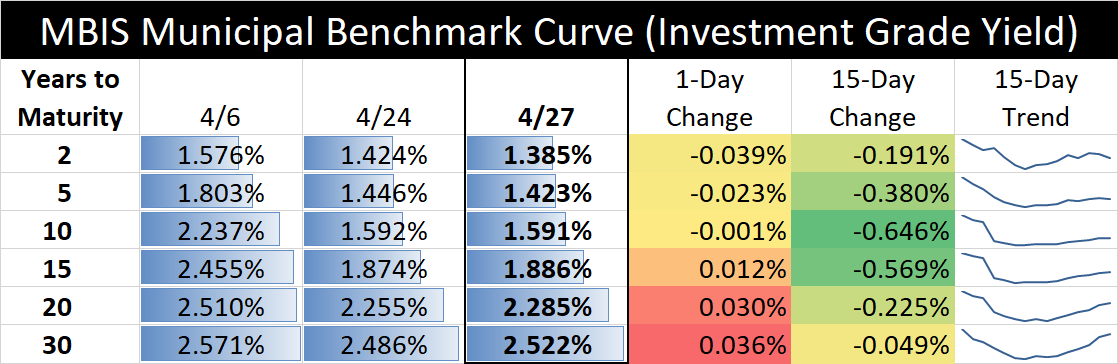
The interest rate table above illustrates recent changes in a sample of MBIS “investment grade” yields. Every issuer’s credit is different. For rates that may be applicable to your municipality, contact our Municipal Bond Advisors, Larry Kleeman and Beth Warren.
Fed expands muni-debt program to cover “smaller” cities, counties (at least 500,000 population for counties and 250,000 for cities)
The Federal Reserve expanded the scope and duration of the Municipal Liquidity Facility, a $500 billion emergency lending program aimed at providing short-term credit to state and local governments as they endure the economic fallout from the coronavirus pandemic.
The U.S. central bank lowered the population thresholds under which counties and cities would be eligible to sell short-term debt to the facility. The new levels are at least 500,000 for counties and 250,000 for cities, down from 2 million and 1 million.
“The new population thresholds allow substantially more entities to borrow directly from the MLF than the initial plan announced on April 9,” the Fed said in a statement Monday.
(Read more: The Bond Buyer)
The Fed won’t move on rates this week, but here are some other things it could do
FAfter unleashing the most aggressive programs to support markets and the economy in its history, the Federal Reserve is likely to pause any additional initiatives until it has more information about how those moves are working and what lies ahead.
That does not mean, however, that central bank officials won’t have some news in store when they meet this week.
In the months since the coronavirus has ripped through the nation and the world, the Fed has slashed its benchmark interest rate to near zero and launched a variety of programs that also look to get money to households and businesses in need.
(Read more: Bonds)
As coronavirus cuts into budget, Olathe furloughs nearly all city staff for two weeks
Facing deep budget cuts because of the coronavirus pandemic, the city of Olathe will furlough nearly all employees for two weeks.
Like all other municipalities in Johnson County, Olathe is bracing for the long-term economic impacts of businesses, hotels and shopping centers remaining closed during the stay-at-home order. Officials expect the coronavirus shutdown to cut into sales and property tax revenues, as well as franchise fees and court fine collections.
“The budget challenge the city is facing is more significant than faced in decades,” city officials said in a statement. “It will likely not only impact the 2020 approved budget, but revenue estimates show it will carry over into the budget process for 2021.”
(Read more: Joco 913 News)
Shawnee Mission closes all school fields after repeated COVID-19 rule violations
Even after the Shawnee Mission school district threatened to issue citations to people who violate social distancing rules on its athletic fields, large groups continued to congregate and play sports, officials said. Now, the district has closed all of its fields.
“Several attempts were made to find a compromise to allow use of the fields while also strictly following personal distancing and other health guidelines,” district officials said in a news release. “Unfortunately, the district continued to experience repeated violations of those guidelines, as well as attempts to circumvent the spirit of the guidelines by organized groups.”
The district’s fields and stadiums had been open, even though schools are closed, to let the community exercise during the COVID-19 stay-at-home order. But the district and local police departments have received several complaints about groups ignoring social distancing rules.
(Read more: Joco 913 News)
University of Kansas announces pay cuts among top officials
The University of Kansas is temporarily slashing the pay of high-ranking administrators and athletic staff in anticipation of the coronavirus causing tens of millions of dollars in financial losses. Chancellor Douglas Girod announced Monday that the school will save $853,000 by cutting the salaries of nearly 40 university leaders by 10% for six months. The salaries of men’s basketball coach Bill Self, football coach Les Miles, and Athletic Director Jeff Long also will also be slashed by the same percentage, generating $500,000.
(Read more: 1350 KMAN)
Will students show up for college in fall 2020? Community colleges offer a hint. It isn’t pretty.
Ask a community college president about what school will look like in the fall and be prepared for an eye roll, lots of shrugging and even a baffled look or two.
They’ve got no clue, really. That’s not their fault. In the coronavirus era of rapidly changing information and restrictions, the presidents have no idea what they’ll be allowed to do, much less how they are going to instruct students. “That will be the million-dollar question. I’m not sure we know yet,” said Martha Parham, the senior vice president for public relations for the American Association of Community Colleges. “A lot depends on how the economy bounces back.”
(Read more: andoveramerican.com)
Gov. Laura Kelly to unveil recovery plan Thursday as Kansas surpasses 3,000 COVID-19 cases, up to 120 deaths
Gov. Laura Kelly said Monday Kansas should expect more guidance on Thursday on how the state will emerge from a stay-at-home order. The governor said she’s been in talks with industry leaders and neighboring states to develop a recovery plan for Kansas. “We’re working with everybody across the state of Kansas that we can, so when we put the plans out, they would have provided us input, but they’ll also know what to anticipate, and can work accordingly,” said the governor.
(Read more: KWCH News)
Dodge City Commissioners to cut own salaries
Budget adjustments were the talk of the recent Dodge City commission meeting as it is estimated $3 million would be lost from the 2020 budget for the city.
According to city officials, city administration and staff are taking steps to adjust the budget in response to the COVID-19 pandemic with substantial cuts needing to be made to account for the shortfall in expected revenues.
“Even with all of the cuts on the expenditure side of the ledger, we were still short over $700,000 in cuts that needed to be made,” city manager Cherise Tieben said. “Because we function on very tight operational budgets already, hard decisions had to be made at the City Commission meeting.”
(Read more: News – Dodge City Daily Globe – Dodge City, KS)
First cruise night a big hit in Hiawatha
Saturday’s Cruise Night in Hiawatha brought more action than local residents have seen downtown in a long time!
Oregon and First streets were packed with cars and trucks of all kinds and all years, with even a motorcycle or two thrown in. Local residents honked at other cars, or some residents sitting around the courthouse and on their porches of houses along the main drag. Everyone was all smiles and after a month of social distancing and a stay at home order, Hiawathans were ready to share the love! Organizers Steve Winters and Ryan Meininger said the event was great and they hope to plan another.
(Read more: hiawathaworldonline.com)
Municipal Bond Trends for April 24, 2020
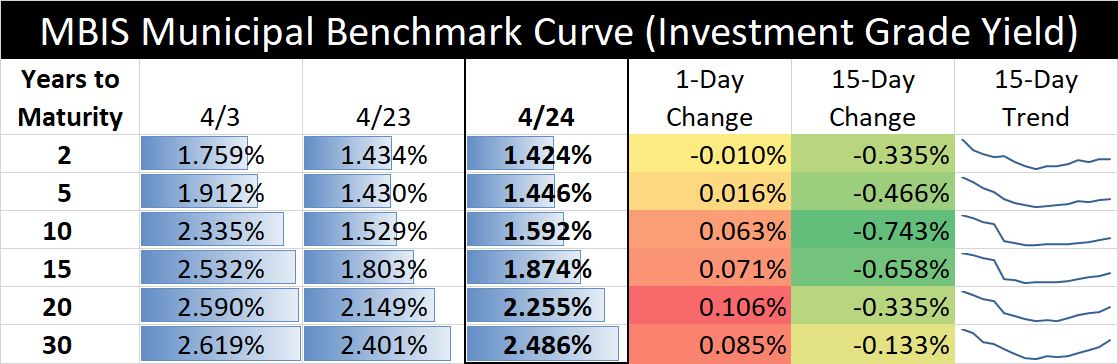
The interest rate table above illustrates recent changes in a sample of MBIS “investment grade” yields. Every issuer’s credit is different. For rates that may be applicable to your municipality, contact our Municipal Bond Advisors, Larry Kleeman and Beth Warren.
Municipal bonds on ‘fragile side of normalcy’ as benchmark yields rise but new deals get done
The secondary muni market was dislocated Friday with high-grade block trading showing swings in yields and rate volatility and price discovery remain problematic for investors and issuers alike. After a week of large issuers bringing sizable deals, Friday did not fully commit to a more stabilized muni market.
The news out of Washington did not help as headline risk clearly had participants questioning direction from D.C. on policies affecting the municipal market.
Triple-A benchmark yields rose by about five basis points across the curve.
(Read more: The Bond Buyer)
Fed’s near-zero rates to last into 2023, economists predict
The Federal Reserve may hold interest rates near zero for three or more years, and its balance sheet will soar above $10 trillion as policymakers seek to revive the U.S. economy from recession, economists said in a Bloomberg survey. Just over half the 31 respondents to an April 20-23 poll predicted the target range for the federal funds rate, now at 0-0.25%, won’t move up until at least 2023. Another 22% said not before 2022. …
Respondents had limited expectations for any substantial changes when the Federal Open Market Committee holds its next policy meeting April 28-29. Large majorities, 90% and 87%, said they didn’t expect policy makers to offer any additional guidance on how long they intend to keep rates near zero, or on the future pace of large-scale asset purchases.
(Read more: The Bond Buyer)
What will ‘reopening’ look like in Wichita area during the coronavirus pandemic?
When the Wichita area reopens businesses shuttered for the coronavirus threat, things will look a lot different than they did before the pandemic hit, according to an array of business leaders who spoke to Sedgwick County Commission on Friday.
The special commission meeting brought together leaders from the retail, restaurant, convention, entertainment, fitness, tourism and religion realms.
The clock is ticking on the commissioners, who are poised to set guidelines for businesses if Gov. Laura Kelly’s stay-at-home executive order is allowed to expire in the coming week.
(Read more: Local News |)
Sedgwick County may have peaked on COVID-19, health officer says
Sedgwick County appears to have passed its peak for coronavirus infections, but there’s a long road back to normal, the county’s top doctor said Friday.
“Fortunately, the hospitals think they have seen the peak, although the peak is very flat,” said Garold Minns, dean of the University of Kansas School of Medicine in Wichita. “They (local hospital administrators) are feeling good about the fact that we are not going to have a huge surge” of new COVID-19 cases.
(Read more: Local News |)
Reno County Health Department recommends use of cloth masks when out in public
Reno County Health Department joins Governor Laura Kelly, KDHE and CDC in recommending use of cloth face coverings when in public places. The recommendation is for cloth coverings, not N95 or surgical masks which are used by healthcare workers and first responders.
You can find instructions on how to make a cloth mask on the CDC website at www.cdc.gov.
New evidence suggests that some people without COVID-19 symptoms can transmit the virus before getting sick. Using a cloth mask can help keep the virus from spreading from a person who may be infected and is not aware to others they are come in contact with. Wearing a mask should be used along with the following measures:
(Read more: Hutchinson, KS – News Flash)
New rules, same local flavor: Overland Park Farmers Market opens during pandemic
Much to the joy of thousands of customers, a seasonal mainstay found a way to open this weekend.
The coronavirus pandemic forced the Overland Park Farmers Market to open a few weeks late this year and in an entirely new location. However, the market is now set up and running in the north parking lot of the Overland Park Convention Center.
The location provides the crowds with lots of room for social distancing. It’s not much like the weekend morning party it used to be, but the vendors are still full of produce, lines of masked customers ecstatically exchanging money for radishes, strawberries, lettuce and flowers.
(Read more: fox4kc.com | FOX 4 – WDAF)
Pandemic not expected to delay property tax deadline
The coronavirus pandemic does not appear to be delaying the quickly approaching May 10 deadline for Kansas property taxes.
Kansas believes delaying property tax deadlines is more of a local government decision, said Zach Fletcher, a spokesman for the Kansas Department of Revenue.
“Property taxes collected at the local and county level help fund critical functions like public safety and schools,” Fletcher told the Lawrence Journal-World. “The governor cannot unilaterally change property tax structures or payments in general, and would not be inclined to cut critical funding sources during a prolonged public health emergency.”
(Read more: KAKE – News)
Dodge City commissioners give up salaries to help with budget shortfall
The city commissioners in Dodge City say they are facing an estimated loss of nearly $3 million from the 2020 budget because of the coronavirus pandemic.
The city says they expect a shortfall in sales tax, property tax, interest, transient guest tax and franchise fees. The commissioners say substantial cuts will be needed to make up for the lost revenue.
During their meeting Monday night, the commissioners said the first priority should be eliminating their salaries for 2020.
“We didn’t get in this for the pay,” said Commissioner Kent Smoll. “We got into this because we really appreciate the City. There’s not going to be much savings, I understand. But it’s partly the principle. We are asking employees to give things up; I want to give up that.”
(Read more: KSN-TV)
’Perfect positive storm’: Studies show Topeka well-positioned to recover from recession
Topeka’s metropolitan area is among the least vulnerable in the nation to the economic damage wrought by the COVID-19 pandemic, according to two recent studies.
Meanwhile, the WalletHub personal finance website says Kansas is likely to suffer less economically from the pandemic than all other states but one.
Those findings reinforce Matt Pivarnik’s optimism that Topeka will quickly regain the momentum it had gained prior to COVID-19, he said in a telephone interview Friday.
“Quite frankly, I look forward to recovery,” said Pivarnik, president and CEO of the Greater Topeka Partnership. “I think that Topeka’s going to be able to have a resilient recovery, and potentially even leapfrog other communities as we return to our new normal.”
(Read more: Local – The Topeka Capital-Journal)
Cruising Main will return
For Scott Becker of McPherson, climbing into his Ford Mustang and cruising down main street on a Saturday night brings back days gone by.
“I used to drag main here in the ’80s and ’90s. My boys are 17 and 20 and over the summer hang out at Lakeside park. They never knew what cruising main was. I believe it’s a generation gap and was lost throughout the years,” Becker said.
And, he believed it was a tradition that should be rekindled. A year ago, he started posting to Facebook, creating a page for photos that he called “Old Farts Drag Main.”
(Read more: News – Butler County Times Gazette)
Hays: No plans for layoffs, cutting services
Despite the COVID-19 hit to the economy, there are no plans to lay off City of Hays employees or to cut city services to the community, according to City Manager Toby Dougherty.
“We’re not there yet, and it’s really not something I’ve considered right now,” Dougherty said of employee layoffs or furloughs. “It would be a rationary measure that comes later on. I can’t see enough of a revenue decline that we couldn’t absorb and move forward … worse-case scenario we’d have to put a hiring freeze in place.”
Speaking to the Hays City Commission at its regular meeting Thursday in City Hall, 1507 Main, Dougherty said it’s possible the city might not fill positions that come open when people retire or quit to downsize by turnover.
(Read more: News – The Hays Daily News)
DRC, DAC looking to spread positivity through art
At the moment, with the Derby Recreation Center shut down due to the COVID-19 pandemic, most of DRC Art Director Aimee Geist’s focus has been on preparations for summer programs at the new Hubbard Arts Center.
While not many DRC art programs have gone virtual yet, Geist has been working on a new project with the Derby Arts Council – to launch in May – that is seeking to engage the community and spread an important message.
“One of the things we’ve been working on is a sidewalk chalk project called the Positivity Art Project,” Geist said
(Read more: Derby News | derbyinformer.com)
Scenic byways lets you see Kansas’ best landscape from the safety of your car
Kathy Artzer knows people can abide by social distancing requirements while still feeding their need for adventure. Annually she leaves her Topeka home and drives several of Kansas’ scenic byways.
“(The byways) have taken me to some places I didn’t even know we had in Kansas,” Artzer said. “They’ve taken me to some really beautiful places. I think they’re a great way to explore the state.”
Sue Stringer, Kansas Department of Wildlife, Parks and Tourism byways manager, said Kansas has 12 recognized byways.
(Read more: Wichita Eagle)
Financial challenges ahead for Pratt Community College
Financial challenges lie ahead for all educational institutions including Pratt Community College. Kent Adams, PCC vice president of finance and operations, shared some numbers with the PCC Trustees at their April 13 meeting.
“We’re going to have financial challenges,” Adams said.
College finances are already in place through June 30 but beyond that, there are many questions.
First of all, the county is going to lose $3 million in valuation for oil and gas. Other valuations went up but the overall loss is $3 million.
(Read more: Pratt, KS – Pratt Tribune)
Crawford County makes plans for input on new coronavirus rules
Though it remains unclear whether the statewide stay-at-home order will expire by the end of next week, Crawford County officials continue to make plans for what kind of policy the county will implement if it does. Since announcing it would hear input from area businesses and the public on that decision earlier in the week, the county commission on Friday made changes to the schedule of when that input session will take place, and said it will be done via radio on Pittsburg State University-affiliated KRPS (89.9 FM) next Thursday, with the opportunity for businesses to submit questions beforehand. “We had talked about next Wednesday doing some sort of a call with the businesses in the county but it’s been pushed to Thursday, which will give us a little more time if the governor puts something out,” County Health Officer Rebecca Adamson said Friday. “We still don’t know how long that might take.”
(Read more: State News – Morning Sun)
Reno County Economic Recovery Task Force begins discussion on reopening
The Reno County Economic Recovery Task Force on Friday (April 24) outlined goals detailed efforts underway toward reopening the local economy.
The statewide stay-at-home order currently is in effect until May 3. While that could extend, the task force in Reno County shares a goal to “establish guidelines for reopening our local economy with the aim to have a skeleton framework to present to the county commission on the event that the statewide stay-at-home order is lifted.”
The task force says it expects to roll out some “wins” on May 4 (following the current May 3 expiration date on the statewide stay-at-home order. What these “wins” might include isn’t yet clear, but the task force says “there is great hope that we can begin to at least (do) a few things on May 4 that we can’t do now. The goal is to formulate that this next week.”
(Read more: KWCH News)
Cluster testing continues in Ford County
The Kansas Department of Health and Environment announced this week two private businesses in Dodge City that showed a cluster of COVID-19 cases.
As described by KDHE, a cluster “is two or more confirmed cases associated to one known exposure.”
With cluster testing rising, confirmed cases come with it as Ford County cases reached 350 on Friday, topping Sedgwick County’s 323 and putting Ford County third highest in the state behind Wyandotte and Johnson County.
Seward County also reached a case of total of 232 with Finney County reaching 107.
(Read more: News – Dodge City Daily Globe – Dodge City, KS)
Pratt County Clerk plans retirement after 39 years
On April 22, Pratt County Clerk Sherry Kruse took notes at her final Pratt County Commission meeting after working in that office since August 1981.
Kruse started out handling payroll and accounts receivable under then County Clerk Alma Walker. In the 1990s, Walker appointed Kruse to Deputy Clerk but she still processed payroll and accounts receivable.
“There wasn’t a lot more to do then,” Kruse said.
(Read more: News – PrattTribune – Pratt, KS)
Amid pandemic, Baldwin City sesquicentennial planners looking at creative ways to engage residents
With the COVID-19 pandemic ending community gatherings for the foreseeable future, organizers of Baldwin City’s sesquicentennial events say they are exploring creative ways to engage residents in the celebration.
As originally conceived, Baldwin City’s sesquicentennial celebration was going to tie into a number of regular community events held throughout the year, culminating in a special event on the 150th anniversary of the city’s official incorporation on Sept. 22, 1870.
Baldwin City Councilman Brian Cramer, the City Council’s liason to the sesquicentennial advisory committee appointed by Mayor Casey Simoneau, said it was too early to cancel the Sept. 22 event or the planned sesquicentennial Fourth of July happenings, but the city was staying flexible to ensure public safety.
Read more: LJWorld.com.
For essential Lawrence city employees, reporting to work includes face masks and daily temperature checks
As the employer of hundreds of essential employees still physically reporting to work, the City of Lawrence may be able to provide an example to employers contemplating how to bring employees back to work safely once stay-at-home orders lift.
For the city, precautions include daily temperature checks, staggered shifts and face masks in circumstances when job responsibilities don’t allow employees to maintain a 6-foot distance. City spokesman Porter Arneill said in an email to the Journal-World that the city began taking employees’ temperatures daily the week of April 12 to minimize potential exposure to COVID-19 for the city’s essential staff.
Read more: LJWorld.com.
Salina approves COVID-19 staffing plan
While there will be no layoffs or other reductions in personnel, around 50% of City of Salina staff could see hours cut because of the coronavirus pandemic. This change comes after the Salina City Commission voted to authorize the city manager to make adjustments to staff. A resolution that the commission passed by a 4-1 vote at a special meeting of the commission Wednesday evening said this was done to address budget shortfalls expected for the city during the COVID-19 …
(Read more: News – Salina Journal)
NLC President Joe Buscaino Statement on Need for COVID-19 Aid to Local Governments
Today, the House passed an interim package to provide $484 billion to small businesses and hospitals. It passed the Senate on Tuesday, and the President is expected to sign swiftly. Unfortunately, state and local governments are being asked to wait until the next bill to get financial relief from the federal government.
The following is a statement from Joe Buscaino, Council President Pro Tempore, Los Angeles and President, National League of Cities.
“The National League of Cities applauds Congress and the Administration for persevering through difficult circumstances to advance bipartisan emergency Coronavirus packages. Unfortunately, none of the funding established by Congress to contain the spread of COVID-19 and protect the economy is guaranteed to reach local governments directly.
(Read more: nlc.org/contents/rss-feed)
Hutchinson Regional Airport feeling the pinch of COVID-19
The stay-at-home order is halting travel and grounding flights but it’s not just the big airports feeling the pinch. Regional airports are seeing revenues take a dive.
It’s normal to see the sights and sounds of planes landing and taking off at the Hutchinson Regional Airport. But since the pandemic, things have changed quite a bit.
“It’s been pretty quiet to be honest with you,” said Pieter Miller, Airport Manager.
(Read more: KSN-TV)