

Kansas Municipal News
Sedgwick County election commissioner raises concerns over voting bill
A House committee has scheduled a hearing Thursday on a bill that would allow Sedgwick County to establish vote centers for the 2020 elections, allowing voters to cast a ballot at any location on election day.
Sedgwick County election commissioner Tabitha Lehman told county commissioners Wednesday that she would have to speak against the bill, because of new procedures that have just been announced by the Kansas secretary of state’s office. Lehman said the changes will have a significant impact on day-to-day operations in her office, because it creates a separate, locked-down system for access to a statewide voter registration database.
Lawmakers approved a bill last year to allow for voting at any location, but secretary of state Scott Schwab said his office will be unable to make that happen in 2020 because of the changes in procedures and systems that will be required. The bill under consideration in the House this year would allow Sedgwick County to move ahead with the process.
(Read more: KFDI 101.3)
An inside look at Wichita’s former downtown library; it’s nicer than you remember
Supporters of a petition drive to force Wichita to vote on whether to tear down historic buildings have gotten a rare look inside the former Central Library, one of the buildings they’re trying to save from downtown redevelopment.
And they like what they saw.
Gone are the bookshelves that blocked sightlines while the building served as Wichita’s main public library.
What remains are huge open spaces with floor-to-ceiling windows offering scenic views of the Century II Convention and Performing Arts Center, the former Carnegie Library and the Garvey Center.
(Read more: Local News |)
Municipal Bond Trends for February 4, 2020
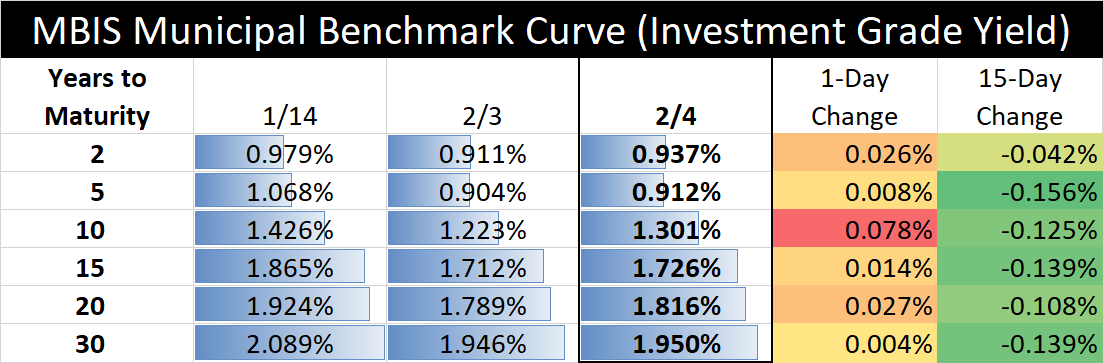
The interest rate table above illustrates recent changes in a sample of MBIS “investment grade” yields. Every issuer’s credit is different. For rates that may be applicable to your municipality, contact our Municipal Advisors.
Wichita could ban or tax plastic bags
Wichita is exploring a citywide ban on plastic bags.
The City Council voted unanimously Tuesday for a new task force to consider how to reduce or eliminate single-use plastic bags in the city.
Members of the task force have said they’re interested in an outright ban or city-wide tax to curb the use of the thin bags. Although they’re convenient and reusable, often ending up as trash bags or cage lining, they’re difficult to recycle and take hundreds of years to biodegrade. They ultimately end up at the landfill or in the river, sometimes harming animals, proponents of a ban say.
(Read more: Local News |)
Hutch rental licensing program repealed
The divisive and sometimes heated discussions over Hutchinson’s Residential Rental Licensing and Inspection Program have quieted slightly. On Tuesday, the city council voted unanimously to repeal the program.
In September 2019, city council members showed interest in fine-tuning – but not burying – a proposal that takes a stick-and-carrot approach to regulating rental housing.
“This issue has torn this community apart,” said Mayor Jade Piros de Carvallo.
“I was a big proponent of the registration program, but it unfairly penalized our landlords. I look forward to working with the community to ensure we don’t take a step back,” she said.
(Read more: Local – The Hutchinson News)
Study of high electricity rates in Kansas points to industry changes, planning needs
The president of London Economics says high electricity rates in Kansas reflect a rapidly changing industry, higher-than-usual surcharges and the absence of long-term planning.
A.J. Goulding delivered his firm’s assessment of the power dynamic between utilities and regulators in hearings Tuesday before Kansas legislators.
Lawmakers in 2019 commissioned a study of why Kansas has higher electricity rates than other states in the region. For its study, London Economics compared Kansas to 18 states.
The firm recommended Kansas establish a state energy plan and mandate the annual publication by utilities of an integrated resource plan. Additionally, the study recommends a shift to performance-based ratemaking, where utilities are rewarded or punished for things like service quality and reliability.
(Read more: Local – The Topeka Capital-Journal)
Lawrence to consider changes to camping ordinances that some say make being homeless illegal
Advocates for the homeless say city camping ordinances criminalize being homeless, and city leaders are questioning whether changes should be made.
Earlier this winter, some residents spoke out against the city’s illegal camping ordinance to the Lawrence City Commission, saying that it gave the city cause to police, ticket and clear the campsites of homeless people who have no other choice but to sleep outside. And some who work to serve the homeless have similar views. Lawrence Community Shelter Executive Director Renee Kuhl recently told the Journal-World that she was against any ordinance that made being homeless or sleeping outside a crime.
Read more: LJWorld.com.
Lawrence developing new method for allocating social service funds
The City of Lawrence is developing a new method for allocating money for social service agencies and programs.
At the Lawrence City Commission’s meeting on Tuesday, Assistant City Manager Casey Toomay said city staff was developing a matrix to help the commission evaluate requests for social service funding from the general fund.
Toomay said the matrix would give commissioners a more quantitative way to evaluate the requests than the previous method, which involved an advisory board that provided funding recommendations. Toomay said that board will now only provide recommendations for how to use the city’s special alcohol fund.
Read more: LJWorld.com.
Will coronavirus force Fed to lower rates in March?
The prevailing opinion is the Federal Reserve will note the downside risks caused by the coronavirus and won’t cut rates in March, but bets are hedged for later in the year.
But some analysts say a rate cut will be needed soon. The coronavirus will strike at consumer confidence, which will cause a drop in spending, said Dan Geller, Analyticom LLC founder. “Since personal consumption makes up 70% of GDP in the U.S., the Fed will have to cut the funds rate to stimulate the economy and restore consumer confidence,” he said.
The illness “certainly has tilted the odds from a slight chance of a rate increase in the last week of January to a one in seven chance of a rate cut in mid-March,” said Robert R. Johnson, professor of Finance at Heider College of Business of Creighton University. “If the conoravirus becomes a true global pandemic and isn’t under control by the date of the Fed meeting, the Fed would likely cut rates in an attempt to stimulate the economy.”
(Read more: Bond Buyer: Feed)
GCCC Releases 2018-2019 Annual Report Report Highlights Key Accomplishments, Fiscal Data & Taxpayer ROI
The 15-page report offers readers a comprehensive look at the institution’s key accomplishments and financial data from the past fiscal year, spanning July 1, 2018, to June 30, 2019.
Some of those accomplishments include new educational pathways with partner universities, state and national titles earned by student organizations, and GCCC’s Centennial Celebration, marking 100 years since the college’s inception in 1919.
GCCC President Dr. Ryan Ruda, who began his tenure at the start of the 2018-2019 academic year, said the report’s synopsis of demographic and fiscal data, along with noteworthy events, reflects the college’s important work in producing positive contributors to the economic and social well-being of society.
(Read more: Greater Garden City » Feed)
How Local and State Governments Can Close Revenue Gaps in 2020
It’s been called a billion-dollar prize – the gap between available revenue opportunities and the ability of local, state and federal government agencies to turn those potential revenue opportunities into reality.
It’s a challenge that many municipalities face. Research from McKinsey estimates that close to 20 percent of government revenues worldwide – or $309 billion in the U.S. – are lost each year, either in uncollected agency fees or due to outbound payment issues.
Compounding the current problem of unrealized revenue are new business models driven by technological, economic and social forces. In addition to financial services such as peer-to-peer lending and crowdfunding, digital sharing platforms for parking spaces, cars, bikes, scooters and RVs have emerged in recent years. These platforms are creating new challenges for local leaders and City Hall which lacks the infrastructure to support efficient permitting, regulation and taxation. However, municipalities can play a key role in helping this wave of emerging companies who are driving the sharing economy.
(Read more: CitiesSpeak)
Controversy fills Johnson County’s election office. Does the system need an overhaul?
Johnson County’s most recent election commissioner abruptly resigned and left behind a string of lawsuits and concerns over delayed vote counts and troublesome technology.
The commissioner before him left the county with a battle over severance pay and a scandal that caused many to question the office’s leadership.
Now as the search lingers on to replace Ronnie Metsker, who left in December, some local officials and state legislators are calling for change. They argue the process of appointing the commissioner in Kansas’ most populous county leads to partisan influence and little local oversight. And they question whether the process hinders the ability to find qualified candidates.
(Read more: Joco 913 News)
Wave gets Naftzger Park entertainment, booze contract; competitors say bid process unfair
City Hall turned over control of events and alcohol sales at the new Naftzger Park to the Wave venue on Tuesday, despite complaints from competing vendors who questioned the process and called it a “sweet deal” for the popular downtown venue operators.
The plan passed unanimously after a lengthy discussion with owners of two companies that also do event planning and promotion who complained that Wave, the operator of an Old Town venue, will have control over any alcohol sales at events at that park.
The new contract also gives Wave the right to control access to the newly renovated multi-million-dollar park and sell admission to events there.
(Read more: Local News |)
Five years after upholding it, Prairie Village city council votes to repeal ban on pit bulls
Following a lengthy public input session in which more than 20 people lobbied the council to take the step, the Prairie Village City Council on Monday repealed the city’s ban on pit bulls.
The move comes nearly five years after a similar proposal was voted down by the council. The issue was reintroduced for discussion at a council of the whole meeting in January, during which the council advanced it to final consideration for last night’s meeting. Prairie Village was one of a dwindling number of Shawnee Mission area cities that still had an outright ban on the breed on its books.
Prior to Monday’s meeting, the council received more than 80 emails from residents who wanted the ban lifted and nine who said they didn’t.
(Read more: Prairie Village Post)
Motion to rescind tax abatement for Dimensional Innovations fails after tense discussion among Overland Park council
An effort to rescind a tax abatement for an Overland Park architectural design company failed Monday night …
It was an early look at how the council members may interact with each other on what is likely to become an ongoing philosophical debate on public financing of private development projects. Farassati has been skeptical of most tax incentives and argues against them at length just about every time they come up. He has also made them a campaign issue in his run for Mayor Carl Gerlach’s seat.
(Read more: Prairie Village Post)
Municipal Bond Trends for February 3, 2020
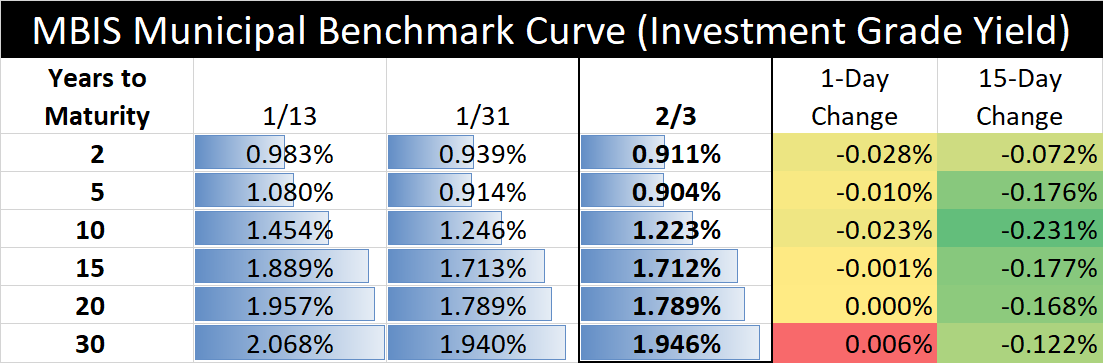
The interest rate table above illustrates recent changes in a sample of MBIS “investment grade” yields. Every issuer’s credit is different. For rates that may be applicable to your municipality, contact our Municipal Advisors.
KDOT’s Cost Share Program accepting applications for spring 2020
After a highly successful first round of the Kansas Department of Transportation’s Cost Share Program last fall, a second round of applications are now being accepted for spring 2020. Applications will be accepted from Feb. 3 through April 15.
The Cost Share Program is designed to provide financial assistance that leverages state funding with local and private funding for projects related to economic development as well as job growth and retention. It will provide funding to local entities for construction projects that improve safety, increase the total transportation investment and help both rural and urban areas of the state improve their transportation system.
(Read more: Kansas Transportation)
Kansas homeowners concerned by state’s rising property taxes
When Mary Coffman and her husband moved to Overland Park from Oklahoma City in 2014, they found a comparable home – and expected their property taxes to be about the same, too.
They were wrong.
The retirees went from paying around $2,600 a year in Oklahoma to $3,200 in Kansas. Six years after their move, Coffman said they’re handing over $5,600 a year, more than double their Oklahoma tax bill.
Coffman said they’re lucky enough that they’re not dependent on Social Security. But they still have to watch their spending and have even talked about returning to Oklahoma.
(Read more: Wichita Eagle)
Retirees wary of plan to refinance KPERS debt
Virgil Funk is nervous about Gov. Laura Kelly’s proposal to refinance the pension obligations of retired state workers and public teachers.
Funk, 82, retired in 1998 after working for 27 years as an educator in Topeka schools. He joined about 100 others from the Kansas Coalition of Public Employees in a rally Monday at the Statehouse.
Kelly for a second year in a row has called on lawmakers to extend debt payments to the Kansas Public Employees Retirement System by 10 years as a means of lowering annual payments now. The process, which is similar to taking out a second mortgage on a house, is known as reamortizing.
(Read more: Community – Cherokee County News Advocate)
STAR bond attraction progresses
A new attraction in Derby’s STAR bond district has moved forward with developers predicting that work will likely begin this May and be completed in the spring of 2021.
Called the Derby Sports Zone, the indoor and outdoor sports center and restaurant would offer activities such as volleyball, sand soccer, yard games, and others.
Its 3.5-acre site was originally on the north side of the district near the dinosaur park, but was moved further south on Rock Road to an 11.2-acre parcel between the Don Hattan dealership and the Derby Marketplace because of a deed restriction on the sale of alcohol.
(Read more: Derby News | derbyinformer.com)