

Kansas Municipal News
Here’s what ‘smart’ traffic signals in east Wichita corridor could mean for drivers
By the end of 2024, some traffic signals in east Wichita will be equipped with radios that allow them to communicate back and forth with smart vehicles. “Right now, it’s really nothing more than letting a driver know when a signal is about to change, which should provide a safer environment and help drivers make better decisions,” Public Works Director Gary Janzen said. The high-tech signals will be installed on Greenwich Road from Central to Kellogg. Janzen said eventually, signals may be able to advise drivers what the optimum speed is to hit more green lights along the corridor. The new technology won’t be used to to track vehicles that run red lights or speed through the intersection, Janzen said. “The focus and purpose of this technology is for traffic safety only.”
Source: Local News | Wichita Eagle
USD 501 will be first in Kansas to offer district-wide free lunches
Topeka USD 501 will offer free lunches to all students starting next school year – and it’s the first district in Kansas to do so outside of the COVID-19 pandemic. Nicole Jahnke, USD 501’s general director of child nutritional services, said the idea behind providing students with free lunches is to eliminate lunchroom inequity. Jahnke said it’s an every day mission to offer nutritious food to all students, regardless of their socioeconomic background. “If you have a child in primary school and they have breakfast and lunch with us, they’ll be saving just under $700 a year per student,” Jahnke said. “And if you have a child in secondary school, it’ll be even more than that. So, it’s quite a big savings.”
Source: KSNT 27 News
Significant Kansas drought affecting farmers and consumers
Since last year, the state of Kansas has experienced a drought. This drought is one of the most significant the Sunflower State has seen in quite some time. While the drought is more so affecting the western part of the state, that doesn’t mean we’re not feeling it right here in northeast Kansas. Last month was one of the driest months that Kansas has seen in 128 years. According to the National Oceanic and Atmospheric Administration, the state only saw an average of 0.54 inches in total precipitation. That’s down 1.51 inches from normal. “March was the 14th driest month since 1985,” K-State Research and Extension Agriculture and Natural Resource Agent Leroy Russell said. “We’re hoping April kind of picks back up. Let the farmers in where they can do the farming, work the ground and get the corn in.”
Source: KSNT 27 News
Governor Kelly Announces Awardees of Nearly $50 Million of Infrastructure and Economic Development Grants

TOPEKA – Governor Laura Kelly today announced awardees for the second round of the Building a Stronger Economy (BASE) economic development grant program. Thirty-eight awardees will receive a share of nearly $50 million in BASE grants, which will be used to address infrastructure and economic development needs where solutions were delayed or slowed because of the COVID-19 pandemic.
The Kansas Department of Commerce reviewed more than 400 applications from the first round and more than 100 new applications from the second round. In total, more than $2 billion in funding was requested for the nearly $50 million program, demonstrating both the need for this program and the many opportunities that exist throughout the state.
“To continue our record-breaking success in attracting businesses and creating jobs in Kansas, we must invest in infrastructure and economic development,” Governor Laura Kelly said. “That’s exactly what these grants do, and I’m proud that we were able to work together, across party lines, to continue driving our state forward.”
The second round of the BASE grant program, as approved by the Strengthening People and Revitalizing Kansas (SPARK) Executive Committee, offers matching funds to address economic development opportunities with the goal of expanding the state’s base of businesses and residents.
“The State of Kansas is determined to strengthen as many communities as we possibly can,” Senate President Ty Masterson said. “These BASE grants will get more vital community projects back on track, while transforming the state’s economy.”
Funds will support infrastructure investments associated with economic development projects. In addition to funds awarded, the BASE program has generated $44 million in matching investment by public and private stakeholders for awarded projects.
“The infrastructure projects this round of funding supports will foster prosperity for future generations of Kansans,” House Speaker Dan Hawkins said. “The SPARK Committee focused on projects that set the stage for strategic long-term growth through thoughtful and targeted planning.”
County and local governments, economic development organizations, local chambers of commerce, and other stakeholders were eligible to apply for the second round of the BASE grant. Applications not awarded from the first round were also considered in the second round. There is a minimum 25% applicant match requirement and applicants were required to document how the project was delayed or affected negatively due to the COVID-19 pandemic.
“Communities throughout our state will receive long-lasting benefits as a result of the BASE grant program,” Lieutenant Governor and Secretary of Commerce David Toland said. “Local leaders proposed specific solutions to address needs in their communities and these focused investments will continue to propel our state’s historic economic growth.”
For a list of BASE grant recipients and more information on the program, click here.
Source: Kansas Department of Commerce
On-Demand bus service could spread throughout Topeka
Topeka’s new micro transit service has been up and running for nearly three months now. City leaders tell 27 News that while the program is still in its early days, the response so far has been promising. Now, the city is working to get the word out to even more people about the new service. Keri Renner is the Director of Marketing and Communication for Topeka Metro. She says Metro-On-Demand, or MOD, offers a more personalized mass transit option than traditional bus service. Topeka’s buses run either every hour or half hour, and travelers must go to a bus station or bus stop to catch a ride. That can make catching a bus difficult for many travelers.
Source: KSNT 27 News
Kansas shakes up liquor laws: Gov. signs alcohol bill
Kansas Governor Laura Kelly has signed a bill that includes several changes to state alcohol laws. The governor signed House Bill 2059, which amends several provisions of the Kansas Liquor Control Act, the Kansas Cereal Malt Beverage Act and the Club and Drinking Establishment Act. One of the more highlighted features of the proposal is the expansion of common consumption areas in the state. This would allow for local governments to have more flexibility in designating areas for drinking.
Source: KSNT 27 News
School board votes 4-3 to close Walton Rural Life Elementary School
The Newton School Board has voted 4-3 to close Walton Elementary School. The board meeting was held in the auditorium of Newton high school because of the number of people who wanted to publicly voice their opinions. Board members and administrators say revenue and the size of the building can’t keep up with the school remaining open. “With the data and information related to enrollment decline versus the cost to run facilities, and the fiscal resources available, the board of education would like to pursue the adoption of the resolution to close the Walton Rural Life Center at the end of the 2022-2023 school year,” said board Vice-President Melissa Schreiber.
Source: KAKE – News
Federal funding to advance technology in Andover one year after tornado
Nearly a year after an EF-3 tornado ripped through Andover, Sen. Jerry Moran announced Monday federal funds for education and law enforcement in the city. In total, $385,000 will be allocated to the Andover Police Department, and $200,000 will go toward the Andover School District. “Everything was empty,” Prarie Creek Elementary school art teacher Jamie Clark said. “There was nothing on the boards, nothing on the walls.”
Source: KSN-TV
Pittsburg community members discuss needs in town
Area residents in Pittsburg on Monday gathered to discuss changes and improvements for the community through the year of 2030. Area Chamber of Commerce officials say, the discussions will be taken into consideration and the group will come back in the fall to present projects for the community. This was the first one of the community conversations. Another one all Pittsburg residents can attend will be Thursday, April 27th at Meadowlark Elementary School at 6pm.
Source: KOAM News
Baxter Springs students will soon have a 4-day school week
It’s going to be a shorter week with longer days for Baxter Springs students. The Baxter Springs School District will adopt a four-day school week. The Tuesday through Friday schedule will begin with the start of the new school year (2023-2024). The Superintendent David Pendergraft says the new schedule is designed to give students an extra day off. He also says the main reason for the transition is due to the lack of qualified staff. “Over the years, the number of applicants that are applying has been diminishing across the board, and we’ve experienced some of our upper-level courses where we’re having a hard time getting qualified applicants,” said Pendergraft.
Source: KOAM News
Mission monitoring situation after bank moves to foreclose on Mission Gateway site
Mission Mayor Sollie Flora says the city is keeping a close eye on the situation after a New York bank sued to foreclose its mortgage on the Mission Gateway property. The civil suit was filed Tuesday, April 18, in Johnson County District Court by Metropolitan Commercial Bank. The suit names as a defendant Aryeh Realty, which owns the long-troubled development at the confluence of Johnson Drive, Roe Avenue and Shawnee Mission Parkway on the site of the former Mission Center Mall.
Source: Prairie Village Post
Prairie Village City Council to dig into much-discussed housing recommendations
The Prairie Village City Council Monday night is set to take its first deep dive into how the city’s controversial housing recommendations could impact single family-zoned districts. That has proven to be one of the thorniest topics of debate around the recommendations since they were first rolled out last summer. Tonight’s meeting comes as the city continues to navigate the increasingly fraught public discussion over how to address ballooning housing costs in the Johnson County suburb.
Source: Prairie Village Post
With Fire Departments Struggling for Volunteers, States Respond to the Alarm
When firefighters show up to a blaze or medical emergency across much of the United States, they most likely are volunteers. It’s also likely the department is understaffed, struggling to replace old equipment and facing uncertainty about its next generation of firefighters. “So much of our country relies on the volunteer fire service,” said Kimberly Quiros, chief of communications with the National Volunteer Fire Council, a nonprofit advocacy organization. “Right now, we’re seeing less volunteers and more calls [for emergency response], but a lot of communities don’t have the tax base and support to switch to a career staffing model.”
Source: Route Fifty – All Content
Cline resigns as USD 430 superintendent
At Wednesday’s meeting of the USD 430 Board of Education, the board accepted the resignation of Superintendent Jason Cline, a little less than a week after it was announced that Cline had accepted the same position at Columbus, Nebraska’s Lakeview Community Schools. Cline’s resignation is effective at the end of the school year, when the Atchison High School graduate will begin his new position on July 1st. He has served as the USD 430 superintendent for 6 years. Later in the meeting, the board voted to hire KASB Superintendent Search Service for $3,500 plus fees to assist in filling the newly-vacant position.
Source: hiawathaworldonline.com
How Local Governments Can Rise to the Infrastructure Complexity Challenge
The federal government is investing nearly $2 trillion in American infrastructure and competitiveness through three historic efforts: the Infrastructure Investment and Jobs Act (IIJA), the Creating Helpful Incentives to Produce Semiconductors (CHIPS) and Science Act and the Inflation Reduction Act (IRA). Taken together, these laws represent a uniquely difficult execution challenge, not only for the federal government, but for local governments across the country.
Source: Route Fifty – All Content
The ‘Dark Store’ Threat to Property Tax Revenues
Some big-name chain-store operators, including Walmart, Lowe’s, Target and the Midwest’s Meijer, have been suing their local governments for lower property taxes on the premise of a controversial legal argument called the “dark store” theory. Localities are fighting back, but there’s a need for stronger legislation to protect tax revenues. Here’s the background: It’s no secret that retail shopping centers and some superstores have been struggling for years as consumer tastes shifted and online sales cut retail traffic. Then the pandemic made matters worse.
Source: Governing
New Federal Program to Help Cities Plan ‘Thriving Neighborhoods’
In Brief: The Thriving Communities Program provides technical assistance to urban, rural and tribal communities for transportation and land-use planning. The Department of Transportation announced 64 communities will receive support in the first year. $21 million will be distributed to four teams of “capacity builder” organizations, including planning consultants, transportation experts and environmental nonprofits. Economic development authorities spend lots of time trying to get businesses to put down roots in their cities and to keep homegrown industries in place: assembling land, navigating tax incentives, and helping out with licensing and permitting and zoning regulations.
Source: Governing: State and local government news and analysis
Municipal Bond Trends for April 24, 2023
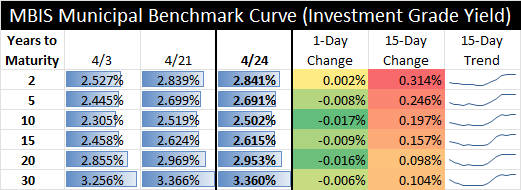
The interest rate table above illustrates recent changes in a sample of MBIS “investment grade” yields. Every issuer’s credit is different, and other financing sources may be available. To obtain comprehensive Financial Advisory services for your local government, contact your Ranson Financial Municipal Advisor, Larry Kleeman, Beth Warren or Henry Schmidt.
Governor Kelly Announces Nearly $10 Million to Expand Housing for Elderly and Disabled Kansans
Governor Laura Kelly announced today that nearly $10 million has been awarded to nine recipients for the construction or renovation of housing for persons with disabilities and the elderly. Funding was made available through the ARPA Building Opportunities for the Disabled and Elderly (ABODE) program launched by Commerce earlier this year. “Safe and accessible residential communities for elderly and disabled Kansans are necessary for living independently,” Governor Laura Kelly said. “These awards will increase housing options that meet the needs of these communities.”
Source: Kansas Department of Commerce
Small Towns Chase America’s $3 Trillion Climate Gold Rush
Colleton County in South Carolina is a quiet rural district best known for its hunting, fishing and, recently, a sensational murder trial. Now it is also a player in America’s new gold rush: a scramble for $1 trillion in federal tax incentives and loans for green energy that is fueling a flood of corporate investments and reshaping local economies. The spending is one of the biggest outlays of taxpayer-financed industrial stimulus since Franklin D. Roosevelt’s New Deal. If successful, it could transform the nation’s economy by creating millions of jobs and driving up to $3 trillion in total clean-energy investments during the next decade. The made-in-Washington initiative also demands a leap of faith from small communities around the country that are committing significant local resources to attract businesses, sometimes in unproven industries. Some have been burned before.
Source: WSJ.com: US Business