

Kansas Municipal News
Garden City ends face covering ordinance
The Garden City Commission voted to not extend the citywide, face-covering ordinance at its regular meeting Tuesday. The commission voted 4-1 to end the ordinance, with Commissioner Deb Oyler dissenting. The ordinance was put into effect to help combat the spread of COVID-19 in the community and has been in effect since the Nov. 17 regular Commission meeting.
Source: Garden City Telegram.
Municipal Bond Trends for March 17, 2021
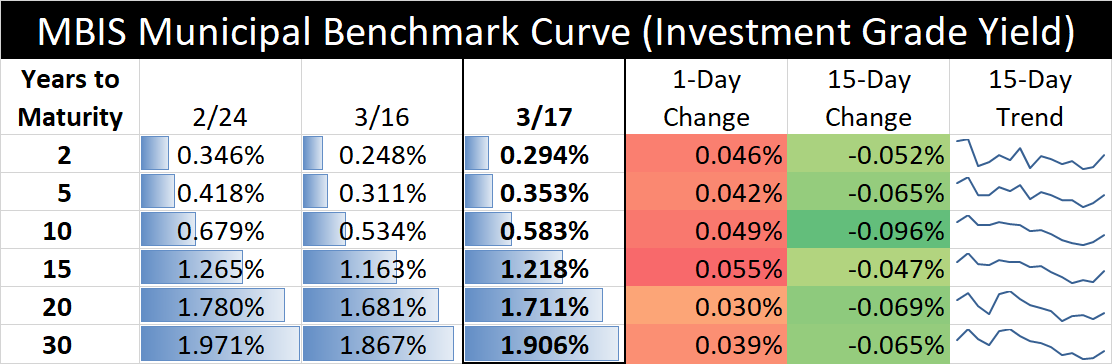
The interest rate table above illustrates recent changes in a sample of MBIS “investment grade” yields. Every issuer’s credit is different. For rates that may be applicable to your municipality, contact our Municipal Bond Advisors, Larry Kleeman and Beth Warren.
Johnson County Chairman Ed Eilert joins other metro leaders in marking one year of COVID-19
Board of County Commissioners Chairman Ed Eilert remembered the 638 Johnson Countians who have died from COVID-19 since March 2020. On Tuesday, Eilert joined three other metro leaders — Kansas City, Mo., Mayor Quinton Lucas, Jackson County Executive Frank White and United Government of Wyandotte County and Kansas City, Kan., Mayor David Alvey — at Union Station to mark the one-year anniversary since the four jurisdictions implemented a region-wide shutdown to control the spread of COVID-19. The four leaders were the first to write notes on a commemorative flower wall that will remain at Union Station for the public to interact with in coming weeks.
Source: Prairie Village Post
Governor Kelly expands visitation for nursing homes
Tuesday, Governor Laura Kelly announced expanded visitation for nursing homes and long-term care facilities, which would allow outdoor and more indoor options for families to see their loved ones. “I feel very blessed that I can be here,” said Larksfield Place resident Mary D. Lounsbury. Lounsbury said in the past year she has felt lucky to be where she is and taken care of. “Sometimes older people don’t like to think going to a place like this. I’d go to it again at the drop of a hat. It’s just, they’re all just nice,” said Lounsbury. But when the shutdown happened, communication with family got more complicated as many nursing homes and long-term care facilities closed their doors.
Source: KAKE – News
Kansas schools are returning kids to in-person learning, but concerns over ventilation linger
After the pandemic hit, the largest school district in Kansas set to calculating how much outdoor air it should pull into its buildings. Wichita Public Schools turned to the nation’s top sources for expertise, then boosted ventilation and filtration in ways that scientists say dramatically cut the risk of inhaling COVID-19. Evidence that schools — as well as operators of other buildings that bring people together — should take those steps has solidified, buoyed by scientific findings that the virus spreads primarily through particles in the air, not by lurking on doorknobs and table tops. Yet scientists say most American schools probably don’t bring in enough outdoor air or filter indoor air the way they should. In some schools, the windows don’t even open.
Source: Prairie Village Post
State to come out with more guidance soon on vaccine Phases 3 and 4
Dr. Lee Norman, Kansas secretary of health, said on Tuesday that the state will come out with more guidance by Monday on Phases 3 and 4 of the state vaccine plan. Gov. Laura Kelly and Dr. Norman announced Monday that Phases 3 and 4 of the vaccine plan would start Monday, March 22. One of the questions raised about the new phases is how will vaccination sites know if a person has a chronic disease and is in one of the phases. The topic was discussed at the Tuesday morning media update at the University of Kansas Health System. Dr. Norman said the state will come out with some guidance on that topic soon. He said that people will be on the honor system, but they might want to bring a pill bottle with their name and the medication name on it, or a copy of their prescription with them when they get a vaccine.
Source: Wyandotte Daily
Fed sees stronger economy and higher inflation, but no rate hikes
The Federal Reserve on Wednesday sharply ramped up its expectations for economic growth but indicated that there are no expected interest rate hikes through 2023 despite an improving outlook and a turn this year to higher inflation. As widely expected, the policymaking Federal Open Market Committee also voted to keep short-term borrowing rates steady near zero, while continuing an asset purchase program in which the central bank buys at least $120 billion of bonds a month. The key changes came in how central bankers view the economic road ahead and what impact that could have on policy. “Following a moderation in the pace of the recovery, indicators of economic activity and employment have turned up recently, although the sectors most adversely affected by the pandemic remain weak. Inflation continues to run below 2 percent,” the committee said in its post-meeting statement.
Source: Economy
A Kansas bill would expand a rural workforce recruitment tool, address housing issues
A bill before Kansas legislators Wednesday would extend and revamp a state program providing financial incentives to those moving to rural areas struggling with workforce retention. The Rural Opportunity Zones program provides designated counties an opportunity to offer income tax credits and student loan repayments in an effort to reverse population decline. Previously, these zones were decided by population loss, but under House Bill 2341 any county with a population of less than 35,000 would qualify. This would expand the program by 16 counties, bringing the total qualifying counties to 93. … a 2020 study indicated 30 counties did not commit any resources to the program and 80% of student loan recipients would have moved to the county regardless. While the study indicated the program has not reversed population decline as expected, supporters of the program believe a lack of incentive does not mean it has failed.
Source: Kansas Reflector
Does Wichita need a leash law for cats? A city board is considering it
A city board is considering a leash law for Wichita cats to reduce the number of felines running wild. Wichita Animal Control Advisory Board member Richard Ruth has proposed a city ordinance change that would make it illegal to let a cat roam the neighborhood, with penalties including a fine and sterilizing and microchipping the cat. The proposal would also limit the number of cats a person can own at four and require owners to annually license their cats and vaccinate against rabies.
Source: Local News | Wichita Eagle
Kansas launches program to help residents with rent. payments, utility bills
The state of Kansas has launched a new program designed to help individuals and families financially impacted by COVID-19 pay rent, utility and internet bills. The Kansas Emergency Rental Assistance (KERA) program is being run by the Kansas Housing Resources Corporation (KHRC). “Keeping Kansans in their homes and businesses – and ensuring they have access to the high-speed internet needed for telehealth, telework, and virtual school – has been a top priority for my administration since day one.” Gov. Laura Kelly said in a news release. “This program will be critical in ensuring Kansans can stay secure in their homes, stay warm, and maintain access to the internet.”
Source: Atchison Globe Now
Local Govs Will Spend Stimulus Relief in Different Ways
With the passage of the American Rescue Plan (ARP), states and localities will once again receive billions of dollars to reduce the financial losses caused by the coronavirus pandemic. But this time local government spending of those funds will look different from before. The ARP works to restart the economy through a well-established plan that encourages vaccine development and pumps massive amounts of federal funding into the economy. In addition to stimulus checks for most people, state and local governments will receive an extra $350 billion, with $65.1 billion in direct federal aid for counties and an additional $1.5 billion for public land counties. A report by CivicPulse found that local governments plan to spend this stimulus payment differently than previous relief packages. While officials still want to ensure health safety measures and PPE demands are met, there will be a shift to make sure that communities will succeed through the pandemic’s duration and beyond.
Source: GOVERNING
Hillsboro utility bills may soar for 2 1/2 years
Hillsboro electric customers will likely see their household electric bills go up 8.4% — an average of $15.33 a month — for the next 24 to 30 months. The increase, motivated by the same factors that could increase bills in Marion, too, will be decided at a city council meeting April 6. City administrator Matt Stiles told city councilmen Tuesday that the rate increase would be necessary to offset a dramatic spike in energy prices during February’s subzero temperatures and a resulting surcharge imposed by the city’s electricity provider.
Source: HILLSBORO Star-Journal
Winfield gas bills to increase for 6 years
The City of Winfield’s plan to spread out natural gas costs accrued during February’s cold weather emergency will result in customers paying an average of $29 more per month over a six-year period to help pay off a state-backed loan the city took out to help pay suppliers. Customers should expect to see utility bills reflecting the increased usage costs beginning with the March 17 billing cycle, according to a press release Wednesday from city manger Taggart Wall.
Source: Cowley CourierTraveler
Kansas Legislature passes rewrite of emergency management powers
Kansas lawmakers on Tuesday passed a bipartisan reform of the state’s emergency management law, installing new checks on powers of the governor, health officers and school boards to manage the COVID-19 pandemic and future disasters. The Senate adopted the legislation by a 31-8 vote hours after it won approval in the House by a 118-5 vote. The measure now goes to Gov. Laura Kelly for consideration. In addition to modifying the decades old Kansas Emergency Management Act, the new legislation extends the current disaster declaration from March 31 to May 28. The changes to KEMA were inserted into Senate Bill 40 — which previously dealt with the Kansas Department of Agriculture’s Division of Conservation. Republicans furious with the governor’s decisions to close schools, businesses and churches and require face coverings wanted additional limits on her powers. Competing plans emerged in the House and Senate before a compromise was reached.
Source: Kansas Reflector
Mayetta sales tax increase approved by city voters
Mayetta’s city sales tax will be increased by half a percentage point following yesterday’s special election, in which city electors voted to increase the sales tax, it has been reported. According to unofficial election results, the vote count was 21-5 in favor of increasing the city’s sales tax to 1.5 percent, effective April 1, to help pay back a 20-year loan through the Kansas Department of Health and Environment to cover the cost of extending a new sewer line to the new Dollar General store that is currently under construction at Mayetta’s western city limits. Sewer line extension costs have been estimated at $396,517, it was reported. Mayetta Mayor Jonathan Wimer has also stated that if revenues generated by the sales tax exceed the annual payment on the KDHE loan, those revenues will be used for other purposes in the city, such as sidewalk and street improvements.
Source: Holton Recorder
Limits on governor’s emergency powers, local COVID-19 orders pass out of Kansas Legislature
A lengthy bill overhauling Kansas’ emergency management laws in light of the COVID-19 pandemic passed out of Kansas Legislature Tuesday, and it will head to the governor’s desk. The bill, a compromise between the House and Senate, deal with multiple issues and was a product of days of intense negotiations between the two chambers. “This was probably the most extreme example of compromise that I’ve seen in my 7 years…” said Rep. John Carmichael, D-Wichita. “When we started out on this… I thought there was no way we ever would reconcile the House and Senate versions.” Both versions had the primary aim of placing restrictions on the Democratic governor’s emergency powers by the majority-GOP legislature, but gone about significantly different ways to do it. The Senate version was also the only one to put limits on COVID-19 orders issued by local and school authorities.
Source: Dodge City Daily Globe.
Johnson County development under fire as Kansas lawmakers weigh expanding STAR bonds
As the Kansas Senate last month debated whether to extend and expand a decades old economic incentive program one project kept coming up. Prairiefire. Critics of STAR Bonds, a 20-year-old incentive program designed to draw tourists to Kansas, held up the south Overland Park development as the ultimate failure. The picture of everything that could go wrong in a STAR Bonds development. And the reason the program should be changed or dropped altogether. Sen. Molly Baumgardner, a Louisburg Republican, said a fifth of STAR Bond projects failed, and that was before a potential expansion of the program.
Source: KC Star.
Municipal Bond Trends for March 16, 2021
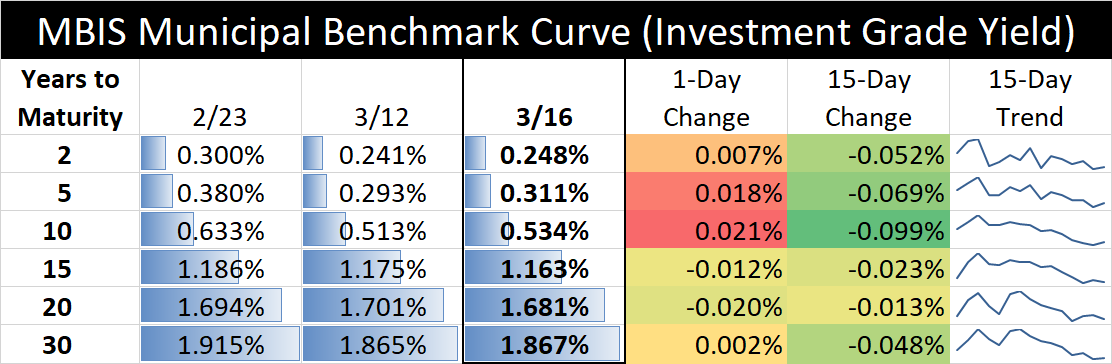
The interest rate table above illustrates recent changes in a sample of MBIS “investment grade” yields. Every issuer’s credit is different. For rates that may be applicable to your municipality, contact our Municipal Bond Advisors, Larry Kleeman and Beth Warren.
LaHarpe to take loan for utilities
Add LaHarpe to the growing list of communities that were socked by exorbitant electric costs following last month’s’ bitterly cold weather. City Council members have declared a state of financial emergency, necessary to apply for a low-interest loan made available by the state to pay the city’s $157,615.70 electric bill for February. The February bill was nearly 10 times the amount LaHarpe normally pays each month (a shade under $17,000 monthly.) The loan would be repaid by reinstating a portion of the fuel cost adjustment the city adds to the base electric rates LaHarpe customers pay each month.
Source: The Iola Register
Governor announces Kansas to move to Phase 3 & 4 of vaccine distribution
Today, Governor Laura Kelly announced the state will move to Phase 3 and 4 of Kansas’ COVID-19 vaccination plan on March 22, 2021. With this move, individuals between ages 16 and 64 with a preexisting medical condition and other non-healthcare workers in critical infrastructure will be eligible for vaccination. “Thanks to an increased supply in vaccine, Kansas will begin vaccinating individuals who qualify in either Phase 3 or Phase 4 on March 22,” said Governor Laura Kelly. “This expedited timeline will allow Kansans to get back to work, back to school, and back to a more normal way of life. I urge all Kansans to do their part by getting vaccinated when it is their turn and continuing to follow the public health guidance, so we can return back to normal.”
Source: Atchison Globe Now
A whole lot of shaking going on, experts look at recent swarm of earthquakes in Kansas
The United States Geological Survey said two more earthquakes were reported in the Wichita area on Monday. Along with the quakes Sunday in Wichita, KSN News asked the experts what is happening. “Usually, you have to look at this for a while,” said John Vidale, USC seismologist. “But there’s a possibility they’re natural earthquakes, but I think in a few months, we will have a much better idea if people can see all the data that’s reported.” Vidale is not ruling out man-made reasons for the quakes. People reported feeling the strongest quakes throughout south-central Kansas, with some reports coming from near Salina and Emporia.
Source: KSNT News
House explores launch of $10 million grant program to boost health of rural hospitals
A Kansas House committee tested the medical community’s pulse Tuesday on legislation earmarking $10 million in state funding for a new grant program to help financially struggling rural hospitals. The Kansas Hospital Association and Kansas Medical Society offered affirmative testimony on the legislation, which would match every $2 invested by grant applicants with $1 from a new state fund. Under House Bill 2174, donors could specify the recipient county but not dictate what hospital within a county received a grant. … “Many rural hospitals across the country continue to financially struggle,” said Tara Mays, of the Kansas Hospital Association. “Our member hospitals are committed to working on efforts that provide flexibility to rural hospitals as well as opportunities to implement alternative rural health models that sustain health care services in rural communities.”
Source: Kansas Reflector
New Prairie Village ordinance gives more protections to city’s aging trees
The Prairie Village City Council Monday evening approved an ordinance that will give further protections to most of the city’s trees. The ordinance classifies trees to be protected in four categories, based primarily on their location on residential streets in on private lots. Those classifications include right-of-way or street trees, frontage trees, lot trees and buildable area trees. Tree removal is not completely prohibited by the ordinance, but it does put more barriers in place. If the tree is dead, diseased, dying, or needs to be removed for construction or safety purposes, it can be taken out and replaced.
Source: Prairie Village Post
Tornado spotted in Johnson County, but not all residents were alerted — here’s why
Staff meteorologist Chris Bowman said tornado warnings and other weather-related alerts can be issued countywide, but in this instance, the warnings were targeted for areas in the county’s southeast corner, around Spring Hill, southern Olathe, Stanley, Overland Park and Leawood. He said that was due to how the storm was moving and what areas the NWS determined would be most impacted. “We draw a polygon around what we feel is the area under greatest threat,” Bowman said.
Source: Prairie Village Post
Grants available….
KDHE has Solid Waste Grants available. Grant applications for the 2021 Solid Waste Grant Program will open March 15, 2021 – May 15, 2021 by the Bureau of Waste Management.
KDHE has more details.
New COVID order to drop gathering capacity restrictions, keeps masks in Sedgwick County
A new Sedgwick County health order issued Monday drops restrictions on gatherings and capacity limits while keeping the mask mandate and social distancing requirements. Meanwhile, local health officials have thousands of vaccine appointments available later this week. Sedgwick County health officer Dr. Garold Minns signed a new health order Monday that allows more reopening in the Wichita area community, Sedgwick County Manager Tom Stolz said during a Monday media briefing.
Source: Wichita Eagle
Governor Laura Kelly announces Kansas will move To Phase 3 and 4 of COVID-19 vaccine distribution
Governor Laura Kelly announced the state will move to Phase 3 and 4 of Kansas’ COVID-19 vaccination plan on March 22. With this move, individuals between ages 16 and 64 with a preexisting medical condition and other non-health-care workers in critical infrastructure will be eligible for vaccination. “Thanks to an increased supply in vaccine, Kansas will begin vaccinating individuals who qualify in either Phase 3 or Phase 4 on March 22,” said Governor Laura Kelly. “This expedited timeline will allow Kansans to get back to work, back to school, and back to a more normal way of life. I urge all Kansans to do their part by getting vaccinated when it is their turn and continuing to follow the public health guidance, so we can return back to normal.”
Source: Great Bend Tribune
On shaky ground: One small neighborhood, two days, six earthquakes
East Wichita was shaken by two more earthquakes Monday morning, bringing the total number of temblors since Sunday to six. Five of the six have occurred in a square bounded by 13th Street on the south, 21st Street on the north, Rock Road on the west and Webb Road on the east. The sixth was just outside that square, slightly west of Rock near Eastview Park. Residents of the neighborhood said damage has been light to imperceptible.
Source: Local News | Wichita Eagle
Bill requires more property tax transparency
A bill that recently passed the Kansas House and Senate would remove the property tax lid enacted on governing bodies a few years ago, replacing it with a requirement to publish notices and hold a public hearing before exceeding their revenue neutral rate. The revenue neutral rate is what the mill levy has to be in order for property taxes to not be higher than the previous year. SB 13 requires governing bodies, such as city and county commissions, to publish legal notices and hold a public hearing before they can exceed their revenue neutral rate for property taxes, and discontinues the property tax lid enacted by the legislature a few years ago. It also prohibits property valuation increases solely as the result of normal repair, replacement or maintenance of existing structures, and establishes a payment plan for payment of both delinquent and non-deliquent property taxes. The bill also reimburses governing bodies for costs associated with publishing notices for the first two years.
Source: Cowley CourierTraveler
Hiawatha votes to move toward rescinding mask mandate – reopens City Hall
The Hiawatha City Commission agreed on Monday night to request an ordinance be brought to the next meeting, which will replace the current mask mandate ordinance. Once approved, the new ordinance would end the mask mandate in the City of Hiawatha after publication, effective April 12.
Source: Hiawatha World Online
Governor: Kansas speeding up COVID shots to hit May target
Kansas will give COVID-19 vaccinations faster than planned so that all adults with medical conditions can seek shots next week and the state will aim for President Joe Biden’s goal of having inoculations available for all adults May 1, Gov. Laura Kelly announced Monday. Kelly said the state will launch both the third and the fourth phase of its planned vaccine distribution next week, a week before the expected arrival of 100,000 doses of a single-shot vaccine made by Johnson & Johnson. The combined phase will cover about 600,000 of the state’s 2.9 million residents, after the first two phases covered twice that number.
Source: KAKE – News
String of Wichita earthquakes raising concerns
Eight earthquakes in northeast Wichita between Sunday and Monday morning have raised concerns for homeowners in the city. Most homeowners insurance policies protect your home from damage due to fire, smoke, lightning or even theft but insurance agents say earthquake insurance is typically sold separately. “Most policies will only allow you to add that coverage on at either the inception of the policy or the renewal,” said M & M Insurance agent Jonathan Lamunyon.Source: KAKE – News
Riley County caught between lawmakers and KDHE in debate over who controls vaccine prioritization
After the Kansas Department of Health and Environment prevented the Riley County Health Department from rolling out COVID-19 vaccinations according to the county’s specific needs, some state legislators want to minimize the state’s power to intervene in how counties make such decisions. A few weeks ago, Riley County health officials announced they were ready to move into phase three of the vaccine rollout. That would have allowed people in the county with severe underlying conditions, such as cancer and some other illnesses, to get their vaccines ahead of the state’s distribution schedule — and way ahead of what had been predicted for Riley County. But Kansas Department of Health and Environment secretary Lee Norman said the county needed to continue following the state’s plan as approved by the federal government and vaccinate another group in phase two: essential workers. … Sen. Richard Hilderbrand, who chairs the Public Health and Welfare Committee, said Senate Bill 295 would put a stop to what he called KDHE’s “micromanagement” of counties. He said he isn’t happy with how Kansas has prioritized its distribution phases and wants to see local governments have more flexibility in how they distribute vaccines. Hilderbrand indicated his committee would take action Tuesday on the proposed legislation.
Source: Kansas Reflector
Cluster of earthquakes in east Wichita shake south-central Kansas on Sunday
If you were woken up earlier than you would have liked Sunday morning after losing an hour to daylight savings time, it may have been due to earthquakes that rattled east Wichita. The Kansas Geological Survey recorded four earthquakes early Sunday morning. … More than 1,600 people reported feeling the strongest earthquake, according to USGS data as of 2 p.m. The vast majority of reports were from south-central Kansas. Additional reports came from near Salina and near Emporia. … The Kansas Corporation Commission previously determined that the swarm of earthquakes in November and December was not related to fracking. “Based on our investigation, KCC staff does not believe the seismicity in Wichita, Kansas is tied to any oil and gas activities in the area,” said Ryan Hoffman, director of the KCC Conservation Division, in a Dec. 23 statement.
Source: Wichita News
Kansas sees its best week of cases in more than eight months
The dropping trend of COVID-19 cases in Kansas continues. The past week in Kansas saw 1,887 new cases, the lowest week since the end of June. The weekly high of cases was more than 19,000 cases at the end of November. From there, it ebbed and flowed before starting to drop in all but one consecutive week so far this year. Friday’s report from the Kansas Department of Health and Environment listed an additional 519 cases, continuing the trend of fewer cases. Each one of the thrice-weekly reports from Sept. 18 to Feb. 19 listed cases in the thousands. The high was more than 7,500 cases on Nov. 23. Each weekly report so far in March has been under 1,000.
Source: Wichita News
Welcome to the only county in Kansas that doesn’t have a COVID emergency
Greetings from Chautauqua, the only county in Kansas where COVID-19 isn’t an emergency. This bucolic and remote county, nestled on the Oklahoma border 100 highway miles southeast of Wichita, is the only place in Kansas that isn’t under a COVID disaster emergency declaration, according to the Kansas Association of Counties. “We didn’t feel like we needed it,” said Rodney Shaw, who serves on the three-member County Commission that doubles as the Board of Public Health. If you wear a mask in Sedan, the Chautauqua County seat, you might as well hang a sign around your neck saying “Not From Around Here.” Coming here is like stepping back into 2019, those halcyon days before a global contagion that would kill an estimated 2.6 million people, including more than 527,000 Americans.
Source: Wichita News
Local government groups present ‘bond modernization agenda’ to Congress
Local government groups told a House committee Thursday the reinstatement of tax-exempt advance refunding and tax credit bonds are top priorities for infrastructure financing, part of a “bond modernization agenda.” They also highlighted the importance of raising the limit on bank-qualified debt to $30 million as part of that effort. … Mayor Stephen K. Benjamin of Columbia, South Carolina, a former president of the U.S. Conference of Mayors, described the reinstatement of direct-pay tax credit bonds through another round of Build America Bonds as “an excellent complement” to municipal bonds. Although all of the proposals have some bipartisan support in Congress, the extent of that support remained unclear at the hearing.
Source: The Bond Buyer
Senate sends Kansas property tax reform package to governor
Sen. Caryn Tyson urged fellow senators Thursday to endorse “historic” property tax reform and overlook changes made by the House to lump school districts into the reform package for local governments. Tyson, a Republican from Parker, credited the late Sen. Bud Estes, a Dodge City Republican who died last month, with engaging her several years ago in the process of figuring out how to fix property tax problems in Kansas. “We are literally taxing people out of their homes,” she said in a speech on the Senate floor, shortly before the chamber adopted the law by a 30-5 vote. The end product would remove the loathed, state-imposed local property tax lid, exclude normal maintenance from property valuations, allow for payment plans, and require written notices and public hearings before raising taxes by any amount. Tax increases are measured by the dollar, rather than mill levy, to abolish the practice of raising taxes by increasing property valuations. Senate Bill 13 now goes to Gov. Laura Kelly for consideration.
Source: Kansas Reflector
Bill requires more property tax transparency
A bill that recently passed the Kansas House and Senate would remove the property tax lid enacted on governing bodies a few years ago, replacing it with a requirement to publish notices and hold a public hearing before exceeding their revenue neutral rate. The revenue neutral rate is what the mill levy has to be in order for property taxes to not be higher than the previous year. SB 13 requires governing bodies, such as city and county commissions, to publish legal notices and hold a public hearing before they can exceed their revenue neutral rate for property taxes, and discontinues the property tax lid enacted by the legislature a few years ago. It also prohibits property valuation increases solely as the result of normal repair, replacement or maintenance of existing structures, and establishes a payment plan for payment of both delinquent and non-deliquent property taxes. The bill also reimburses governing bodies for costs associated with publishing notices for the first two years.
Source: The Arkansas City Traveler
Rural Americans in Pharmacy Deserts Hurting for COVID-19 Vaccines
As the Biden administration accelerates a plan to use pharmacies to distribute COVID-19 vaccines, significant areas of the country lack brick-and-mortar pharmacies capable of administering the protective shots. A recent analysis by the Rural Policy Research Institute found that 111 rural counties, mostly between the Mississippi River and the Rocky Mountains, have no pharmacy that can give the vaccines. That could leave thousands of vulnerable Americans struggling to find vaccines, which in turn threatens to prolong the pandemic in many hard-hit rural regions.
Source: KCUR News
Sedgwick County Commissioners reflect on one year of COVID-19 restrictions
“We didn’t really know what this virus was or how deadly it can be,” said Commissioner Lacey Cruse, as she reflects back on March 2020 when the coronavirus pandemic began. A year ago today, March 13, Sedgwick County put its first restriction in place by creating a ban on gatherings of 250 people or more. Within a week of their first ban, Sedgwick County reported its first presumptive-positive COVID-19 case on March 19, 2020. “This thing was supposed to be just, if you recall, a couple of weeks, maybe a couple of months. By Summer we’ll be fine,” said Pete Meitzner, Sedgwick County Commission Chairman. Instead, it turned into months of meeting after meeting. The commission serving as the board of health faced tough decisions.
Source: KSN-TV
State grants set to improve broadband
Critically needed broadband will soon be available to more than a dozen Kansas communities after the first-round recipients of a state grant program were announced Thursday. The Broadband Acceleration Grant Program, created in fall 2020, aims to increase broadband access across the state through a 10-year, $85 million investment. The program is operated through the office of broadband development in conjunction with the Kansas Department of Transportation’s Eisenhower Legacy transportation program. The initial round provided $5 million in total grant awards to 14 projects in 18 communities; each recipient company matched the state grant it received.
Source: The Iola Register
City of Lawrence to pay 48 fire, police and other employees nearly $1M total in back overtime because of classification mistake
The City of Lawrence has agreed to pay nearly $1 million in back overtime to dozens of firefighter captains, police sergeants and other city employees. Following both an outside and internal review, the city determined it had mistakenly misclassified certain positions as not eligible for overtime when they actually were, according to a city news release Friday. As a result, the city will be paying back overtime totaling $998,600 to 21 fire captains, 24 police sergeants and three city planners. “The City has a responsibility to ensure employees are paid accurately and fairly,” Human Resources Director Lori Carnahan said in the release. “We are committed to correcting any underpayment of overtime to which our employees may be entitled. This is a complex computation and we have been working hard to get it right for our employees.”
Source: LJWorld.com.
City leaders to discuss potential strategies amid ‘critical’ shortage of homes for sale in Lawrence
As the home-buying season gets underway in Lawrence, those in the industry say the city is facing a historic shortage of homes on the market that requires city leaders to take action. Lawrence Board of Realtors President John Huntington said that in his 30 years of experience, he has never seen such a low inventory of homes for sale. As of this past week, he said, only 44 homes were on the market in Lawrence. “We’ve never come even close to numbers like this,” Huntington said. By contrast, around this time last year there were roughly 400 local listings. The board sent a letter to the Lawrence City Commission this past week stating that the city’s housing shortage had hit a “critical crisis” and that the board is seriously concerned about how it will affect housing affordability as well as other economic factors.
Source: LJWorld.com.
Boutique hotel planned for downtown Hutchinson building
Most of the four-story building, erected in 1910 as a downtown office building, has been vacant for more than 50 years — and it shows, with crumbling plaster ceilings, grime-coated floors and deteriorating plywood in the windows. … Their plans now, [Mark] Davenport said, are to convert the building into a boutique hotel. “It will be like a hotel style, but unique to the building,” Davenport said. “So, not like a hotel chain vibe, but it will present the history and character of the building in the décor and design of the building.” The first floor housed some retail space. Its last tenant, Classic Barber Shop, moved out in 2010 after Davis advised he was marketing the building. The second through fourth floors were all offices, though they’ve been vacant since the 1960s, when the building’s elevator was shut down. “There was a lot of history there,” Davenport said. “It’s still there.”
Source: Hutchinson News