

Kansas Municipal News
County approves purchase of 5 license plate reader cameras for main highways
Neosho County commissioners Tuesday heard from Neosho County Sheriff Greg Taylor regarding traffic cameras and the commission approved the purchase of five for the county. Taylor said the Chanute Police Department asked him to come to a meeting to discuss license plate reader cameras created by Flock Safety. “These are cameras that they put out throughout the city,” Taylor said. “End up being five of them. Essentially a vehicle goes by that’s got a NCIC, you know, it’s wanted for stolen vehicle or an Amber Alert as it’s coming into their jurisdiction. Those cameras would read the plate, send their jurisdiction notification, ‘Hey, this vehicle just came into your jurisdiction,’ so that they could try to get it stopped.” The five cameras’ total cost is $15,000. Commission chair Gail Klaassen said she thought it was a good price for the five cameras. “It’s one year at a time so you’re not locked into a long-term contract. You can evaluate and see if it’s actually worthwhile or not,” Taylor said of the cameras. “What makes this probably the most enticing thing: You get access to their nationwide system.” Taylor said officials had discussed obtaining five for Neosho County. “Essentially on the main thoroughfares coming into Neosho County, like north and south 169 Highway, same one on 59 Highway and then this other one on 47 coming into Neosho County. Because 39 will all get covered by Chanute,” Taylor said. “We have quite a bit of money still left over in the Pilot fund.” Taylor said that funding could be used to pay for the first year. The cameras also will give the sheriff’s office the ability to see how many cars are coming to and through the county each day on the highways, Taylor said. It also will help the department with ongoing investigations, Taylor thought.
Source: The Chanute Tribune
State, local leaders debate tax program
County leaders want the state to reinstate the Local Ad Valorem Tax Reduction. The program was introduced to help local governments during difficult times, but the state has withheld funding for the past 20 years. Kansas, grappling with economic challenges, introduced the Local Ad Valorem Tax Reduction (LAVTR) in 1937 to alleviate the burdens on local governments during the Great Depression. For the last 20 years, the state has withheld that funding. Today, a measure to reinstate the funding is gaining traction. During the economic turmoil of the 1930s, the state faced a dire situation, with Kansas being hit especially hard by the Dust Bowl. LAVTR was conceived to stabilize and reduce local property taxes by channeling surplus state sales tax revenue to struggling counties. By its design, the funds paid for such services as police and fire protection, parks, streets, jails, elections, and many other services county governments are required to provide. Allen County would have received $529,100 in LAVTR funds in the most recent payout, had LAVTR been in effect. In 1965, the funding became law. Considered a demand transfer, two payments were made – Jan. 15 and July 15 – based on the formula set in statute: 65% is distributed based on population, while 35% is distributed based on property tax valuations. The 1990s brought changes, with amendments allowing reductions in transfers if the state’s ending balance fell below a certain threshold. The early 2000s saw the end of increased distributions, setting the stage for a steady decline in LAVTR funding. In 2001, the amount for distribution in fiscal year 2002 was set at $27,340,335.50. In 2002, the amount for distribution in fiscal year 2003 was set at $26,246,722. Less than half of what it was supposed to be. Between 2001 and 2022, Kansas counties have lost over $1.7 billion in revenue from LAVTR alone. “While LAVTR is the focus, we’ve also lost out on billions in County and City Revenue Sharing funds and Special City-County Highway Fund (SCCHF),” noted Allen County Commissioner Bruce Symes. “All three lost amounts total $3.5 billion to counties and cities.” THE INTENT behind LAVTR was not to eliminate local property taxes entirely, but to provide stability and potential reductions during economically favorable periods. However, the lack of funding over the years has shifted the burden back onto property taxpayers. Fast forward to 2023, and there is a glimmer of hope for LAVTR. On March 28, 2023, the Kansas House debated LAVTR funding as a potential budget amendment for the 2024 fiscal year. The proposed amendment, introduced by the House Minority Leader Vic Miller, aimed to fully fund LAVTR for the first time since 2000. Despite passing decisively with an 83-40 vote, the lack of support from the House majority party leadership and little momentum in the Senate has left the future of LAVTR uncertain.
Source: The Iola Register
A look inside the Village, Lawrence’s community to help people recover from homelessness
Fifty small cabins will soon be available to help Lawrence community members experiencing homelessness recover and secure housing. The City of Lawrence has raised the Village of Pallet emergency shelters at 256 N. Michigan St., the former location of Veritas Christian School. Lawrence Community Shelter staff members will run the site. Misty Bosch-Hastings, homeless programs coordinator for the City of Lawrence, said she thinks a lot of people will probably compare the village to the city-sanctioned camp in North Lawrence. But “I want them to know that this is a very well thought out plan. The operational plans are to help individuals end their homelessness,” Bosch-Hastings said. “It’s not just a place to sleep and party, and it’s actual working towards an end to their homelessness, with any support that they need to do so.” Veterans, older people, women emerging from domestic violence situations and people with disabilities who require specialized support and care are among the people the village aims to serve. Local agencies that work with people who are unhoused will be able to refer people for a spot. It is not a low-barrier shelter; drugs and alcohol will not be allowed, and the village will have a curfew, with case-by-case exceptions for people who work nights. There will be no smoking allowed inside the cabins, and there will be a designated outdoor smoking area. Despite snow falling Friday and a temperature of 32° outside, the small heater units kept cabins warm. The structures are small, but three journalists and a city staff member could comfortably stand inside one of the 64-square-foot spaces. Here’s a panoramic image taken from the center of one cabin. Touch or click to load the panoramic, drag the image around and get a look inside. Guests will be allowed to decorate the insides of their cabins. Dry erase markers work on the walls. Each cabin has lights, a fire extinguisher, wall outlets and four windows. Shelving provides space for clothing and belongings, and a small desk surface. There’s also sitewide WiFi access. Bedding will also be provided for guests, Bosch-Hastings said. Staff members at the shelter’s main campus, 3655 E. 25th St., will prepare three meals a day and deliver them to the village. Cicely Thornton, homeless programs project specialist for the city, said guests will be able to have two totes stored if they have possessions that won’t fit in their cabins. There are 50 64-square-foot cabins for guests. They’re spaced about 10 feet apart. The site also has three 100-square-foot cabins — one that will serve as the staff office, and two that will serve as meeting spaces.
Source: The Lawrence Times
Clerk tabbed as 1st county administrator
Longtime county clerk Tina Spencer will become Marion County administrator Feb. 1. The first to hold the position, she already is a familiar face, having been county clerk since 2013 and was deputy county clerk from 2005 to 2013. County commissioners voted Friday to hire Spencer on a three-year contract. Her salary for 2024 will be $100,000. It will be reviewed each following year. Her duties will include effectively administrating the affairs of the county; coordinating and enforcing resolutions, policies, and rules; overseeing appointed department heads and human resources; attending all commission meetings; presenting proposed policies; preparing estimates of revenues and expenditures; monitoring programs and budgets of all departments; and keeping commissioners informed of the financial condition of the county, “I know that I will have a lot to learn, and it will be somewhat experimental and fluid as we figure out the actual structure of the position and what works in Marion County,” Spencer said. “I don’t expect the transition to be easy – it required a shift in thinking, away from ‘how we’ve always done it.’ I am looking forward to facilitating that thought process for our organization. We have so many great people, all with their own ideas and amazing expertise. I would like to channel that to benefit our entire organization.”
Source: HILLSBORO Star-Journal
Miller retires from county position
After helping guide Barton County through the 2001 Hoisington tornado and the COVID-19 pandemic, longtime Barton County Emergency Management Director Amy Miller will retire retiring at the end of the year after 37 years with the county. Miller was recognized by the Barton County Commission Thursday morning. But, while sorry to see her leave, commissioners also met Sean Kelly, a county engineering tech and assistant emergency manager, who was promoted to fill the post. “Amy Miller was hired on Jan. 10 1986, and is currently the county second-longest working county employee,” said County Administrator Matt Patzner. She announced her retirement earlier this year and leaves the post as of Dec. 31. Miller couldn’t be at the meeting, but Patzner read the letter of appreciation that they will present to her, along with a commemorative clock. “Few employees today have reached 37 years of service, fewer employees have reached 37 years while dealing with natural and man-made disasters, as well as insurance, workers compensation and such matters,” he read. “Having worked in various departments in the county, and with a background in journalism, you were a natural selection for a job that you understand, developing plans and response to the disasters we face on a daily basis,” he continued. “You were tasked with answering our ‘what ifs’ and you never failed in providing obtainable solutions that kept our citizens, our infrastructure safe and operational. “Focus, prevention, preparedness, response, recovery and mitigation are words we associated with your position,” Patzner read. “Educated, measured, well-intentioned, responsible and collaborative are words we associated with you. The hours spent in tabletop exercises paled in comparison to response to the Hoisington tornado, the global pandemic and other disasters over the last 37 years,” he noted. “Through it all he remained committed to your mission. For what you have brought to the table and what you have left for your legacy, you are appreciated.”
Source: Great Bend Tribune
Six fast-charging EV locations coming across Kansas
Kansas Gov. Laura Kelly announced on Wednesday that more than $4.6 million in federal funds will be directed to the first six locations selected for the state’s National Electric Vehicle Infrastructure (NEVI) Formula program. With existing fast-charging stations spread across the I-70 and I-135 corridors, these selected locations will fill gaps in EV charging stations along the state’s major highways and interstate system. “As more electric cars and trucks make their way onto Kansas roadways, they will need access to adequate charging facilities,” Governor Laura Kelly said. “With these awards, we’ll ensure electric vehicle charging stations are accessible to all Kansans for local and long-distance trips.” The awarded projects must provide a minimum 20% local cash match, bringing the total investment to over $5.8 million. The six new direct current (DC) fast charging stations are awarded to the following Kansas locations: Emporia, Flying J, 4215 W Hwy 50 (I-35); Garden City, Love’s, 3285 E U.S. 50 (U.S. 400); Cherokee, Pete’s, 20 U.S. 400; Fredonia, Pete’s, 2400 E Washington St. (U.S. 400); Belleville, Love’s, 1356 US Highway 81 (U.S. 81); Pratt, Casey’s, 1900 E 1st St (U.S. 400). “These six new stations will give more Kansans the option to drive electric vehicles,” said Tami Alexander, Transportation Electrification Manager at the Kansas Department of Transportation (KDOT). “KDOT is committed to enhancing the access and convenience for EV users by leveraging the federal match to build a robust, connected, and sustainable EV charging network.”
Source: Great Bend Tribune
Municipal Bond Trends for January 5, 2024
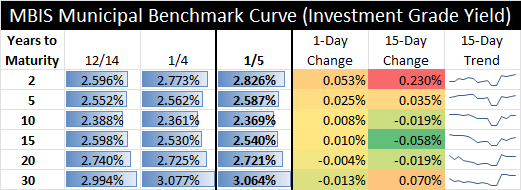
The interest rate table above illustrates recent changes in a sample of MBIS “investment grade” yields. Every issuer’s credit is different, and other financing sources may be available. To obtain comprehensive Financial Advisory services for your local government, contact your Ranson Financial Municipal Advisor, Larry Kleeman, or Henry Schmidt.
City Of Russell, KRSL/KZRS Russell Radio Partner For Russell Community Impact Award
The City of Russell is thrilled to announce the Russell Community Impact Awards launch, an exciting monthly celebration dedicated to recognizing and honoring the unsung heroes in our community who are shaping Russell into a better place to live, work and play. These awards, co-sponsored by the City of Russell, KRSL/KZRS Russell Radio, and the Kansas Municipal Energy Agency, aim to ignite a sense of community pride and civic engagement by spotlighting those individuals, businesses, and organizations that exemplify the very essence of our town’s values and potential.
Read more: KRSL
Municipal Bond Trends for January 4, 2024
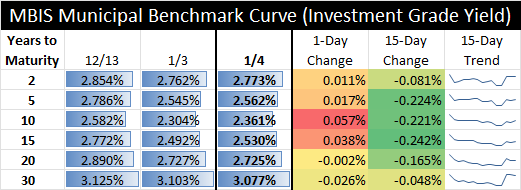
The interest rate table above illustrates recent changes in a sample of MBIS “investment grade” yields. Every issuer’s credit is different, and other financing sources may be available. To obtain comprehensive Financial Advisory services for your local government, contact your Ranson Financial Municipal Advisor, Larry Kleeman, or Henry Schmidt.
Municipal Bond Trends for January 3, 2024
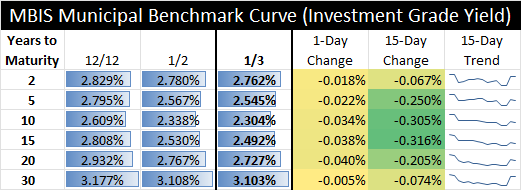
The interest rate table above illustrates recent changes in a sample of MBIS “investment grade” yields. Every issuer’s credit is different, and other financing sources may be available. To obtain comprehensive Financial Advisory services for your local government, contact your Ranson Financial Municipal Advisor, Larry Kleeman, or Henry Schmidt.
Next phase of Kansas’ gradual repeal of state sales tax on food to yield savings of $150 million
Gov. Laura Kelly said the next scheduled reduction in the state’s sales tax on groceries Jan. 1 would cut the rate in half to 2% and enable shoppers in Kansas to avoid $150 million annually in food costs. The agreement embraced by the 2022 Legislature and the governor established a three-year approach that included a Jan. 1, 2023, drop in the state sales tax on groceries from 6.5% to 4%. The next step on Jan. 1 moves the state’s assessment to 2% on food, food ingredients and certain prepared foods. That would trigger a reduction in state tax collections of $12.5 million per month. Kansas would join the majority of states by exempting groceries from state sales tax collections on Jan. 1, 2025. Local government sales taxes would still apply to groceries.
Source: The Lawrence Times
Marion County appoints County Clerk Tina Spencer as the first County Administrator
The Marion County Commission voted today to appoint County Clerk Tina Spencer as the first County Administrator. … Spencer is a Master-Certified County Clerk and holds a Mini MPA Certificate for Executive Development in Public Administration awarded by Wichita State University Hugo Wall School of Public Affairs. She has extensive county government experience, having served as Marion County Clerk since January 2013 after serving as Deputy County Clerk since 2005. Spencer also has private-sector management experience. During her time as County Clerk, she has held leadership roles in the statewide Kansas County Clerks & Election Officials Association. … Spencer’s appointment will create a vacancy in the County Clerk position, which will be filled by the Marion County Republican Precinct Committee. Spencer’s first day as County Administrator is slated for Feb. 1.
Source: Hillsboro Free Press
Former Manhattan Mayor, who led city through 1993 flood, passes away
Former Manhattan City Commissioner Roger Maughmer died Friday at Ascension Via Christi Hospital, following complications from pneumonia. He was 78. Maughmer served six years on the city commission from 1989 to 1995, serving as mayor during the 1993 flood and was a longtime member of the Manhattan Optimist Club. A native of Cheyenne, Wyoming, Maughmer moved to Kansas in 1965 and eventually settled in Manhattan, where he worked for Southwestern Bell for 25 years. He often returned to Wyoming to his family cabin and was involved in racing cars with his son. He is survived by his wife Barbara and sons Glen and Bob as well as his grandchildren and great-grandchildren. A celebration of life will take place at 2 p.m. Saturday at the Yorgensen-Meloan-Londeen Funeral Chapel. Memorial contributions may be made to the Midwest Dream Car Collection.
Source: 1350 KMAN
Fort Scott Has A New Human Resource Director and City Manager Reflects on 2023, Looks To 2024
Fort Scott City Manager Brad Matkin was asked what the city’s accomplishments were this year and also what is on the horizon for 2024 and he sent his reply. He also announced a new administrative position has been filled by Payton Coyan. Payton Coyan started as the Fort Scott Human Resource Director on December 27. She has four years of experience in driving strategic human resource operational initiatives, with a focus on talent acquisition, employee retention, succession planning, organizational development, legal compliance, and grievance management. She also has skills in recruitment, interviewing, resume screening, negotiating, conflict resolution, streamlining operations, and heightening employee productivity by mastering HR situations for integrating human resource functions with overall goals, according to a press release. She has experience managing employee benefits, employee hiring and onboarding, performance management, and HR records. Coyan is a graduate of Ottawa University. “Outside of work, I enjoy spending time with family and friends,” she said in the press release. ” I come from an amazing family and am fortunate to have… every one of them in my life. I am a lifelong resident of Bourbon County and love our community full-heartedly. In my free time, I enjoy…camping, (going) on a nature walk, walking downtown, or reading a book.”
Source: Fort Scott Biz
Edgerton Lake, dam exploration project moves forward
Two years ago, the City of Edgerton approved a $75,000 project to explore repairing the Edgerton Lake Dam as part of the city’s 2022-2026 capital improvement project. During the Edgerton City Council meeting last month, city council members agreed to pay Affinis $115,000 for a draft scope and contingency covering various project expenses related to city engineer time and printing materials. The draft scope fee is $105,425, and the contingency portion of the project is $9,575.City officials said the additional $40,000 will come from a special park and recreation fund, with the original $75,000 from the park impact fee. CIP project manager Holly Robertson said the original $75,000 project budget was developed based on an understanding that most engineering firms would be able to provide a similar level of service
Source: Gardner News
Governor Kelly Announces Grocery Shoppers Can Expect an Additional $150M in Tax Relief in 2024
Governor Laura Kelly today announced that in 2024, consumers in the Sunflower State are projected to see an additional $150 million in savings because of the “Axe the Food Tax” legislation >she signed in 2022. According to projections from the Kansas Department of Revenue, the reduction of the state sales tax on groceries from 4% to 2% will save shoppers $12.5 million per month in 2024. “By taking a middle-of-the-road approach, we have been able to continue putting money back in the pockets of every Kansan,” Governor Laura Kelly said. “This reduction is a step toward eliminating the state sales tax on groceries completely, which will happen in 2025.” After working tirelessly to put the state on solid financial footing, in 2021 Governor Kelly called on the Kansas Legislature to eliminate the state sales tax on groceries as soon as possible. The legislature ultimately passed legislation that gradually reduced the state sales tax on groceries over three years. In 2023, the state sales tax rate on groceries went down from 6.5% to 4%, saving consumers $187.7 million per year. By the end of 2024, it is projected that shoppers will have saved more than half a billion dollars in sales tax on groceries over the two years the reduction has been in place.
Source: Governor of the State of Kansas
For Public Finance, a Year for Stability and Cautious Optimism
For state and local government financiers, the good news for 2024 is that most financial functions will be more predictable. Budget projections will be easier and more reliable, at least for the calendar year, as the economy continues settling fairly smoothly to a slower pace with inflation easing and interest rates drifting down with it. Of course, a slowing economy can be expected to be accompanied by softening tax revenues, and that has been reported in some states already. Nonetheless — and absent the usual unforeseeables like new wars, oil shocks and pandemics — public finance is returning to something resembling business as usual. With a few exceptions, the “New Normal” is becoming the “Old Normal,” at least for budgeting, collective bargaining, pension funding, tax rates and debt issuance. Wall Street has come to a growing consensus that the economy is gliding to a “soft landing,” with the only question being how long this can last. Inflation likely won’t drop in 2024 to the Federal Reserve’s target of 2 percent, so while interest rates will likely drift somewhat lower, don’t look for anything near the unusually minuscule levels that prevailed before and during the COVID-19 pandemic. Borrowers will still pay and investors will still earn a positive real rate of return on debt instruments. Mirroring that overall economic glide path, upward pressures on salaries are likely to ease. But labor markets nationally will remain tight by historical standards, making it an ongoing public-sector challenge to hire personnel amid tight budgets.
Source: Governing
County approves wage increases, splits on Rural Opportunity Zone program
The County Commission approved a budgeted raise for employees, as well as elected officials and itself. The Commission voted 3-0 to approve providing a 3 percent cost of living increase to county employees for 2024. “We discussed this in budget season too so it’s all been approved in the 2024 budget,” he said. The plan also allocates $147,000 to alleviate an issue County Administrator Anthony Swartendruber described as wage compression. As hiring wages have risen they’ve begun to outpace wages for existing employees. Swartzendruber said the money would help provide some gap between employees with longer tenures and new hires. 54 County employees would be affected by that provision. County Commissioners will now paid $36,014 annually. The County Attorney( District Attorney) will receive $124,521, the County sheriff $111,638, the County Clerk $87,630, the County Register of deeds, $78,094, the County treasurer $75,760. In other news, the County approved a resolution to participate in a state program aimed at drawing out-of-state college graduates to live in Kansas counties, but not before objections were raised. As part of the program, the recipient will receive $3,000 a year in college loan forgiveness for up to five years. The State, through the Department of Commerce, pays half of that cost and requires a local match for the other half. Harvey County has been part of the program since 2021, but provides no local match. Instead, businesses or other organizations are charged with paying the local match. Renewal of the program came up on the County’s Jan. 2 agenda and Amy Siple addressed the county during the public comment section of the meeting. “This feels like a slap in the face to Harvey County Citizens,” she said “You’re asking us to pay off student loans for people to move into Harvey County.”
Source: Harvey County Now
Wichita bans corporate political donations on last-minute party-line council vote
Corporations and limited liability companies will no longer be allowed to contribute to Wichita City Council and mayoral campaigns after a contentious debate and 4-3 vote Tuesday. The four Democrats on the council approved the measure over the objection of their Republican colleagues during the final meeting before incoming Mayor Lily Wu, a Libertarian, and two new Republican council members take office. In a break from standard procedure, outgoing Mayor Brandon Whipple made an emergency declaration, allowing the council to finalize the reform Tuesday and forgo the standard second reading that would have otherwise been required next week. Whipple said the emergency declaration was necessary because the state-mandated $500 contribution limit for individuals and businesses resets with the start of a new year. “If you gave tons of money last campaign, you now can do this tomorrow if this doesn’t pass today,” Whipple said. The Republicans didn’t buy his logic. “I don’t think anyone would think that this is an emergency, and as a public health professional before I was elected to this position, I am just concerned with diluting the word ‘emergency,’” council member Becky Tuttle said. “I also believe firmly that businesses should have a say in who runs our city,” she said. “Businesses pay property tax, they pay sales tax. I don’t think they should get to vote, but I do believe they should have a say.” The city previously barred political committees, corporations, partnerships, trusts, labor unions, business groups and other organizations from contributing to candidates. But those restrictions were dropped in 2015, five years after the U.S. Supreme Court’s landmark Citizens United decision, which prohibits the government from restricting independent spending for political campaigns by corporations and other groups.
Source: Local News | Wichita Eagle
Fire causes damage to Paris Park pavilion in Arkansas City
A fire damaged the Paris Park pavilion in Arkansas City on New Year’s Day. Arkansas City Fire/EMS Department responded to the fire around 4 a.m. Firefighters found heavy flames engulfing the south end of the pavilion. Crews were able to contain the fire in the area, preventing further spread and minimizing potential damage. Damage is estimated at $10,000. Anyone with information is encouraged to contact Arkansas City Police Department Lieutenant Detective Jason Legleiter at 620-441-4435 or Chet Ranzau, Arkansas City Fire Marshall, at 620-441-4430.
Source: KSN-TV