

Kansas Municipal News
Commissioners discuss county’s unpaved roads
The combination of recent weather events that adversely impacted unsurfaced roads in Harvey County didn’t show deficiencies in the roads, it created them, according to Jim Meier, director of the Road and Bridge Department for Harvey County. Meier addressed the Harvey County Commissioners on Tuesday morning at the request of Commissioner Becky Reimer after multiple calls and emails on the rough road conditions in January. In his written report, Meier listed a history of regrade projects and major road improvements dating back to 2012, including last year’s big project on N. East Lake Road from NE 60th north 1.75 miles for $43,790. Meier said that regrade projects are very weather-sensitive and can only be performed during certain times of the year. He said the limitations on projects include temperature, moisture and road closure.
Source: Harvey County Now
Commercial solar ban set to expire in March, requirements could be changing
A six-month ban on commercial solar projects in Sedgwick County expires in March. County Commissioners are looking into what needs to change before projects get the green light. The Advanced Plans Committee of the Sedgwick County Planning Department did not recommend changing much when it came to the process of getting a conditional use permit for commercial solar. However, Sedgwick County Commissioner David Dennis raised some red flags during Tuesday morning’s meeting. “Up to this point, we really haven’t given any guidance on what we think ought to go into it,” said Dennis. Currently, there are no size restrictions on solar projects. Dennis said that has to change. “I disagree that there should be no size. We need to come up with a size that’s manageable, and 640 acres is exactly one square mile, and if you put solar panels on one square mile, that’s a pretty good-sized solar project,” said Dennis. Invenergy plans to file for a conditional use permit to build solar panels that would cover 750 acres of unincorporated land in Sedgwick County between Colwich and Maize.
Source: KSN-TV
Lessons for Kansans in Oklahoma City’s unified push on homelessness
Before its passing in 2012, Johnny’s Lunch Box in downtown Oklahoma City was a legendary gathering spot where the coat-and-tie crowd shared tables and banter with the blue-collar multitude. In the early 2000s, Dan Straughn often grabbed a bite there with fellow business and community leaders. The restaurant also provided a window into a perplexing local concern, given that it was located down the street from the main library, which was serving as a de facto day shelter for the homeless. “You could just sit there and watch a parade of stereotypical homeless-looking people walk back and forth,” recalled Straughan, then vice president of the city’s United Way. “One of the oil and gas guys at the table said to us other guys, and it was all guys at the time: ‘This homeless issue never gets better. Every year we put money into the system with our foundations and charitable giving, and the numbers never get any better. Or maybe they do, but do we even know what the numbers are? We’re all smart business guys, we ought to be able to figure this out.’” That conversation marked the beginning of a grassroots community effort to better coordinate homeless services and eventually create the Homeless Alliance, a one-stop center housing various agencies. Wichita appears to be reaching a similar crossroads.
Source: KLC Journal
Commission discusses moratorium on zoning
Commissioner Carl Wood revisited the zoning issue in the county asking County Counselor Jim Emerson for more details on a moratorium. Emerson said that using a moratorium is a way to delay companies from building solar and wind farms as it gives the county time to update its strategic plan, zoning laws, and land usage. This is not a short process but can take a year or more to complete. Commissioners need to adopt a resolution giving Emerson the authority to draft a moratorium and hire an outside consulting firm to review zoning laws and the county’s strategic plan, which Emerson admits needs updating. Many of the county’s rural residents are opposed to countywide zoning laws, fearing it gives the county government the authority to say what is allowed or not allowed on private property. There are other options than zoning the entire county. Cities and towns are already zoned, so extending the boundaries of those zoned areas is one possible solution. Another is zoning only specific parts of the county to allow or disallow construction of alternate energy facilities. Not an advocate of zoning the county, Commissioner Bruce Blair says that some form of zoning is necessary to stop the construction of solar and wind farms in places they are not wanted. While passing zoning laws is a definite yes or no about what can be built where, a moratorium slows the process down and gives the commission and residents time to decide what is the best course of action.
Source: Morning Sun
Busy Bentley resident excited to serve on school board
Reba Lee, a former city council member for five years, looks forward to representing Bentley on the USD-440 Board of Education. Her first meeting was in January. Lee said that once children move from Bentley Primary School to Halstead Middle School, parents don’t give Bentley much of a thought after that, and she gets it. “I feel like sometimes Bentley does get overlooked a little bit, so maybe I can be the voice for Bentley,” Lee said. She thinks her time on the city council will help her term on the school board. “I learned a lot about different things that a lot of people don’t know about the ins and outs of the town, and I feel like I can bring that to the school board; just kind of give a perspective of the school board from Bentley,” Lee said. Lee and her husband have three children—a fifth grader, a fourth grader, and a 2-year-old—and have lived in Bentley for 10 years. Lee used to run childcare camps but said it wasn’t working out with her husband’s crazy deployment schedule, so in 2015, she decided to stay home with her children. Now, her husband runs a construction business and flips homes on the side. She has a pop-up consignment sale she runs three times a year. She also said she has a “small farm” in her backyard containing two pigs, three goats, some ducks, turkeys, chickens and dogs. Plus, she loves to garden. And if that wasn’t enough, the Lees purchased the old Independent office at 220 Main Street and are renovating it into a venue called Magnolia, which will open soon.
Source: Harvey County Now
Norton County Hospital wants sales tax hike for support
Like many smaller Kansas hospitals, Norton County Hospital is dealing with financial issues, and leaders think a countywide sales tax hike could help. It recently sent a letter to the Norton Area Chamber of Commerce asking the Chamber to support a one-cent tax hike. The letter is from Norton County Hospital CEO Kevin Faughnder, Interim CEO Kellen Jacobs, and CFO ReChelle Horinek. They say the hospital’s average operating margin in 2021, 2022, and 2023 ranged from minus 15 to minus 20%. They say the typical operating margin for many Kansas Critical Access Hospitals is minus 11%. Norton County Hospital is dealing with lower insurance reimbursement rates, higher costs of goods and services, and inflation. They say county tax support for NCH in 2021, 2022, and 2023 was 1.1 to 1.4%, while other Kansas Critical Access Hospitals averaged 6%. “According to the American Hospital Association, hospitals need a small profit margin to keep pace with life-sustaining advances in medicine, help support our workforce, and take care of our patients and community,” the letter said. “Approving our request for a one percent sales tax increase moves us closer to that goal and keeps the doors to our hospital open for business.” The letter to the Chamber points out how NCH helps the community by producing outside jobs. “For every one person we employ, we create 0.33 jobs in Norton County outside of the hospital,” the letter said. “We are also a dollar multiplier, meaning for every dollar that we pay out, more than 50% is spent in Norton County.”
Source: KSN-TV
Kansas liquor law changes could let retailers sell wine
New legislation under discussion by state lawmakers could make wine more readily available in Kansas. On Thursday, Feb. 1, Democrat Rep. Dan Osman introduced a new bill to the Committee on Federal and State Affairs, which could make sweeping changes to Kansas’ liquor laws. The legislation, House Bill 2677, authorizes the sale of wine by cereal malt beverage (CMB) retailer licensees in the Sunflower State. If passed in its current state, the bill would alter or insert language in existing state liquor laws allowing for the sale of wine containing not more than 16% alcohol by volume. Under current state law, a CMB license holder may sell or offer for sale any CMB and beer containing not more than 6% alcohol by volume, according to the Kansas Department of Revenue’s website. CMB licenses are generally handled by city or county clerks depending on where the establishment or business is found. These are issued in one of three formats: on-premise, off-premise and special event licenses. Last year, Gov. Laura Kelly signed off on legislation enacting several changes to the state’s liquor laws. These changes included the establishment of common consumption areas, allowing dogs in microbreweries, and allowing for more bars to open on Sundays.
Source: KSN-TV
Fort Scott’s economic development initiative
An economic development initiative was the center of attention tonight in Fort Scott. All part of a proposal by the Healthy Bourbon County Action Team during tonight’s city commission meeting. Officials say, in the last five years, Fort Scott has lost 5 businesses and more than 640 jobs. Part of the collaborative initiative requests $50,000 to support the Center for Economic Growth – and an additional $80 to $100,000 salary to be budgeted by the city to hire an innovation and strategy director. “I think our proposal was very well received. I think every one of those commissioners wants what’s best for this community, so just to be able to start the conversation was important to us,” said Jody Love, Healthy Bourbon County Action Team founder. The proposal was tabled during tonight’s meeting. Commissioners did approve $40,000 requested by Bourbon County REDI.
Source: KSNF/KODE
Kansas City, Kansas, recorded its least deadly year in a decade. Police watchdogs are taking notice
Kansas City, Kansas, Police Department statistics show a significant reduction in violent crime during Chief Karl Oakman’s first two years as head of the agency, and community watchdogs say the changes are commendable. After decades that reinforced the department’s reputation as a corrupt force that failed to respond to a large violent crime problem — which past FBI reports confirm — the Kansas City, Kansas Police Department appears to be making strides toward better results. That’s even as former KCKPD Detective Roger Golubski faces a federal criminal trial on allegations that he was a dirty cop who protected drug dealers and serially abused Black women. Not including police shootings, KCKPD reported 24 homicides in 2023, the lowest since 2012, when there were 22. (On the other side of the state line, in Kansas City, Missouri, police recorded the city’s deadliest year, with 182 homicides.) LaDora Lattimore, who headed a domestic violence shelter in KCK for more than 40 years and now leads the Law Enforcement Advisory Board, said she’s been “more than impressed” with Oakman’s work. The 75-year-old Lattimore, who said she’s worked with “many, many, many” chiefs over the years, could name only one other that she thought did a good job. “We can’t negate the fact that he is a law enforcement officer and yet he approaches it from a global perspective,” Lattimore said. “He knows the officers can’t just respond (to crime) and not have community support.” Oakman, who took over the embattled department in June 2021, said he believes the community needs to trust police, but he also believes police must trust the community. If they don’t, he said, they will only respond to 911 calls and not invest in people.
Source: KCUR News
KS Supreme Court closes school funding lawsuit
A new move by the Kansas Supreme Court could make it harder for schools to argue they’re fairly funded. The state Supreme Court closed a years-long funding lawsuit Tuesday. It required the state to meet adequacy and equity requirements in financing public education. If the budget didn’t meet that requirement, it could be challenged. Since that ruling, the Kansas Supreme Court held oversight over K-12 education funding, and the state fully funded it for the last five years. Now, the court is ending that oversight, and schools would have to start from scratch to challenge budgets. Schools would have to file a new lawsuit in a lower court and work their way up. “The legislature must not take this ruling as license to cut funding from our public schools and crush an entire generation of Kansas students. Our schools have made so much progress over the past five years because we’ve fully funded K-12 education. Our students can’t afford to turn back the clock – not back to tax experiments funded by school budget cuts, to 4-day school weeks, or to costly lawsuits. I am committed to standing against any and all attempts to strip our schools of the funding they need to prepare our students for success.” Statement from Governor Laura Kelly (D)
Source: KSNT 27 News
Streets dominate Frontenac discussion
The Frontenac City Council spent most of Monday night’s meeting talking about an issue that many city governments are wrestling with this time of year – streets, potholes and repair. One group of citizens turned out with questions and concerns about the condition of North Sugar Creek Road. Others were there to talk about Barbara Lane and Herman Lane in northwest Frontenac and at least one was there with concerns about the future of Free King Highway. City Administrator John Zafuta said the city was aware of the problems on Sugar Creek Road, which have worsened rapidly because of winter weather and heavy truck traffic serving the Sugar Creek Packing Plant and the Diamond Dog Food Plant. “There are about 100 yards, there, where it looks like the top 3 inches have just collapsed,” Zafuta said. “We had hoped to get through to next year, because there are some state funds that could be available.” Zafuta said he is working with Triad Environmental to assess the stretch of road and make suggestions about what might be done to stabilize it and keep it from deteriorating further until a permanent solution can be found. That permanent solution will have to take into account not only the current truck traffic, but anticipated growth in the future. “According to them (officials with Diamond Dog Food and Sugar Creek Packing), we could see another 200 trucks a day in a couple of years,” Zafuta said. He’ll share the information he gets from Triad with the council, Zafuta said, so they can discuss how to move forward.
Source: Morning Sun
County and many cities struggling with available housing
Several cities and parts of rural Harvey County have common ground with a shortage of houses on the market and limited available land to build more housing. After an unprecedented increase in housing appraisal costs that was determined by market value, realtors in the area said the increase was being driven by a lack of houses on the market. Several cities confirmed that was the case but said one of the problems they were facing was limited land for housing. Karen Rothe, Harvey County’s planning, zoning and environmental director, manages housing starts for the rural areas in the county. Rothe said there were 15 housing starts for 2023. Rothe said she has noticed that houses on the market go quickly and new houses aren’t being built. She said new builds have slowed because some people wanting to build have to wait with the increased costs in materials. She added that when people move, fewer houses are being added to the market with the rise in Airbnbs in the county. After being approved to split off a five-acre lot from a 40-acre lot, she said this practice has become quite popular. She said she gets frequent phone calls asking her what the smallest size split is allowed or how many splits are allowed.
Source: Harvey County Now
Property values rise again
Allen County residents can expect to see a potential 10-25 percent increase in property valuations this year, according to Allen County Appraiser Jami Clark. “That doesn’t mean every single property,” Clark clarified to county commissioners Tuesday morning. “We might come across a property that we think can hold its current valuation.” The appraiser’s office will send valuations out April 1. Clark noted that properties sometimes get undervalued or overvalued. “It goes both ways,” she said. “It is not as often to be overvalued.” Giving an example, she noted that one house valued at $263,000 recently sold for $260,000. “So, we were within 10%, but we were $3,000 over,” she said. In contrast, a house was valued at $11,000 that sold for $36,000. Another was valued at $148,800 that sold for $205,000. “These undervalued houses are why the valuations are increasing 10 to 25 percent,” noted Commissioner Bruce Symes. Clark agreed. “We look at what’s happened in the last year and determine what we consider the interest to be on how much difference there is from our valuations to what they actually sold for,” Clark explained. “Most likely, we’ve undervalued rather than overvalued.” From valuation to sale price, the state gives the county a leeway of 10 percent. “People say we’re just ‘assuming’ when we make the valuations,” said Clark. “That’s all we can do. Assume what’s going on with the dwelling. By seeing a new roof and windows, we assume they’ve remodeled the house. So, we say that it’s been remodeled.” Clark added she encourages people who are thinking about signing up for the Neighborhood Revitalization Program (NRP) to visit with her to clear up any confusion on how it works. The program offers a tax rebate to property owners who make improvements, such as new structures or remodeling efforts, to their properties. The rebate is equal to the amount their property taxes increase because of the improvements.
Source: The Iola Register
A one-of-a-kind behavioral health facility is coming to Fort Scott
Ft. Scott to soon be home to a one-of-a-kind behavioral health facility. “You know, we all need health care. As you know, in 2019, we lost our hospital and recently lost our E.R.. So we’re always looking to a different kind of health care. And this need is going to bring in doctors, etc,” said James Harris, Bourbon County Chairman Commissioner. The Kansas Renewal Institute will soon take over the former Mercy Hospital Fort Scott facility. Officials say the incoming provider will be designed to treat both children and adults, offering several services, including comprehensive addiction support. “We’ll be accepting patients for the whole continuum of care from detox stabilization through outpatient. So obviously we have a large enough space here. We can do multiple units. We’re serving adolescents and adults for detox, residential, and then as well as outpatient services here too,” said Jonathan Gross, JGHealthcare Solutions CEO. The JGHealthcare Solutions CEO says they want to be more than just a local facility, and instead be, quote, “a beacon of hope for the entire state of Kansas.” “It’s important to be able to offer all those services to meet the needs of the community. So will we see a big need for eating disorders versus substance use disorders and mental health? We want to be duly licensed to be able to provide all those services depending on the need that we see,” said Gross.
Source: KSNF/KODE
Study examines teacher retention in Kansas
As the K-12 teacher shortage increases across the U.S., including in Kansas, school districts are looking for answers on how to recruit and keep teachers. In Kansas, organizations including the Educator Perceptions and Insights Center are educating school districts one by one. EPIC is trying to combat the 31% increase in teachers leaving the profession from 2020 to 2022, which resulted in a projected economic impact of $49 million due to teacher turnover, the organization said. As of 2022, there were 55,000 teacher vacancies nationwide, as reported by Teacher Shortages in the U.S. In Kansas, the number of shortages from 2022 to 2023 was more than 1,600, with a profession dropout rate of 11% after the 2021-22 school year, the Teacher Shortages website reported. As of October 2022, 18% of all public schools had at least one vacancy and more than one quarter had more vacancies, according to the National Center for Education Statistics. EPIC and Emporia State University, in collaboration with the Kansas National Education Association, Kansas Association of School Boards and the United School Administrators-Kansas, surveyed approximately 60% — or 24,000 respondents — of K-12 Kansas educators. The average age of those surveyed was 43, with 44% classified as Generation X and 38% being millennials. The majority of those surveyed have worked in more than one district. What the survey found is teachers are looking for a number of items, including higher pay and support. The support includes help with finding substitute teachers, more mental-health services, more planning time, more development opportunities and better leadership on school boards.
Source: Wichita Business Journal
Municipal Bond Trends for February 6, 2024
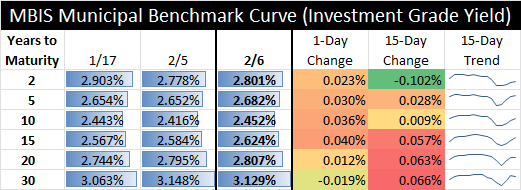
The interest rate table above illustrates recent changes in a sample of MBIS “investment grade” yields. Every issuer’s credit is different, and other financing sources may be available. To obtain comprehensive Financial Advisory services for your local government, contact your Ranson Financial Municipal Advisor, Larry Kleeman, or Henry Schmidt.
Leaders to consider new hearing process for some violations of Douglas County’s animal code
Douglas County leaders will soon consider a new process for enforcing the county’s animal code — specifically, for handling cases where people with animals that are dangerous or a nuisance have repeatedly failed to comply with the rules. At their meeting on Wednesday, county commissioners will consider implementing an administrative hearing process for animal code violations to either enforce citations or provide other avenues to resolve complaints. Currently, there are no formal sanctions or fines for violating the animal code, and cases are exclusively resolved through a process facilitated by the Lawrence Humane Society, which the county has contracted with since 2022 to enforce the code in unincorporated areas of the county.
Source: LJWorld
Grow Hays’ “Secret Sauce”
Throughout the state, Grow Hays is recognized as unique and Executive Director credit’s this to a “secret sauce,” the organization’s strong relationships with municipalities, governing agencies, the business community and with individuals and organizations within the Community who do not provide funding, such as USD489.
Source: Hays Daily News
Lawmakers eye school finance policy change: Law would help growing districts, hurt shrinking ones
A controversial proposed change to school finance law would benefit district with growing enrollment while hurting ones with declining enrollment. Legislators are considering House Bill 2485 and Senate Bill 386, which would require school funding to be based on the current school year or the preceding school year. The Senate version could be passed out of a committee this week.
Source: CJonline
Municipal Bond Trends for February 5, 2024
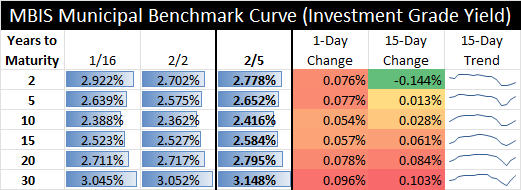
The interest rate table above illustrates recent changes in a sample of MBIS “investment grade” yields. Every issuer’s credit is different, and other financing sources may be available. To obtain comprehensive Financial Advisory services for your local government, contact your Ranson Financial Municipal Advisor, Larry Kleeman, or Henry Schmidt.