

Kansas Municipal News
Wichita launches $5 million program to boost affordable housing supply
As housing supply remains stubbornly low throughout Wichita, low-to-moderate income households remain particularly impacted. The city announced Thursday an initiative aimed at increasing affordable housing options in the city’s core, through a $5 million investment in the creation of the Affordable Housing Fund program. AHF provides an avenue for developers and contractors to buy and rehabilitate homes that can then become viable and accessible to low-to-moderate income individuals and families — either as rentals or houses available for purchase. “The program will develop safe, healthy and affordable housing options for income-qualified residents,” a news release said. In early May, the city plans to issue a Request for Proposal that will allow qualified applicants to submit offers to buy available units within the program pilot areas, propose a per-unit scope of work for needed renovations of existing affordable housing units, request up to $40,000 per housing unit for renovation or purchase, and ask for project-based voucher assistance. Sarah Gooding, city real property section manager, said during a Thursday media briefing that the pilot locations are between North 25th and 26th Streets, largely along Minnesota, Ash and Piatt; and near Meridian and Pawnee, primarily along Haskell and St. Clair.
Source: Wichita Business Journal
Municipal Bond Trends for April 12, 2024
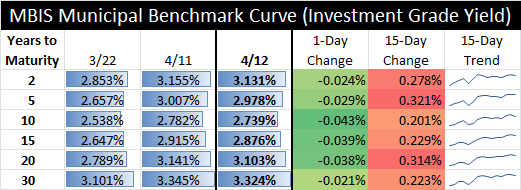
The interest rate table above illustrates recent changes in a sample of MBIS “investment grade” yields. Every issuer’s credit is different, and other financing sources may be available. To obtain comprehensive Financial Advisory services for your local government, contact your Ranson Financial Municipal Advisor, Larry Kleeman, or Henry Schmidt.
66,000-square-foot Immaculata Church is a draw to City of St. Mary’s
The impact of the building stretches beyond the town of St. Marys, population 2,749. On an average weekend, about 4,000 people attend the four Masses celebrated at Immaculata. “Not only has it already drawn many people here from other SSPX chapels, but it has also drawn more Catholic souls here who are learning about tradition,” said Father Patrick Rutledge, who has served as rector of the parish for eight years. “It has also drawn even many non-Catholics to come and see what the Catholic faith and the worship of almighty God is all about.”
Source: Salina Journal
Here’s how officials are working to make Topeka ‘the ideal site’ for new aviation jobs
Wichita has long been known as the Air Capital of the World. Efforts are taking off to likewise turn Topeka into a key center of operations in the aviation industry. The Metropolitan Topeka Airport Authority and economic development officials here are teaming up to work to create an environment aimed at bringing hundreds of aviation jobs to Topeka, The Capital-Journal was told recently by Curtis Sneden, director of economic development for the MTAA.
Source: CJonline
Municipal Bond Trends for April 11, 2024
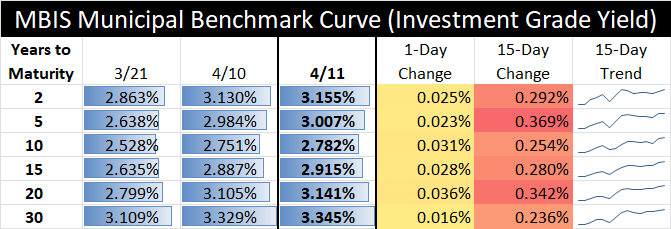
The interest rate table above illustrates recent changes in a sample of MBIS “investment grade” yields. Every issuer’s credit is different, and other financing sources may be available. To obtain comprehensive Financial Advisory services for your local government, contact your Ranson Financial Municipal Advisor, Larry Kleeman, or Henry Schmidt.
Municipal Bond Trends for April 10, 2024
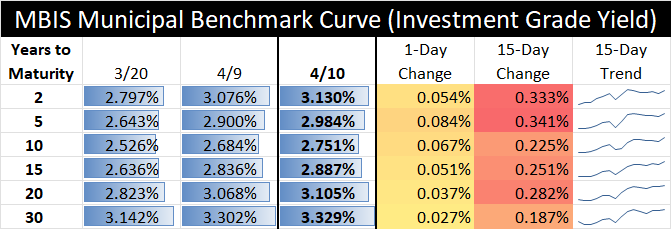
The interest rate table above illustrates recent changes in a sample of MBIS “investment grade” yields. Every issuer’s credit is different, and other financing sources may be available. To obtain comprehensive Financial Advisory services for your local government, contact your Ranson Financial Municipal Advisor, Larry Kleeman, or Henry Schmidt.
Hot inflation data pushes market’s rate cut expectations to September
As recently as January, investors had high hopes that the Federal Reserve was about to embark on a rate-cutting campaign that would reverse some of the most aggressive policy tightening in decades. Three months of inflation data have brought those expectations back down to earth. March’s consumer price index report Wednesday helped verify worries that inflation is proving stickier than thought, giving credence to caution from Fed policymakers and finally dashing the market’s hopes that the central bank would be approving as many as seven rate cuts this year.
Source: CNBC
Public works director made interim city administrator of Hiawatha
Public Works Director Brad Scott was made Interim City Administrator based on approval by all city commissioners at the end of Monday’s City Commission meeting. In the meanwhile as Scott serves in the interim position, he will also advertise the city administrator position. Mayor Becky Shamburg congratulated Scott for accepting the position.
Source: City Government | hiawathaworldonline.com
North Newton changes marijuana possession from misdemeanor to infraction
People caught with a small amount of marijuana in their vehicles in North Newton will be issued a traffic infraction ticket if this is their first offense. North Newton City Council members unanimously passed 4-0 an ordinance amending the uniform public offense code for possession of marijuana on Monday night. Councilman Dennis Campbell was not at the meeting.
Source: Harvey County Now
Merriam latest JoCo city poised to tighten rules on AirBnbs
The Merriam City Council on Monday mostly expressed interest in stricter regulations for short-term rentals — such as AirBnbs or Vrbos — within the city. This comes about a month after the city of Fairway approved stricter regulations for short-term rentals. Currently, Merriam treats short-term rentals the same as regular rental units, subjecting short-term rentals to landlord licensing and rental inspection requirements.
Source: Johnson County Post
Shawnee agrees to loan money to 2 new downtown businesses
Shawnee City Council approved two forgivable loans for new businesses coming to the area…. Both loans come from the Shawnee Entrepreneurial and Economic Development grant program (SEED, which is a city-run program that provides one-time payments in the form of forgivable loans to businesses as part of the city’s efforts to encourage expansion of existing businesses and attraction of new employers, according to city documents.
Source: Johnson County Post
Bonner Springs creates STAR bond district for 180-acre Mattel theme park
The Bonner Springs City Council laid the groundwork for tax incentives to support the development of a $490 million Mattel-themed entertainment hub near the Kansas Speedway. On Monday, the City Council unanimously approved the creation of a new sales tax revenue (STAR) bond district to support the potential creation of a Mattel-themed amusement park, three new hotels, a Christmas village and various other entertainment spaces.
Source: Kansas City Business Journal
Kearny County students learn about fentanyl prevention
Students in Kearny County learned about fentanyl prevention April 3 in two presentations, one at Lakin High School and the other at Deerfield High School. The 45-minute assemblies featured a new DARE fentanyl curriculum designed to teach students good decision-making skills that will help them lead healthy lives and cope with high-risk circumstances including drugs like fentanyl. The Kearny County assemblies were two of the first presented in the state of Kansas using the new fentanyl prevention curriculum. Presenters included Randy Combs, Kansas Attorney General’s office Statewide DARE Program coordinator; DARE officers, Deputy Kyle Carlisle and Detective Garnett Hartman; and Kearny County Emergency Management Director Jared Webb.
Source: Garden City Telegram
10-year Treasury yield jumps back above 4.5% after March inflation tops estimates
U.S. Treasury yields were little changed Wednesday, as investors looked out for the release of U.S. consumer inflation data later in the day, which could signal the outlook for interest rates. At 7:05 a.m. ET, the yield on the 10-year Treasury was almost flat at 4.358%. The yield on the 2-year Treasury was last at 4.739% after dipping by less than one basis point. Yields and prices move in opposite directions, and one basis point is equivalent to 0.01%. Investors awaited fresh inflation figures, as uncertainty about the path ahead for Federal Reserve monetary policy, specifically for interest rates, has grown in recent weeks. The consumer price index for March is due out on Wednesday, ahead of the producer price index that will be released on Thursday. Economists surveyed by Dow Jones are expecting the CPI to have risen by 0.3% from the previous month and by 3.4% from the previous year. This would be a 0.2 percentage point increase, compared to the February reading of 3.2%. Core CPI, which strips out more volatile food and energy costs, is expected to have hiked by 0.3% on a monthly basis and by 3.7% on the year. Investors are closely watching the data for hints about if and when the Fed will cut interest rates this year, after recent economic reports and comments from policymakers cast doubt over expectations that multiple rate trims will take place in 2024.
Source: CNBC – Bonds
Mulvane relaunching farmers market in April
The Mulvane community will once again have a farmers market, with the Market on Main set to start for the season on April 14. It will be set up on Prather Street in downtown Mulvane, adjacent to Nessly Auto Park. Farmers, crafters, makers, home-based merchants and more will be taking part. Market dates are set for the second Sunday of each month, from 1-4 p.m., through October. Vendors are still sought, and those looking to sign up or for more information can visit mulvanechamber.com.
Source: Derby Informer | Area
City of Wichita settles lawsuit for police department targeting people of color on gang list
Tuesday morning, the Wichita City Council approved a settlement in a lawsuit its facing for the police department targeting people of color on its gang list. The federal lawsuit was filed in 2021 by Progeny, a local juvenile justice group. According to the lawsuit, WPD’s gang list includes 5,200 people, 1,700 active members, 3,000 inactive, and 221 gang associates. The suit claims police target people on the list with frequent stops and searches over minor traffic violations. It also says there’s a minimum bail of $50,000 if charged with a violent crime. It states black people make up 60% of Wichita’s gang list, Latinx make up 25%, and white people make up 6%. “This was something that I cared about before I was on council and it’s an opportunity to reform it,” said Wichita city council member Brandon Johnson when talking about why he was glad the city reached this settlement Tuesday. He says the current state statute makes it too easy for someone to be listed as a gang member, and he thinks this is a step in the right direction. “We had some business leaders who were on there and were concerned about their records and being labeled gang members there. They haven’t had that type of gang activity for decades,” said Johnson when talking about how someone could be on the list even if they were no longer active, simply because they had a past or they knew people involved. Under the settlement, the city will pay $550,000, as well as make some changes to its system.
Source: KAKE – News
Wichita school board moving ahead with long-range building plan
Wichita school board members had discussions Monday night on the next steps for a long-range master plan for the buildings in the school district. The board is looking at next steps after the planned closings of two middle schools and four elementary schools. The plan is looking at a mix of actions including rebuilding, renovation, consolidation and maintenance. A recent community survey identified the top priorities as optimizing and upgrading school buildings to address building needs and enhance the learning experience. The board will have public comment sessions on April 22nd and 23rd to get input on the building plan. There will be two meetings each day. On April 22nd, there will be a meeting at 5:30 p.m. at the administrative center, and at 7:30 p.m. at Brooks Middle Magnet School. On the 23rd, there will be a session at 5:30 p.m. at West High School, and at 7:30 p.m. at North High School. Parents have been circulating petitions to urge the board to reverse its decision to close the Hadley and Jardine middle schools, and the Clark, Cleaveland, Park and Payne elementary schools.
Source: 101.3 KFDI
Haysville hopes new playground will convince residents to keep 1% sales tax for parks, roads
Monday was a big day for Haysville kids like Aspen and Adrianna after patiently waiting for months to finally get to try the brand-new playground at Riggs Park. “My mom and dad said we would come here on the opening day of the park,” said Aspen. “We were going to come to the park. We planned it,” said Adrianna. With a cut of the ribbon, Haysville Mayor Russ Kessler says hundreds of kids spent the day on the new playground with smiles from ear to ear. But he says equipment like this doesn’t come cheap. “Roughly $300,000. And that’s included with the pour-in-place ground,” said Kessler. Kessler says the playground is made possible by something that’s coming up for a vote in Haysville for the first time in ten years: a 1% sales tax the city uses to improve roads and parks. “It’s pretty awesome. You know, I’ve never seen it this crowded, so you know the kids really enjoy it,” said resident Ronnie Kinnamon. Some residents are on the fence about whether they want to extend the 1% sales tax in May, but people like Kinnamon say after seeing his grandson having so much fun Monday, he hopes voters won’t cut the funds. “It’s good for the kids. Anything to keep the kids occupied so they’re not into other things that they shouldn’t be doing, you know,” said Kinnamon. And it may come as no surprise that the kids agree.
Source: KAKE – News
‘Drinking zones’: Topeka Common Consumption Areas open soon
Topeka residents will soon be able to consume alcohol in public in two new parts of town. Starting on April 15, bar patrons in the downtown and North Topeka Arts District (NOTO) areas will be able to bring their drinks outside of the establishment. Common consumption areas (CCA) will be marked with signage designating the area and times that drinking is permitted. The CCAs will be open from 8 a.m. to 11:59 p.m. seven days a week. Individuals must purchase drinks from licensed establishments and not bring alcoholic drinks into the CCA areas. “Common Consumption is a natural evolution of our continued development efforts to support businesses while providing exciting environments for Topekans,” said Councilman Spencer Duncan. “Topeka isn’t just putting this in place here but also led the effort at the state level that is now bringing it to all Kansans, as other communities implement it. It continues our commitment to listening to our citizens and businesses and working with them to be a premier Capital City.” The downtown CCA will encompass Fourth Street on the north, 10th Avenue on the south, Quincy Street on the east and Jackson Street on the west.
Source: KSNT 27 News
Community feedback on Central Topeka Grocery Oasis
A food desert in Topeka is one step closer to being no more. Tuesday, Central Topeka Grocery Oasis held a public meeting to get feedback on what people are looking for in a new grocery store. The Dillons on Huntoon and Washburn closed in 2016. Since then there’s been a need in the community for a grocery store. Fast forward to 2018, a group of neighbors started working on this project to make that a reality. Now, with property purchased on 12th and Washburn, that grocery store is creeping its way into the market. That brings us to today. From the layout of the store to the food options inside, community members met at Mt. Olive United Methodist Church to give feedback on what they want to see when the doors open. “Our number one priority is for Topekans outside of central Topeka as well to know that this store is for the community,” Central Topeka Grocery Oasis Vice Chair James Monson said. “We are working closely with consultants and the architect and engineers to design what we think is the perfect store. But the reason we’re hosting this event is so that we can gather feedback from the community.”
Source: KSNT 27 News