

Kansas Municipal News
Mission latest JoCo city to consider stricter short-term rental rules
The city of Mission may limit how many short-term rental licenses can be issued to a single owner. … Other cities like Fairway, Merriam and Shawnee have all adopted ordinances this year regulating short-term rentals in some way. Prairie Village is also looking into requiring all rentals in that city to have a 30-day stay minimum, which would effectively ban short-term rentals in that city.
Source: Johnson County Post
Centralized campuses are a common answer to the homeless crisis. Wichita has plenty to learn from
The multiagency center, or MAC, will be new to Wichita, but the concept of it — a dual resource center and shelter — has been tried and tested for years in cities across the country, from Eugene, Oregan to Bowling Green, Kentucky. In hopes of answering residents’ questions, The Journal connected with similarly-operating navigation centers in three cities — San Antonio, Phoenix and Reno, Nevada — to learn more about how their resource got started and the impact it has made on its community.
Source: KLC Journal
Crawford County residents provide feedback on U.S. 69 Highway study
“A generational highway” that was the reaction of one Crawford County resident after attending the U.S. 69 highway study meeting in Pittsburg today. “Yeah, I think this is an interesting process that they’re doing, sharing with us information, and then gathering information from us,” said Belinda Brumfield, Crawford County resident. Belinda Brumfield is one of many Crawford County residents who attended the second round of the Kansas Department of Transportation’s U.S. 69 highway study meeting.
Source: KSNF/KODE
Topeka proposes TPD pay increase to address officer shortage
The City of Topeka is trying to address a shortage of police officers by offering more competitive pay. The city budget manager said there’s a shortage of 40 officers, and that there’s a growing pay gap for officers in the Topeka Police Department (TPD) compared to similar cities. Robert Perez, Topeka’s city manager, said addressing the officer shortage is a high priority. He says currently the city is forced to rely on cops working overtime.
Source: KSNT 27 News
Wichita to step up efforts to reduce water use
The City of Wichita will be asking residents to do more to reduce water use in order to hold off mandatory water restrictions. Public Works Director Gary Janzen talked about a “call to action” during a workshop meeting Tuesday with the Wichita City Council. He said the plan is for the city to restrict its own water use, while calling on residents to take voluntary steps, and there will be a proposal to raise water rates for higher volume users. Janzen said the goal is to reduce water consumption by ten percent. He said the city historically sees an increase in water use during the months of July, August and September, and now is the time to change course and change habits. The plan will have the city stepping up restrictions on water use at its public facilities and parks, to follow stage two of the city’s drought response plan. The city is not officially going to stage two, which would have mandatory restrictions, but residents will be urged to take voluntary steps to reduce their water use. Residents will be asked to reduce outdoor watering and limit watering to one or two times per week.
Source: 101.3 KFDI
Clearing up confusion around solar ban
At a recent Harvey County Commission candidate forum, a question was posed: how does a solar farm operate in the county, with a ban on solar farms? The question came after candidates were asked if they supported the wind and solar ban currently in place in the county. Kyle McCaskey, the communications director for the county, said that the solar farm near East Lake is on private property, not county property. McCaskey said it’s run by Butler Electric Cooperative. Karen Rothe, director of the planning, zoning and environment department, provided further information about regulations for private solar farms or projects in the county. Rothe said it wasn’t a complete ban. The ban only applies to commercial wind and solar, not private landowners. According to the county’s website, the ban only applies to unincorporated areas of the county. According to Rothe, the solar farm in question was in line with current regulations. She added that the solar farm by East Lake had even been used as the model by the planning commission to determine solar regulations in the county. “We haven’t had any complaints about that solar project,” Rothe said. For private landowners, there are still regulations. A solar farm must not be more than 10 acres, and the main use of the solar must be personal use. A portion of the electricity produced must be used in Harvey County. “You can’t just hook it into the electric grid and send it off to Florida where Harvey County sees none of it,” Rothe said.
Source: Harvey County Now
Task force hoping for full-time child care coordinator in Harvey County
With a large gap in child care options in the county, a child care task force hopes a dedicated employee could lead the charge in finding solutions. The task force is working to address issues around child care in the county. According to Child Care Aware of Kansas, the county currently can only fulfill 25 percent of the potential child care slots needed and needs up to 1,400 more child care slots. In the past, they reached out to child care providers to learn what their biggest issues and needs were. Now, to be as effective as possible, the task force said they need to hire someone to focus on meeting the community’s needs full-time. “A lot of what we’re doing is out of our normal 9 to 5 work,” said Dalton Black, director of Harvey County United Way, who is also on the task force. After receiving responses from child care providers from a survey they sent out, Black said they have some ideas of how to make changes to serve them and the community better. Some of the top issues child care providers listed in their survey were food costs, staff retention, paying staff salaries, facility maintenance and training certification. They feel it would be best to have a coordinator in charge. “We’ve followed other communities and what they’re doing,” Black said.
Source: Harvey County Now
In SMSD, one school raised $610,000 in donations, while another took in $300. Is that fair?
Donation statistics presented to a special committee Friday by Shawnee Mission School District administrators showed a lopsided giving advantage when it comes to the district’s wealthiest schools.
But whether that disparity is resulting in more staff positions or better educational outcomes for those schools gifted more money wasn’t clear. It’s also not immediately clear if the district plans to do anything to address the gaps among schools. Over the previous three school years, about 80% of donations dedicated to a particular school — funds brought in through traditional PTA fundraisers, as well as more direct gifts like checks written by parents and grandparents — went to schools with less than 20% of students on free or reduced lunch, according to administrators.
That is nearly $2.4 million going to 16 schools. By comparison, 31 other schools in the district that have 20% or more of their students on free or reduced lunch received just shy of $550,000 combined. The differences grow more stark when broken down by feeder pattern. Schools in the Shawnee Mission East feeder pattern led donation totals by a wide margin, receiving $2.15 million overall. That’s more than twice the district’s four other high school feeder patterns combined. SM North’s feeder pattern was a distant second with $250,000 in donations, followed by SM Northwest with $195,000, SM South with $149,000 and SM West with $110,000.
Source: Johnson County Post
Citizens ask for limited zoning in Bourbon County
Bourbon County Commissioners on Monday learned more about a topic that has cropped up during discussions on solar panel developments – limited zoning. Commissioners have discussed zoning in recent months and have also been asked by citizens to consider adopting limited zoning as it relates to certain land uses. Commissioners have discussed both sides of the debate on solar panels, and heard from landowners who oppose the developments for various reasons.
Source: Fort Scott Tribune
JoCo OKs $3.7M to renovate Lenexa hotel into homeless shelter
The proposed homeless services center at a repurposed Lenexa hotel took another step forward last week, as a majority of county commissioners agreed to fund $3.3 million in renovations. The commission also voted to approve a 10-year agreement with reStart Inc., the Kansas City-based nonprofit tasked with operating and ultimately owning the shelter. Commissioners considered whether to use federal Housing and Urban Development funds for the renovations, but rejected the idea because of the added cost and extended time period. Using a HUD grant would require an environmental impact statement that could take up to two years to complete, and the sale of the hotel and nearby restaurant depends upon closing by the end of October. HUD money also would drive the cost of renovations to $4.86 million and require a remediation plan for noise, radon and soil contamination. The Kansas Department of Health and Environment has already monitored the site and determined the levels are safe, said Assistant County Manager Joe Connor. Instead, the money will come from COVID relief funds that are a part of the county general fund.
Source: Johnson County Post
City of Bentley entering Stage 1 of water conservation plan
The City of Bentley is entering Stage 1 of its water conservation plan. Bentley City Administrator Tim Bryan said the town is one of the few communities to purchase raw water from the City of Wichita. Wichita is planning for Stage 2 status and has been in Stage 1 since January 2023. Gary Janzen, the director of Wichita Public Works and Utilities, said Tuesday that projections indicate Wichita will reach Stage 2 criteria by Aug. 1. If the Wichita city manager issues a public declaration of Stage 2, residents will only be allowed to water lawns one day a week. The City of Bentley said Stage 1 is a voluntary effort and focuses on education and water-saving tips. “We want to be responsible partners with Wichita and good stewards of this finite resource,” Bryan said in a news release.
Source: KSN-TV
Sedgwick County commissioners looking for new way to fund arts and culture services
A plan to fund arts and culture services in Sedgwick County through a sales tax continues to move forward. Currently, arts and culture services are paid for with property taxes. County commissioners are trying to come up with a way to lower property taxes while funding community-centered programs. Commissioner Jim Howell thinks such a plan may need to get approval from the state legislature but says it could be a way to keep funding going without ever touching property taxes. He says property taxes should only fund core government and public safety services and is proposing a one-eighth-cent sales tax to pay for everything else. “If the economy thrives and there’s growth in the economy, then the sales tax generates more money, and that eighth of a cent generates more money they can share between, and we would have to have some type of advisory board that would create recommendations for it to be adopted by the commission on how that money should be split up,” Howell said.
Source: KSN-TV
The ‘Big Ditch’ prevents major flooding in Wichita. Could it serve another purpose?
Eighty years ago this spring, the Little Arkansas River spilled out of its banks in a way that spelled big trouble. Swollen by heavy rain, the river and nearby Chisholm Creek drove an estimated 5,000 Wichitans from their homes, washed out bridges and covered much of downtown. In Riverside Park, the historic Park Villa building was surrounded by acres of water four feet deep. In the stockyards along 21st Street, workers loaded 4,000 hogs onto railroad cars to keep them from drowning. To the north, Valley Center and a swath of Sedgwick County were under water. Flooding was blamed for two drownings and two fatal heart attacks. The deluge overshadowed news from World War II for a few days, although flooding in Wichita was nothing new. Large areas of the city had been submerged during floods in 1877, 1904, 1916 and 1923. The 1944 flood was only different in that it convinced local leaders that something had to be done, probably because the city had nearly doubled in size during the war years and the potential for damage was so much greater. But the proposed solution — what came to be known as the “Big Ditch” — was controversial.
Source: Local News | Wichita Eagle
As drought deepens, Wichita is poised to double rates for biggest water users
Wichita could soon raise rates for its high-volume water users as it ramps up its response to the drought. Next month, public works director Gary Janzen will present the City Council with a proposal to roughly double rates for tier two and three water customers, which would largely affect businesses that get their water from the city. Most residential customers would not be affected by the proposed rate changes. Only 18% of residential customers ever reach tier two (more than 110% of average winter consumption) and only 2% reach tier three (more than 310% average winter consumption), according to data provided by Janzen at a council workshop Tuesday, Wholesale customers — including the cities of Derby, Valley Center and Bel Aire — also would not be affected.
Source: Local News | Wichita Eagle
Lawrence Police Department, DOJ to hold community partnership workshops
The Lawrence Police Department, working with the Department of Justice, will hold two half-day workshops “where DOJ facilitators hope to improve trust and develop partnerships between police and community members.” The program’s goals are to improve trust and develop partnerships between law enforcement and the community, engage in dialogue to identify issues and solve problems collaboratively and address longstanding community distrust and historical barriers, according to a flyer about the workshops. “I’ve always said I want our officers to police our community the way the people want to be policed,” Chief Rich Lockhart said in the release. “When I heard the Department of Justice facilitates a program to help strengthen our partnerships and continue the dialogue moving us in that direction, I knew they were the experts to bring on board.”
Source: The Lawrence Times
Lawrence school district administrators say cell phone ban in draft handbook was a mistake; board approves teacher raises
A districtwide cell phone ban was included in a draft of an updated student handbook, but Lawrence school district administrators and board members made some clarifications on Monday. Students aren’t to have their cell phones out while they’re in class across the district. Elementary and middle school policies don’t allow students to use their phones at all during school hours unless granted permission. High school students, however, are still permitted to use their phones outside of class time. The handbook draft originally included in the school board meeting agenda for Monday said that “students found using their phone during school hours without permission will be required to check their phone in and out of the office each day,” and phones “must be turned off before entering the building and remain in their backpacks until dismissal.” Between Monday morning and the evening meeting, that original draft was replaced with a redlined copy. The handbook was also reclassified from a consent agenda item — which would typically be approved in one motion with no discussion — to a new business item. Previously, the district used separate handbooks for elementary, middle and high schools. Jayci Roberson and Waymond Ervin, who are the district’s new director of elementary schools and director of secondary schools, respectively, said they noticed all were very similar. Consolidating them into one would hopefully create better alignment across the district, they told the board. “That increases our consistency, as far as communication with our community, our students and our staff,” Ervin said.
Source: The Lawrence Times
Municipal Bond Trends for July 23, 2024
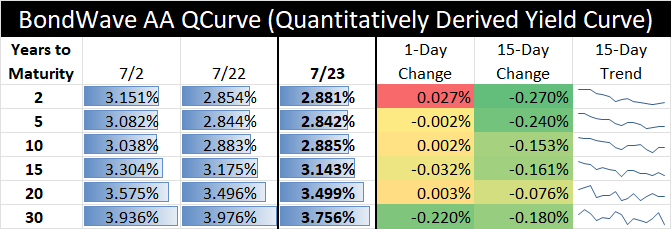
The interest rate table above illustrates recent changes in a sample of AA rated bond trades reported to the Municipal Securities Rulemaking Board’s EMMA® system. Every issuer’s credit is different, and other financing sources may be available. To obtain comprehensive Financial Advisory services for your local government, contact your Ranson Financial Municipal Advisor, Larry Kleeman, or Henry Schmidt.
Municipal Bond Trends for July 22, 2024
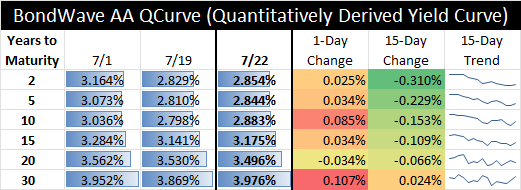
The interest rate table above illustrates recent changes in a sample of AA rated bond trades reported to the Municipal Securities Rulemaking Board’s EMMA® system. Every issuer’s credit is different, and other financing sources may be available. To obtain comprehensive Financial Advisory services for your local government, contact your Ranson Financial Municipal Advisor, Larry Kleeman, or Henry Schmidt.
Manhattan city manager candidates to meet with public Monday
Finalists for Manhattan city manager will meet with residents of the city on Monday from 4:30 to 6 p.m. at the Flint Hills Discovery Center. The list of the four finalists for the position of Manhattan city manager have been released to the public and they’re coming to Manhattan to meet with the public and commissioners next week. … The finalists are Jacob J. Wood of Salina, Jaime Miller of Paris, Kentucky, Jason Gage of Springield, Missouri and Danielle Dulin of Warrensburg, Missouri. Both Wood and Dulin are K-State graduates.
Source: themercury.com
Cyber outage affects Wichita, Sedgwick County
A worldwide cyber outage affected computer systems across the U.S. and around the world, with impacts on airlines, banks and other systems. The issue was apparently triggered by a software update from the CrowdStrike cybersecurity firm. The CEO of CrowdStrike said they were “actively working with customers” globally and that a fix was being deployed. CEO George Kurtz added that “this is not a security incident or a cyberattack.” In Wichita, the outage affected records systems for the Police Department, along with other systems. Sedgwick County closed its tag offices because of the outage. The county treasurer’s office is open, but it was only able to process payments by check or cash for customers with their bill in hand. Treasure Brandi Baily said the motor vehicle system is on the state software and that was still down Friday morning, so the tag offices were closed. The county’s chief information officer, Mike Elpers, said the software update had a negative impact on all Windows devices. He said about 75 to 80 percent of the county’s work stations received the update. Elpers said his staff worked throughout the night late Thursday into Friday morning to get systems back online, and he said they were making good progress.
Source: 101.3 KFDI