

Kansas Municipal News
Garden City launches Citizens Academy program for 2023
Garden City has announced the return of its popular Citizens Academy program, which will take place from March 23 to May 11. The free, eight-week course is open to all Garden City residents who want to learn more about services provided by the city and its daily operations. The program gives people a behind-the-scenes look at what happens within the City on a daily basis and helps them better understand how their community is run. The Citizens Academy program will be led by City staff and includes tours of facilities, as well as group activities. Participants will have the opportunity to engage with City leaders and staff, ask questions, and learn about the various services and programs provided by the City.
Source: KSN-TV
‘Fund the Field’: McPherson schools announce matching fundraiser opportunity
On Friday, the McPherson Public Schools Capital Campaign committee announced that there will be a $100,000 matching funds opportunity for their “Fund the Field” capital campaign project. This campaign was put together to help fund a new outdoor facility at McPherson High School. This includes a regulation artificial turf soccer/football field and an eight-lane track.
Source: KSN-TV
The Parsons Police Department is rolling out a new program
A new community outreach program is in the works for a local police department. The “Parsons Police Department” is rolling out a new program called “R-U-O-K”. The computerized system is geared toward helping people with medical conditions, mental health, and well-being concerns, as well as those who are at high risk for falls. They can add information like address, medical history, and emergency contacts. The system then makes daily automated calls to check in on anyone enrolled in the program.
Source: KSNF/KODE
Shawnee County 911 calls could change
Shawnee County commissioners plan to vote on a program that could change how 911 calls are fielded. 911 calls have a wide range of resources needed, and in the past valuable resources have been sent to a caller’s location, when they were needed more somewhere else. The Nurse Navigation Program changes that. The program was created by the American Medical Response to give everyone calling 911 the proper care. If the call is determined a lower equity call, meaning a lower-tiered emergency, such as illness or non-life-threatening injuries, then they will be put in touch with a nurse navigator to walk them through the best steps for their care.
Source: KSNT 27 News
Lenexa’s Sar-Ko-Par Trails Park to get major facelift this summer
Lenexa will go ahead with upgrades to Sar-Ko-Par Trails Park on 87th Street Parkway. The work will reimagine the Indian Trails Aquatic Center, add new parking and sidewalks throughout the 51-acre park and update the aging skate park. Last week, the Lenexa City Council voted unanimously to greenlight three separate projects related to the park on the city’s capital improvement project list valued at a total of $17.3 million.
Source: Prairie Village Post
Coffey County tapped for computer chip plant
Kansas Gov. Laura Kelly announced Monday that EMP Shield, a Burlington-based company that specializes in protecting electronic devices from destructive magnetic pulses, plans to invest $1.9 billion in a computer chip manufacturing facility in rural Coffey County. The facility will create more than 1,200 jobs averaging $66,000 annually, Kelly said at a news conference. EMP Shield will build its facility on 300 acres in near Beto Junction in northern Coffey County.
Source: The Iola Register
Gov. Kelly Announces Airport Improvements
Governor Laura Kelly announced that 66 airport projects across the state have been selected for Kansas Airport Improvement Program (KAIP) funding for planning, constructing, or rehabilitating public-use general aviation airports. “Whether it be airplane manufacturing, a link in the supply chain logistics, or travel, the Kansas aerospace industry is an essential part of our state’s economy,” Governor Laura Kelly said. “These grants ensure the safety and longevity of Kansas airports, all while contributing to economic growth and job creation.” The aviation industry represents over 120.6 billion in economic impact across a broad spectrum of supply chain and manufacturing industries in Kansas.
Source: Andover American
Could county level income taxes solve the property tax problems in Kansas?
One Kansas lawmaker thinks county-level income taxes are the answer to sparing Kansans the burden of ever-increasing property taxes. Sen. David Haley, D Kansas City, calls the proposal, SB 79, an earnings tax and says it’s based on the system in Kansas City, Missouri. Under the proposal, county residents would have to approve the up to 1% tax by vote. “We contend that a majority of anyone in a taxpaying entity, or that county, should be allowed to vote,” Haley told the Senate Assessment and Taxation Committee Monday morning. “This would be triggered by the vote of each county, as to whether or not this would be imposed. And it would be put before the electorate every so often – in 10 years.” Half of the money raised would go to lower property taxes in that county.
Source: KAKE – News
Dwarf Goats: One Man’s Idea for Saving a Town in Rural America (Wilson, KS)
The former mayor of Wilson, Kan., believes he can lure travelers off Interstate 70 to see a collection of frolicking goats; he is butting heads with skeptics. Like many visionaries, David Criswell can’t say exactly how he dreamed up his big idea. Yet after chewing it over, Mr. Criswell, the former mayor of Wilson, became convinced he could milk a roadside attraction starring Nigerian dwarf goats clambering up and down a cluster of grain silos. “I’m going to bring people to town with these goats,” Mr. Criswell said. He anticipates herds of travelers pulling off Interstate 70 to visit his towering dwarf-goat playground. “Visually entertaining,” Mr. Criswell said, and a boost for local business. He envisions visitors buying souvenirs, meals and gas.
Source: Wall Street Journal
USD 252 superintendent interviews to start next week
The USD 252 Board of Education will start interviewing superintendent candidates next week, following a special meeting on Tuesday to review applications. According to board president Emily Darbyshire, interviews are set to begin Tuesday, Feb. 21. Information about the candidates will be released Tuesday morning. Outgoing Superintendent Michael Argabright announced his retirement effective June 30, 2023 last year. He’s led the district for more than 16 years.
Source: Emporia Gazette
Johnson County releases 2023 market study analysis, sees residential and commercial growth
Johnson County has released its Market Study Analysis for the Assessment Year 2023, examining the real estate market in the county – including both the residential and commercial markets. … The study found that nearly 90% of residential properties increased in value for 2023. The median single-family residential sale price rose 13.8% from 2021 to 2022, leading to an average increase in residential values of 12%. Commercial real estate also remained steady, specifically within the office and retail sectors. Overall, commercial values also increased at a rate of 12%.
Source: Johnson County Kansas |
After 43 years on the streets, Wichita police department’s ‘Dirty Harry’ retires
Chuck Loftis and another Wichita officer snuck on top of a pool hall at Ninth and Grove. It was the ‘90s and violent crime was skyrocketing as gangs fought over who could sell drugs where. A spotlight on the building kept the dealers below from being able to see them. They peered down, saw an exchange for crack and called in the description of the dealer to officer Robert “Bob” Bachman, who was down the road in a marked police car. Bachman pulled up. The dealer threw his crack and ran, but he didn’t get far, Loftis said. A man came out the door of the pool hall and yelled back inside: “Dirty Harry got Bobby,” Loftis recalls the man saying.
Source: Local News | Wichita Eagle
Should the Lawrence City Commission expand to 6 members plus a mayor? Voters will decide next year
Lawrence city commissioners approved one change to city government Tuesday night and set the stage for another potential big change, though that one will be up to voters to decide. Beginning with the 2023 general election, all Lawrence city commissioners will serve four-year terms. But how many commissioners the city will have, and whether we’ll have a directly elected mayor, will be up to voters to decide in November 2024. Commissioners also decided to ask city voters to weigh in on the city’s form of government in the 2024 general election. They passed a resolution that will put several decisions on the ballot, all wrapped up into one question.
Source: The Lawrence Times
Municipal Bond Trends for February 17, 2023
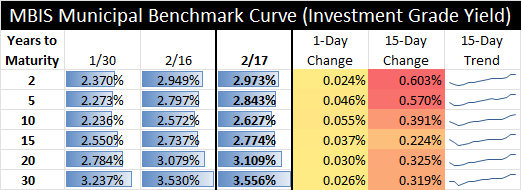
The interest rate table above illustrates recent changes in a sample of MBIS “investment grade” yields. Every issuer’s credit is different. For rates that may be applicable to your municipality, contact our Municipal Bond Advisors, Larry Kleeman, Beth Warren and Henry Schmidt.
Municipal Bond Trends for February 16, 2023
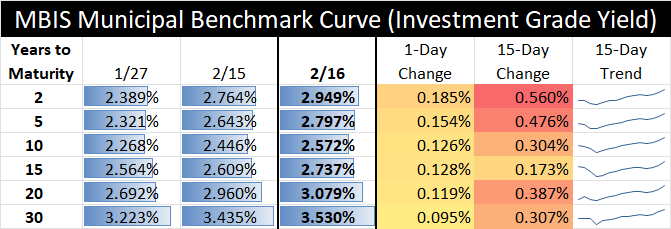
The interest rate table above illustrates recent changes in a sample of MBIS “investment grade” yields. Every issuer’s credit is different. For rates that may be applicable to your municipality, contact our Municipal Bond Advisors, Larry Kleeman, Beth Warren and Henry Schmidt.
Future uncertain for Walnut Valley Festival
The executive director of the Walnut Valley Festival confirmed comments he made recently on an area TV program that the beloved annual music event is struggling financially and its future is somewhat in doubt. Bart Redford, interviewed for an episode of “Positively Kansas” that aired Feb. 6, said the 51st festival will definitely be held in September, but there are no guarantees beyond that. “Where we go after that is an open question,” Redford told the KPTS. “We’re at a point where we’ve got to make it to continue on. No festival out there, no venture that you can think of, continues operating at a loss indefinitely.”
Source: Cowley CourierTraveler
Colorful murals to brighten downtown Dodge City
Dodge City was selected to receive a Community Challenge Grant from AARP Livable Communities and AARP Kansas to create murals in our historic downtown. The Dodge City Public Art Advisory Committee (PAAC) is proud to announce that the project is nearing completion. The PAAC has been working with talented artist, Efe Tekdemir from the design firm Gardner Design in Wichita, Kansas. Input gathered from community table days informed the direction of these three dynamic works of art that will infuse the area with color and excitement while honoring our city’s rich heritage and cultural diversity. The murals have been sent to Luminous Neon for test prints and final production should be underway soon. The murals will be installed at the same time, a process expected to take approximately two days.
Source: Dodge City Daily Globe
Manhattan discusses Parks and Rec cost recovery model
Manhattan’s Parks and Recreation Department updated the city commission with their proposed cost recovery model at their meeting Tuesday. The current model sorts all programs into one of five tiers. Tier 1 would consist of the programs with the most community benefit, and as the tier number increases, the programs become more individualized. The tiers are situated on a cost recovery pyramid indicating that programs with the most community benefit will require the smallest cost recovery percentage.
Source: 1350 KMAN
Kansas school administrators question bill adding school board members to district payroll
The hypothetical cost of implementing a Kansas House bill enabling local school districts to pay elected board members $20 per hour for a commitment of less than two hours a week would cost taxpayers $2.8 million annually. Adopting the change would break a 50-year precedent in Kansas law that made local school board members volunteers without a salary… Jim Karleskint, a former state legislator and Holton school superintendent … did raise with the committee a series of concerns. “In many school districts,” he said, “the superintendent is selected as the chief negotiator for the board. In years of limited fiscal resources, the board and the teacher’s association would be even more at odds when board members are receiving pay for serving on the board. We would envision board members would receive pay for days they are on board business. It is our concern this could be taken advantage of and resented by the community.”
Source: Atchison Globe Now
City commission discusses state incentives for additional housing in Salina
With the need for housing in the community not going away anytime soon, Salina continues to look for opportunities to make it easier for developers to build in the area. During its meeting Monday, the Salina City Commission discussed and ultimately decided to lend support for incentives for three housing developments in the community. Lauren Driscoll, the city’s director of community and development services, presented the commission with multiple resolutions to consider on the topic. “As you’re aware, we’ve been very much engaged in dealing how to provide more housing in Salina related to future employees (coming from) corporate expansion of some major employers as well as overall growth in the community,” Driscoll said.
Source: Salina Journal
Prairie Village looks to remake city hall and police HQ
Prairie Village is looking to either renovate or completely rebuild its city hall and also remodel the city’s police department headquarters next door. City staff presented three preliminary project options at a special city council session on Saturday that came with projected price tags for work on both buildings ranging from $29 million to $42 million. This comes as the city is also gauging public opinion on a new community center on the site of the aging Paul Henson YMCA, which sits directly south of the current city hall and police building.
Source: Prairie Village Post
Leawood’s new history book in the works for 75th anniversary
In celebration of Leawood’s 75th anniversary, the city is publishing a new history book later this year. The roughly 100-page book — loosely titled “Leawood — The Journey Continues” — will chronicle the city’s history from 1997 to 2022 from a variety of perspectives, from economic development to arts and public outreach. City staff is slating for a fall publication, after which time the book will be available for purchase.
Source: Prairie Village Post
House bill would repeal 50-year ban on compensating members of local school boards
The hypothetical cost of implementing a Kansas House bill enabling local school districts to pay elected board members $20 per hour for a commitment of less than two hours a week would cost taxpayers $2.8 million annually. Adopting the change would break a 50-year precedent in Kansas law that made local school board members volunteers without a salary, but the idea seemed to make sense to Rep. Kristey Williams, chair of the House K-12 Budget Committee. She said during a Tuesday hearing the legislation could serve as a token of appreciation for board members and affirm the value placed on work to improve education of children in public schools.
Source: Cowley CourierTraveler
Municipal Bond Trends for February 15, 2023
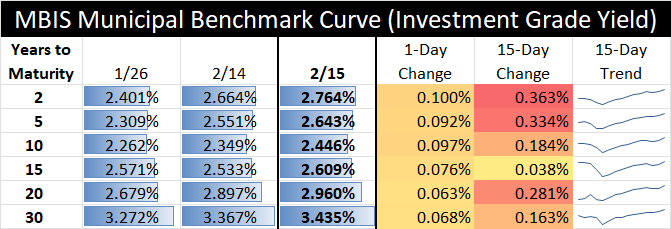
The interest rate table above illustrates recent changes in a sample of MBIS “investment grade” yields. Every issuer’s credit is different. For rates that may be applicable to your municipality, contact our Municipal Bond Advisors, Larry Kleeman, Beth Warren and Henry Schmidt.
Lyon County may use private entity for shelter services
Lyon County may be close to an agreement with a private entity for animal control services, Sheriff Jeff Cope told city and county commissioners Wednesday afternoon during a joint luncheon. Cope said he was not yet able to disclose who the private entity was, but said he expected a contract to come through to the Lyon County Commission in the coming week. “We would be able to address the quarantine issues for animal bites, vicious animals, court orders and things like that,” Cope said.
Source: Emporia Gazette
Uniontown: Improving Community Spaces Grant Available
“The Healthy Bourbon County Action Team (HBCAT) is gearing up for a placemaking project in Uniontown,” President and CEO Jody Hoener said. They are seeking Uniontown resident’s input for a grant to improve the small town of almost 300 people in Bourbon County. “We have a survey for community members to fill out,” Hoener said. … “We have already been working on Creative Placemaking projects in Fort Scott: the 3rd Street Park Improvements and the Downtown Arch projects,” Rachel Carpenter, Director of the The Center for Economic Growth at HBCAT, said. … “Some examples would be: park improvements, murals in an alley way, public space for studying or a public art sculpture about the place’s history,” Carpenter said.
Source: Fort Scott Biz
Zoning hurdles could face solar project
With many dangling details remaining, issues surrounding a planned solar farm in central Barton County were the topic of a County Commission study session Wednesday morning. All county officials know for sure is that developer Acciona Energy USA will soon seek zoning permits for the project and hope to be well into construction within six months.
Source: Great Bend Tribune
Hesston offers new communication method
The city of Hesston has added a new way to reach residents with information they could find helpful with an app that texts information to those who sign up. City clerk Jason Thrasher said city employees were researching a way to alert residents of timely issues when he came across Text.My.Gov a couple of months ago. Those who sign up for the free app get a text notifying them about anything going out in their neighborhood. “Anything people need to be aware of, this gives us a way to push things out,” Thrasher said.
Source: Harvey County Now
Upcoming regulations will see cities reaching out to homeowners
The Hiawatha City Commission met on Monday evening, and were addressed by Water & Lights Superintendent Brad Scott on upcoming lead and copper pipe regulations. Scott reported that the new clean water initiative will require cities to report on the number of lead and copper pipes in use, and to replace a certain percentage per year based on the percentage of lead or copper pipes running to residences in the city.
Source: hiawathaworldonline.com
Group in hopes of establishing a food corridor in central Kansas
The Kansas Rural Center is in the first of a three-year grant project to develop a cooperative food hub for 12 central Kansas counties along I-135, including Harvey, Sedgwick, Reno and Marion Counties. The project is just getting off the ground. According to Ryan Goertzen-Regier, program and administrative manager for the Kansas Rural Center, they received a grant from the USDA and started during the last quarter of 2022. He said they have funding for staff to work on the project for three years.
Source: Hillsboro Free Press
Partnership promises better response times in wrecks
A technology partnership between the sheriff’s office, Kansas 911 Coordinating Council, RapidDeploy, and OnStar was demonstrated for emergency responders and county commissioners Thursday. Adding the RapidDeploy mapping and OnStar communications to the enhanced 911 service the county already has will make it easier to get faster help at no additional cost to the county. Crash locations can be pinpointed as soon as a caller notifies dispatchers.
Source: HILLSBORO Star-Journal
Audit finds western Kansas keeps losing water, despite local efforts
Local agencies in western Kansas have had decades to slow the decline of the Ogallala Aquifer, but most areas had less water last year than they did a decade ago, according to an audit released Wednesday. The audit, which evaluated groundwater management districts, or GMDs, was released as a staggering drought and attention from the governor and Legislature bring renewed attention to the near-crisis state of water in western Kansas. Auditors found the agencies had little direction from the state and limited authority. “While they appear to operate within their current expectations, their overall role in addressing the state’s water situation is limited,” the audit says.
Source: Kansas Reflector
Local and regional Kansas airports receive funding for repairs and upkeep
Kansas Governor Laura Kelly today announced that some local and regional airports will receive Kansas Airport Improvement Program funding for repairs and upkeep. Officials with the state say funding is strictly for the planning, constructing, or rehabilitating public-use general aviation airports. “Whether it be airplane manufacturing, a link in the supply chain logistics, or travel, the Kansas aerospace industry is an essential part of our state’s economy,” Governor Laura Kelly said. “These grants ensure the safety and longevity of Kansas airports, all while contributing to economic growth and job creation.”
Source: KOAM News
Dogs could come back to Shawnee brewery if bill passes
Dogs could be allowed back inside Transport Brewery in downtown Shawnee if a bill in Topeka backed by a local lawmaker passes. Last summer, state regulators from the Kansas Department of Agriculture prohibited the brewery and others like it from having dogs inside its taproom, deciding the space fits the formal definition of a “food preparation” area. But a bill currently making the rounds in the Kansas House could change that.
Source: Prairie Village Post
Cities defeat efforts to restrict planning outside boundaries
Cities on Wednesday defeated legislative efforts to curb their ability to plan for development just outside their boundaries, an authority they said was important for ensuring orderly growth patterns. The House local government committee turned back a bill repealing the ability of municipalities to impose land-use requirements in a three-mile area just outside the city limits.
Source: Sunflower State Journal
House panel limits cities ability to regulate vacant property
A House committee on Wednesday morning signed off on a compromise bill that will limit the ability of local governments to regulate vacant and commercial property. The House Local Government Committee agreed to retain the ability of local governments to impose registration requirements on a vacant residential or commercial property in order to keep it from falling into disrepair and blight. However, they could not impose fees or taxes for registering the properties.
Source: Sunflower State Journal
Manhattan parks and rec proposes facility fee structure based on peak hours
Manhattan city officials have proposed using peak and non-peak hours in an update of parks and recreation rental fees. City recreation superintendent Chris Curtis told Manhattan city commissioners Tuesday that staffers in his department have been looking at ways to improve the department’s cost recovery model to better utilize department funds. He said there are currently two categories for parks and rec rental fees — commercial and non-commercial. “In practice, we hardly ever charge the commercial rate,” Curtis said, “as it’s hard to identify a customer as commercial or not.”
Source: themercury.com
Change of land use primary focus of crypto data center hearing in Jefferson County
A proposal to develop a commercial data center about a mile north of McLouth along the east side K-92 highway will go before the Jefferson County Regional Planning Commission Monday, Feb. 27. … The request is being made by Crypto Colo Center Corp. (CCC) … “In short, the applicant is proposing a small scale data center that utilizes metal storage shipping containers to house the computer components needed for the data center. Those containers are proposed to be powered by generators fueled by natural gas that is produced on site,” Dustin Parks, Jefferson County’s community development director, explained. … In its “executive summary,” CCC states, “We specifically would like to point out that Kansas is an important location for us, as it has large deposits of underused pressurized natural gas, and we plan to scale our business by taking over additional gas production leases around our current 81-acre phase one facility.”
Source: JeffCountyNews
Kansas school administrators question bill adding school board members to district payroll
The hypothetical cost of implementing a Kansas House bill enabling local school districts to pay elected board members $20 per hour for a commitment of less than two hours a week would cost taxpayers $2.8 million annually. Adopting the change would break a 50-year precedent in Kansas law that made local school board members volunteers without a salary, but the idea seemed to make sense to Rep. Kristey Williams, chair of the House K-12 Budget Committee. She said during a Tuesday hearing the legislation could serve as a token of appreciation for board members and affirm the value placed on work to improve education of children in public schools. “We don’t have this restriction on municipalities or counties,” Williams said. “Do you think paying someone could at least give them the sense that they have a greater obligation to be informed?”
Source: Kansas Reflector
Harvey County residents could vote on wind towers
The wind energy regulations adopted by county commissioners in October appear headed to a vote after about two dozen people voiced their disapproval during a marathon Harvey County Commission meeting Tuesday morning that dragged into the afternoon. … The remainder of the meeting was contentious at times until commissioners agreed to consider a six-month moratorium on wind turbines and also put the issue of renewable energy to a public vote. Planning and Zoning Director Karen Rothe led off the official discussion by telling commissioners that the planning commission had been inundated with people asking them to revisit the 1,000-foot setback requirement or to ban wind turbines.
Source: Harvey County Now
Newton BOE splits over closing, shrinking Walton
On a 4-3 vote, the Newton Board of Education voted to reduce Walton Rural Life Center and Northridge Elementary School to one-section schools, meaning one classroom per grade. The decision followed two previous board discussions, beginning on Jan. 26, about shrinking enrollment leading to a decreased need in space and staff, as well as high turnover in existing staff, blamed on low district pay. “We have to react to the loss of students in the district,” Board Member Matt Treaster said at the meeting. “The first option of doing nothing isn’t an option.”
Source: Harvey County Now
Lawrence City Commission approves ordinance changes aimed at helping people find housing
Lawrence city commissioners on Tuesday approved an ordinance change that creates a protected class based on source of income, as well as status as a survivor of domestic violence, sexual assault, human trafficking or stalking. The change also disallows discrimination based on prospective tenants’ immigration status. It means that landlords will not be able to discriminatorily deny someone housing just because their rent money will come from a housing voucher, settlement, benefit, subsidy, Veterans Affairs Supportive Housing voucher and more. … Many large, out-of-state landlords have stopped accepting vouchers in Lawrence, Commissioner Brad Finkeldei said — but he said in speaking to those landlords, they have said they accept them in cities or states that require them to accept vouchers, and they don’t accept them in places that don’t. He said he thought that was a pretty compelling argument.
Source: The Lawrence Times
Municipal Bond Trends for February 14, 2023
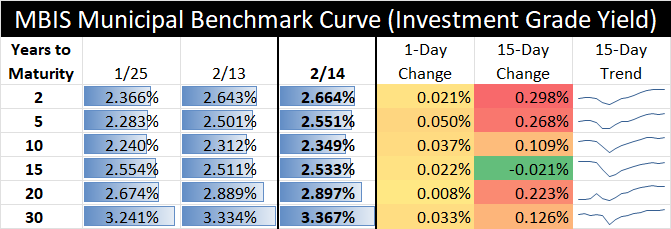
The interest rate table above illustrates recent changes in a sample of MBIS “investment grade” yields. Every issuer’s credit is different. For rates that may be applicable to your municipality, contact our Municipal Bond Advisors, Larry Kleeman, Beth Warren and Henry Schmidt.
Popularity growing, Great Bend Rec getting involved with eSports
The gaming world of eSports has been around for some time, but the explosion in popularity over the last few years has caused many markets to get involved. The Great Bend Recreation Commission is now in the process of bringing eSports, video games turned into a spectator sport, to the community to enjoy. Getting advice from Barton Community College eSports coach Curtis Rose, Great Bend Rec Business Director Joe Henry said the Rec wants to create tournaments and leagues for gamers to compete, but also for those interested in watching.
Source: GC Telegram
Inflation Brings Back the Heat
The Federal Reserve can probably take last month’s bump up in inflation in stride. That doesn’t mean it shouldn’t care about it. The Labor Department on Tuesday reported that overall consumer prices rose a seasonally adjusted 0.5% in January from December and it revised December’s monthly change from down 0.1% to up 0.1%. Core prices, which exclude the often volatile food and energy categories in an attempt to better capture inflation’s trend, rose 0.4% in January, with December’s gains revised to 0.4% from 0.3%.
Source: WSJ.com: Markets