

Kansas Municipal News
Disaster declaration approved for May storms in Kansas
The Federal Emergency Management Agency says disaster assistance will be available to help with recovery efforts from severe storms that hit 14 Kansas counties in May. … Public assistance federal funding is available to the state, tribal and eligible local governments and certain private nonprofit organizations on a cost-sharing basis for emergency work and the repair or replacement of facilities damaged by the storms in Barton, Ellsworth, Harvey, Hodgeman, Lincoln, Morris, Ottawa, Pawnee, Reno, Rush, Russell, Stafford, Wabaunsee and Wyandotte counties.
Source: 101.3 KFDI
Municipal Bond Trends for August 20, 2024
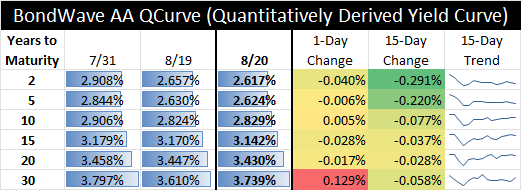
The interest rate table above illustrates recent changes in a sample of AA rated bond trades reported to the Municipal Securities Rulemaking Board’s EMMA® system. Every issuer’s credit is different, and other financing sources may be available. To obtain comprehensive Financial Advisory services for your local government, contact your Ranson Financial Municipal Advisor, Larry Kleeman, or Henry Schmidt.
Disappearance of city clerk leaves Peabody in challenging situation
Christopher King, husband of Jonathan Clayton, interim city clerk for the City of Peabody, reported him missing on Aug. 3. His disappearance has left his family, friends, and the City of Peabody scrambling for answers. The disappearance: Clayton’s last known phone conversation was with Peabody Mayor Catherine Weems at 9:20 a.m. on Aug. 3. Clayton mentioned attending a PMSA meeting at 11:30 a.m. and that his husband, Christopher King, was unwell. Weems noted no changes in Clayton’s behavior “Even our conversation on Saturday morning seemed perfectly normal,” Weems said. However, when Clayton failed to appear at the meeting, concerns arose. “A PMSA board member contacted me when Jonathan didn’t show up. Jonathan was never late,” Weems said. Fearing an accident, she shared her earlier conversation with him. Board members couldn’t locate Clayton, and when he didn’t return home, King reported him missing. Peabody Police Chief Philip Crom said the department is actively working on the case. Clayton, 42, is 6 feet tall, around 215 pounds, with brown hair and hazel eyes. He was last seen driving a red Chevy Silverado with an extended cab. Clayton served as the interim City Clerk of Peabody. He was originally hired as the city’s animal control and health and safety officer. Crom said law enforcement pinged Clayton’s phone on Aug. 4, but by Aug. 5, it was off. Searches of Peabody and Newton by his husband and sister have been unsuccessful. “The last ping that hit was at the Holiday Inn Express that morning at 10:30 a.m,” King said. King said staff at the hotel said he came in, asked to use the bathroom, and left. King also said that the Kansas Highway Patrol did a search of Clayton’s grandma’s farmland in Kiowa County. “His sister, Jessica, and I have spent many hours searching this area, Newton and around Marion County, and the highway patrol has, as well. So the searches have been going on and are continuous. And now I think there are folks looking at a lot of digital and online interactions to see if that could find out where he’s at from that,” King said. Clayton and King, a city council member in Peabody, operate CK Vintage, an antiques and craft store in the city. Clayton also took a job working for the City of Peabody as the city’s animal control and health and safety officer in 2023 after leaving the Kansas Department of Commerce, where he served as the director of economic recovery. Due to vacancies of Peabody staff, Clayton was promoted by the Peabody City Council to serve as interim clerk in June. Clayton also volunteered with the Peabody Main Street Association, which aims to revitalize the City of Peabody, and had received $1.5 million in state grant funding for its work. “Jonathan could talk to anyone, and they respected him,” PMSA Board Member Morgan Marler said. King said they are working continuously to find him. “There are lots of things that will come out later that I’m not at liberty to speak about because it involves the investigation,” he said. Clayton’s past: With increased media scrutiny as well as a continuing investigation into his disappearance, Clayton’s past has surfaced. In 2016, Clayton was arrested for financial crimes in Philadelphia and later pled guilty to one count each of forgery, theft by unlawful taking and conspiracy to commit theft. He completed probation but still owes restitution of approximately $195,000. The Department of Commerce claims they were unaware of these charges, while the City of Peabody confirmed they knew but emphasized that Clayton had no access to city funds. The mayor, as well as the police chief, have reiterated multiple times that there is no criminal investigation related to Clayton in Peabody. “We do not have concerns about any criminal activity on the part of Jonathan Clayton during his city duties,” Weems said. Weems told the Wichita Eagle in an interview that he did have access to the city credit card, but no improper purchases were found. According to King, he was also arrested in association with the Philadelphia case but was not charged with the crime, which involved a plan to take funds from a ride-sharing platform Clayton worked for in Philadelphia and use them to fund a theatre company he and King were both involved in. “I was arrested initially because I owned the theater company,” King said. “He did the financial part of it. I did the creative part of it. But I was never convicted of any felonies or anything.” Peabody Main Street, where Clayton volunteered his time as a grant administrator, was also aware of Clayton’s past criminal charges. According to Marler, the PMSA board has expressed no concerns about any criminal activity on the part of Clayton. She said Clayton helped PMSA enact several policies that have allowed them to obtain documentation and show that no mismanagement of funds has occurred. According to documentation from PMSA, provided to the Department of Commerce and the Hillsboro Free Press, as grant administrator, Clayton did not have access to any PMSA funds. “Our community embraced him and his husband, even after we found out about the felony, because we truly believe that people deserve second chances,” Marler said. There are no criminal charges pending in Peabody. “Here in Peabody, all I’m working on is the missing persons case,” Crom said. “There is no criminal investigation or allegations of criminal behavior in Peabody. I know the Kansas Highway Patrol has an investigation open, but I do not have details about that.” In the Wichita Eagle article, King told the paper Clayton was under investigation for his handling of money for the State of Kansas and while serving on multiple board positions in his hometown of Mullinville. Captain Candice Breshears of the Kansas Highway Patrol issued the following statement. “The Kansas Highway Patrol is an assisting agency to the Peabody Police Department regarding the Jonathan Clayton missing person case. This is an ongoing investigation, and there is no other information available at this time,” Breshears said. “Please refer to the KBI missing person report or contact the KBI for any information regarding Mr. Clayton’s whereabouts.” The email: On Aug. 8, Clayton’s email account sent an automatically scheduled message to various officials and media, with a disclaimer noting it was to be sent upon his incapacitation or death. The email contains allegations against Department of Commerce employees, including Lieutenant Governor David Toland and others Clayton previously worked with. Clayton resigned from the Kansas Department of Commerce on Nov. 20, 2023, after serving as director of economic recovery for several years. The email alleges that Clayton was made to alter grant application scores for BASE grants in order to funnel them to certain legislative constituencies, like Butler and Johnson counties. The grant used federal COVID funds to distribute $100 million in funds in the first round of awards in 2022, according to a state press release at the time. Butler and Johnson Counties received $51.6 million in awards, according to the Kansas Department of Commerce website. Newton applied for one such $12 million grant to pay for upgrades for the Kansas Logistics Park and did not receive it. A second round of $50 million in funding was awarded, with Halstead receiving $144,000 to build a spec building at its industrial park. The Department of Commerce acknowledges receiving the allegations made in Clayton’s email. “The Kansas Department of Commerce has been made aware of allegations of misconduct against a former employee in connection to activity that occurred after they left state employment,” Patrick Lowry with the Department of Commerce said. “We are reviewing the matter to determine what, if any, impact the alleged activity may have to the agency or community partners. We are also assisting state and federal law enforcement, as appropriate. Due to the ongoing investigation, we will have no further comments at this time,” Since the email was sent five days after Clayton disappeared, some assumed this meant he had access to his email. However, Crom said that is not the case. Rather, Clayton had scheduled the email in advance. “Each week, a prompt would come up on his computer and ask if he wanted to send or delay the sending of the email,” Crom said. “He would just delay it another week. But when he wasn’t there to press the delay button, the email automatically sent on Aug. 8.” King said, at this point, he would not say anything negative about Toland. “Anything that I would say that Jonathan told me which is hearsay at this point. And to protect myself, I’m going to not say anything at all,” King said. “I’m just thankful for all the help they’ve given Peabody and everything they’re doing for Peabody.” PMSA implications: Clayton’s disappearance coincided with the Department of Commerce’s denial of the second $750,000 portion of a $1.5 million BASE grant to PMSA. He was scheduled to meet with PMSA on the day he went missing to transfer grant data from his laptop. In May 2023, the Department of Commerce awarded PMSA $1.5 million to revitalize Peabody’s historic district, with Clayton playing a key role in securing the grant as the then director of economic recovery. “He came into town like a magical unicorn,” PMSA Board Member Lindsey Hutchison said, acknowledging his significant help. However, as Clayton volunteered with PMSA after resigning from the Department of Commerce, delays in receiving the second grant installment caused growing concern. “Here is this guy that works for the Department of Commerce that wants to move to our little town and help us apply for this huge grant, a grant that could save our downtown. And he did help, he had a big heart, but we all know there are no magical unicorns. And this has hurt us,” she said. By July, PMSA had yet to receive the funds. Clayton repeatedly assured the board that all documentation was submitted and under review. On July 26, Amber Cabrera, a Department of Commerce attorney, informed PMSA they were missing documents, setting an Aug. 9 deadline. Clayton’s removal as grant administrator was requested during a meeting between PMSA, Cabrera and Department of Commerce Director Erin Starr. On July 29, PMSA received a list of needed documents. The meeting Clayton scheduled with PMSA board members the day of his disappearance was arranged so board members could begin downloading all of the pertinent BASE grant data from his laptop. Marler said the board members believed it would be a simple transfer of data from his laptop onto one of their devices. With Clayton missing and no access to his laptop, the board began attempting to contact the Department of Commerce and working with local law enforcement in an effort to locate Clayton. The Department of Commerce did not return their phone calls; rather, they sent a termination letter at the end of the business day on Aug. 6, advising PMSA their grant had been terminated and funding needed to be returned to the Department of Commerce. Instead of giving up, PMSA board members dug in and worked even harder to find the needed documents. On Aug. 12, the board accessed Clayton’s computer with help from his sister, who was able to provide passwords. They thought they would just download his hard drive and retrieve their documents. However, they found 760 accounts requiring passwords and tens of thousands of documents, all unlabeled or filed. “Our volunteer board has put in more than 650 hours, as of Aug. 16, while each of us maintained our full-time employment,” Marler said. While the work has been tedious, the board has been able to confirm critical information; all projects have been completed, contractors have been paid and there was no embezzlement by Clayton from the BASE grant account. The Hillsboro Free Press contacted the Department of Commerce on Aug. 16 to inquire about the status of the grant funding. The Department of Commerce, via Lowry, advised the Free Press an extension has been granted, and PMSA now has until Sept. 4 to submit the needed documentation. They also now have staff in Peabody working directly with PMSA, providing technical assistance and explaining the reporting requirements. While Clayton is not here in person to address the documentation concerns, his automatically sent email alluded to the situation. “Finally, the allegations by the commerce department that I did not provide sufficient documentation for two BASE grant awards is unilaterally unfounded and I believe to be a form of retaliation,” Clayton stated in his email. “These allegations have been escalating since my October 2023 departure from the commerce department.” Unanswered questions: Two weeks have passed since Clayton disappeared, leaving many questions unanswered. The most pressing: where is he, and is he safe? “We and even the people that he’s wronged at this point cared about him, and they still care about him. All of us wanna see him. If he’s done anything illegally, we want him to face the consequences, because all of us strongly believe in that. But we wanna know that he’s safe. And if there’s some kind of mental health crisis going on, we wanna make sure that he can come home and get the help that he needs at the same time,” King said. Weems asked for patience and understanding as they navigate the situation. “Peabody is resilient, and we will persevere,” Weems said. If anyone has any information about Clayton’s whereabouts, they are urged to contact the Peabody Police Department or the Kansas Bureau of Investigation.
Source: Harvey County Now
Halstead working to improve safety for students
Planning is underway to update a portion of Sixth Street in Halstead, making it safer for students on their way to school. “It will make it safer for children to walk,” Halstead City Clerk Julie Wait said. This is part of the Safe Routes to School project Halstead is working on. Wait said from Sixth to 10th Street, there are no sidewalks. “They [students] are walking in the street,” Wait said. Wait said the project would also improve the existing sidewalks. Wait added that the proposed improvements would make the street more visually appealing, as well. Halstead received a $400,000 Transportation Alternatives Grant from the Kansas Department of Transportation. Wait said the city is required to match 20 percent, or $80,000, and cover any additional costs that come up from inflation. According to a report from County Administrator Anthony Swartzendruber, the county and city are working to reach an agreement for maintenance of the roads. The county is responsible for maintaining the two inner lanes of Sixth Street. The city maintains the outer two lanes. Initial city plans involved combining and re-striping the outer two lanes and condensing it into one lane. This would create 11-foot east and westbound lanes and an 11-foot turn lane. The city also planned to add a four-foot bike lane on either side of Sixth Street. “The re-striping of Sixth Street should naturally decrease the speed of traffic, improve the flow of traffic, allow for sidewalk expansion along Sixth Street and allow for the addition of bike lanes,” Wait said in an email. Plans for the street and the possible re-striping are still being finalized. The city completed the first phase in September 2021, which involved developing an improvement plan for the road. Wait said the city worked with Lochner, the engineering consultant, to complete phase one. Together, they analyzed the town to find what streets and sidewalks needed to be replaced and to determine what the route for the safe streets project would be. The city is now working on the second phase, which carries out those plans. Wait said so far the city has been planning out the project by meeting with engineers and the department of transportation. As of the time of writing, a start date and timeline for the project is unknown.
Source: Harvey County Now
Governor Kelly Announces Elanco to Invest $130M, Create 70 Jobs in Elwood
Governor Laura Kelly announced today that Elanco Animal Health Inc., a global leader in animal health, is investing $130 million to expand and renovate its manufacturing facility in Elwood. The expansion in Doniphan County is expected to create approximately 70 new jobs over the next two years. “The continued investment by Elanco speaks to the work my administration is doing to attract and retain businesses,” Governor Laura Kelly said. “Elanco’s expansion is not only creating new jobs but is adding to the unparalleled economic momentum that has made Kansas the best state in the nation to live, work, and raise a family.” Elanco is located within the Animal Health Corridor, which is the single largest concentration of businesses working to improve animal health worldwide. These businesses produce everything from veterinary pharmaceuticals to specialized food for livestock and pets. Elanco’s Elwood site currently manufactures and ships its Canine Parvovirus Monoclonal Antibody and will be the flagship location for Elanco’s future monoclonal antibody manufacturing. This product is the first and only USDA conditionally approved targeted treatment for parvovirus, which affects an estimated 330,000 dogs annually in the U.S. The expansion will add the needed capacity to support Elanco’s growth in monoclonal antibody innovation. “Expanding the capabilities at our Elwood manufacturing site is a critical step toward executing the most exciting pipeline in Elanco’s 70-year history,” Elanco Manufacturing and Quality Executive Vice President Grace McArdle said. “In partnership with our Elanco research and development colleagues, this site plays a key role in delivering solutions that are transforming the way veterinarians and pet owners care for the world’s animals. We appreciate the commitment of the State of Kansas, Doniphan County, and the City of Elwood to help pets live longer, healthier, more active lives.” This project will help enhance the local economy through increased tax revenue and serve as a stable long-term employer in Elwood. The company will be better positioned to optimally serve customer demands with improved project development and commercialization lead times. “Sitting in the heart of the Animal Health Corridor, Kansas is a powerhouse in this critical sector – attracting companies from across the nation and around the world,” Lieutenant Governor and Secretary of Commerce David Toland said. “Elanco is an excellent example of the top-notch employers the Kelly-Toland administration is committed to partnering with as we grow the state’s economy.” Design-build firm Burns & McDonnell, headquartered in Kansas City, is leading the expansion project as the primary provider of integrated design and construction services.
Source: Kansas Department of Commerce
Halstead sets another public hearing for battery storage
With the City of Halstead still awaiting feedback from Concurrent LLC, the planning commission tentatively set a public hearing for their next meeting on Monday, Sept. 16. City Manager Ethan Reimer hoped this would get a response from Concurrent, a company wishing to locate a battery energy storage system (BESS) in Halstead. The commission listed regulations at a meeting in June. The city attorney then sent the regulations to Concurrent but hadn’t heard back. “I’m hoping this will put pressure on them,” Reimer said. Reimer said if he told them there was another public hearing, he hoped that would encourage Concurrent to respond to the BESS regulations proposed. According to past reporting by Harvey County Now, the commission requested regulations around the noise level. After testing areas in town, the commission agreed that the noise decibel should not exceed a level of 75 within 100 feet of the property. The commission also set restrictions of a 25-foot setback for the side and rear of the property. The commission said they wanted regulations available to the public before the meeting so that the meeting had different community feedback from the last public hearing. “I want regulations up so people can look at them ahead of time,” Tessa Windling, chair of the planning commission, said. The commission said they would reschedule the public hearing if information wasn’t up for the public two weeks out from the meeting. The commission also approved a conditional use permit for two accessory structure requests. The sheds were for personal use and would be 1,500 square feet, which exceeds the 720 square foot limit.
Source: Harvey County Now
Lawrence City Commission agrees to put sales tax increase on ballot, continues discussion of 2025 budget
Lawrence city commissioners decided Tuesday that they will ask Lawrence residents to vote on whether to approve a .05% sales tax increase to fund homelessness programs. Otherwise, much of the 2025 city budget is still up for discussion. Commissioners heard from more than 30 people during their budget hearing, most asking them not to increase property taxes. Many also asked commissioners to maintain funding to staff Lawrence-Douglas County Fire Medical fire trucks with four staff members rather than cutting staff for each truck to three, as the city manager’s budget had proposed. In their discussion, commissioners considered ways to save on costs and potentially lessen tax increases, such as using fund balances — essentially the city’s savings accounts, or funds kept on hand in case of emergencies. They agreed that spending fund balances was not sustainable but thought it could help get through a particularly difficult year when sales tax revenues came in far below what the city anticipated. Commissioner Brad Finkeldei summarized items the commission would like city staff members to look into and bring back for further discussion: Funding 149 total operational staff for Lawrence-Douglas County Fire Medical, and staffing each fire truck with four people; Adding one LDCFM deputy chief; Funding non-sworn personnel for the Lawrence Police Department; Postponing the start of construction of new fire stations by one year; Looking at using special funds to fix some playgrounds; Authorizing Parks and Recreation to look into advertising and sponsorships; Charging the University of Kansas for false fire alarm calls; and Decreasing the amounts of raises some city staff members will receive. Here’s the full text of the question commissioners approved to put on the ballot: “Shall the City of Lawrence, Kansas be authorized to repeal the 2019 Sales Tax in the amount of five one-hundredths of one percent (0.05%) in the City of Lawrence, Kansas, and replace it with the levying of a new special purpose retailers’ sales tax in the amount of one tenth of one percent (0.1%) for the purposes of (1) providing and improving the quality, availability, and affordability of housing in Lawrence, acquiring land for future affordable housing units, investing in private/public partnerships for the provision of affordable housing, and such other related affordable housing purposes as may be in the best interest of the City, and (2) providing temporary emergency shelter for persons experiencing homelessness and related services including but not limited to providing food, laundry, transportation, storage, non-prescription medical supplies, case management, and outreach services as well as homeless prevention services including but not limited to rent stabilization funding, utility assistance, assistance obtaining government identification cards, government benefits, and such other related programs and services for persons experiencing homelessness as may be in the best interest of the City, the collection of such sales tax to commence on April 1, 2025 and shall terminate ten years after its commencement, all in accordance with the provisions of K.S.A. 12-187 et seq. and amendments thereto?”
Source: The Lawrence Times
Manhattan is ‘special place’ for incoming city manager Danielle Dulin
Home is where the heart is, and Manhattan’s newest city manager said she is returning to work in a community she always has loved. Long before the Manhattan city commission appointed Danielle Dulin as city manager early this month, she was an economics student at K-State. She grew up in the small Kansas town of Bucklin about 30 miles southeast of Dodge City, but it was in the Little Apple that she met Mike, her husband and a fellow K-State graduate, and began her professional career.
Source: 1350 KMAN
Property crime up, violent crime down in Kansas
An annual report on crime in Kansas shows property crime rising and a decline in violent crime, providing benchmarks that may guide law enforcement and community leaders. The Kansas Bureau of Investigation’s Crime Index Report, which summarizes crime data submitted by law enforcement agencies from across the state, shows property crime increased by 2.6% and violent crime decreased by 3.7% from 2022 to 2023. The number of reported property crimes increased to 66,782 cases. The report said the overall crime index was “heavily impacted” by the uptick in property crimes, increasing from 26.7 offenses per 1,000 people in 2022 to 27 offenses per 1,000 people in 2023. The property crime rate was 10% below the 10-year average. “Property offenses have steadily declined in recent years, making 2023 the first year since 2017 that the state experienced an uptick in property crime reports,” the report said. “Property crime offenses are assumed to be underreported to law enforcement.” The crime that saw the largest individual increase was motor vehicle theft, which was up 4.8% Law enforcement agencies recorded 13,294 violent crimes throughout the state. The violent crime rate was nearly 10% above the 10-year average. The number of reported rape cases decreased by 12.6%, or 161 cases, from 2022 to 2023. Although crime stats compiled by the KBI can be helpful for identifying trends, the KBI said in a news release “it is often not possible to draw further interpretations or conclusions from the data. It is dependent on victims reporting crimes.” “We typically see more property crimes than violent crimes based on raw numbers,” said Sgt. Drew Fennelly, public information officer for the Lawrence Police Department. “Crime touches each community very differently. The reasons for trends could be very different in Wichita, Kansas City or Dodge City.” Melissa Underwood, spokeswoman for the KBI, didn’t respond to inquiries for this story. Adrianne Nuñez, spokeswoman for the Willow Domestic Violence Center of Lawrence, said the data is important for looking at crime on a broader scale. Agencies like the Willow use a variety of data from across the state to spread awareness or use in training, she said. “We believe tracking crime data is important. It gives us a snapshot of what is happening in our communities,” Nuñez said. “We hope these statistics continue to drop to the point that our job is unnecessary. More specifically, we hope these statistics continue to evolve to reflect the most accurate information in our communities while allowing survivors to be safe.” The report does not track specific categories of murder or aggravated assault in the data, which can make it difficult to draw conclusions about statewide violence within smaller communities. While the 3.7% decrease in violent crime overall is a step forward for Kansas, organizations like Moms Demand Action still worry about gun violence and incidents that are not counted in the annual report. “I do think it’s beneficial to track the data because data gives us things that we can improve on,” said Shannon Little, a Moms Demand Action co-leader and volunteer. “Comparing different sets of data will give you different answers. Even though our violent crime rate has gone down almost 4%, Kansas still has some of the weakest gun safety laws in the country.”
Source: Derby Informer | Area
KDOT accepting applications for Innovative Technology Program
The Kansas Department of Transportation is now accepting applications for the fall 2024 round of the agency’s Innovative Technology Program. The Innovative Technology Program provides financial assistance to governmental and non-governmental organizations for innovative transportation-related projects that promote safety, improve access or mobility and implement new transportation technology. “Innovative technology” is broadly defined as any technology that does not currently exist in the local community of the project. This allows local communities to determine what projects to submit based on their specific needs. All transportation system projects are eligible, including roadway (on and off the state system), rail, aviation, unmanned aerial systems (UAS), bicycle/pedestrian, public transit, software and technology infrastructure. Candidate projects should include investments that provide transportation benefits and are not eligible for other KDOT programs. This round of grant funding has an overall budget of $2 million, with a maximum awarded amount of $1 million per project. A project concept must be submitted and approved by KDOT before an application is provided to the applicant. The project concepts deadline is Nov. 17, and the application deadline is Nov. 30. A facts sheet is available on the program at https://www.ksdot.gov/Assets/wwwksdotorg/bureaus/divInnovTech/Innovative_Technology_FactSheet.pdf. For the project concept submission form, go to https://forms.microsoft.com/g/FThTTFKQ5s. Both documents are on KDOT’s internet. A few past approved projects include Truck Driving Simulators for the CDL Program expansion at Seward County Community College, an AI-Based Road Condition Assessment in the City of El Dorado and a UAS Flight Operations and Simulation Center for Kansas State University – Salina.
Source: Emporia Gazette
Vote passed to let citizens decide if county commission should increase to five
The Bourbon County Commission plans to let voters decide whether to add two commission districts in the November election. On Monday, the commission passed by a 2-1 vote a resolution that would place the following question on the Nov. 5 ballot: “Shall the current number of Bourbon County Commission Districts set forth in KSA 19-203(1)(b)(c)(d)&(e) be increased to five Commissioner Districts?”
Source: Fort Scott Tribune
Common Consumption Area expanded
The Great Bend City Council adopted an ordinance Monday that greatly expands the downtown Common Consumption Area, which allows a committee to allow alcohol sales in designated areas during select events. The vote was 6-1, with councilmember Davis Jimenez opposed and councilmember Kevyn Soupiset absent (he arrived a short time later). Before voting, the council heard from audience member Dee Ann Grummon, who expressed her opinion that “expanding the ‘Common Consumption Area’ is not a wise idea.” “Is it impossible to draw a crowd with food, art and music/entertainment only, or is alcohol the magic ingredient for any event to be successful?” she said. Her comments will appear on the Great Bend Tribune’s public forum and a link will be provided later. The Common Consumption Area (CCA) was created by ordinance in 2021 at the request of Great Bend Economic Development. At present, it includes the 2100 block of Forest Ave., which is the block in front of the Tribune. Final Fridays on Forest events in this area involve closing the street to traffic and allowing food and alcohol vendors and live music. GBED’s Great Bend Alive sets up tables and chairs, with volunteers at the entrances to make sure alcohol is not brought in or carried out of the area. At the Aug. 5 City Council meeting, GBED Director Sara Arnberger asked for an ordinance expanding the CCA to also include: The crosswalk across Williams along the south side of Forest Ave. (to The Landing, a new gathering area); Half of the block that includes The Landing; Lakin Ave. between Williams and Main; 12th Street between Williams and Main Arnberger said the committee would not ask to use all of the area all of the time. “This gives us flexibility into the future,” she said. The item was tabled on Aug. 5 after councilmember Cory Urban said he would like to change the makeup of the CCA Committee that decides when to utilize the areas. City Attorney Allen Glendenning amended the ordinance at that was what was approved Monday night.
Source: Great Bend Tribune
‘Time to turn the page’: Attempt to recall Prairie Village mayor after housing saga fails
An attempt to recall Prairie Village Mayor Eric Mikkelson will not move forward after a group — unhappy with the city’s efforts to address its shortage of affordable housing — did not collect enough signatures to place the initiative on the ballot. “Time to turn the page,” Mikkelson said in a statement to The Star. “We move forward best when actually united.” It was a group of residents’ ninth attempt at recalling the mayor in recent months, as the northeast Johnson County city has been embroiled in controversy over officials’ consideration of adjusting zoning laws to allow for a wider variety of housing, such as duplexes and small apartment buildings. Johnson County District Attorney Steve Howe rejected eight previous recall petitions, which cast a variety of accusations against the mayor, ruling that that they were insufficient and that their claims did not meet the grounds for ousting a local official under state law. Howe found the ninth petition met statutory requirements, allowing the group to collect signatures to try to put the mayoral recall up for a public vote. The group — which has called itself Save Prairie Village — had until mid-August to collect more than 4,000 signatures for it to be valid. But this week, the recall committee on its website said that effort had failed. The latest mayoral recall attempt centered on Mikkelson’s communication with a city-hired consultant firm during that tension last year. The recall committee accused Mikkelson of misconduct in office, alleging he misused taxpayer dollars by having the consultants help him advocate against previous petitions aiming to recall him. Mikkelson said the accusation is false and amounts to damaging, “abusive smear tactics.” Edward Greim, an attorney representing the recall committee, previously told The Star, “It is ironic that it was the very process of trying to fight off the earlier recalls that support this recall.”
Source: Joco 913 News
City council approves ordinance changes for short-term rentals, purchasing of naming rights
On Tuesday, the Wichita City Council approved the city budget for 2025, as well as several other items, including ordinance changes for short-term rentals and the purchasing of naming rights. The Wichita City Council approved ordinance changes regarding short-term rentals like Airbnbs. The changes make the renter responsible for issues like underage drinking, property damage, and illegal fireworks at a “nuisance party,” defined as “a social gathering of five or more people on a residential property in which certain nuisance-type activities occur.” The council will revisit who is responsible for dispersing parties if the police come during their meeting on Sept. 3. The City also voted to let private sector partners purchase naming rights at parks and cultural facilities in Wichita. The purchasing of naming rights could start late this year or early next year and establish agreements for 2026. The city council needs to approve each contract. The naming rights for the baseball stadium, tennis center, and ice rink are up for grabs.
Source: KSN-TV
Parsons PD receives safety tool donation to boost officer visibility
Flashing lights could be the thing that saves a police officer’s life. “During those periods when officers are out working traffic crashes and other incidents in the middle of the night, they need to be seen,” said Robert Spinks, Parsons Kansas Police Chief. Visibility and more safety are a couple of important things the Parsons Police Department will now be able to increase with the help of a new tool. “This is an opportunity where we’re taking custody of enough Guardian Angel devices to equip all of our patrol officers,” said Spinks. On Monday, Parsons Police Chief Robert Spinks announced the department received the donation from local manufacturer CST Industries, worth about four thousand dollars. “CST again, safety is number one with CST, so being able to funnel that out into the community is important to us. So, like I say, there’s no hesitation in being able to give these to the Parsons Police Department,” said Steve Trimble, CST Plant Manager. “On behalf of everybody at Parsons Police Department, I’d like to thank CST for their donation,” said Officer Frank Pousher, Parsons Police Department. Patrol officers such as Officer Frank Pousher can use the lights to assist them with traffic stops, crash scenes, and when the weather hinders visibility. They have settings like blinking “SOS” in Morse code or blinking red and blue lights. “Help me by being a little bit more visible. If I work nights on that traffic accident, I don’t want to be hit by doing traffic stops. So that helps,” said Pousher. All with preventing injuries on the roadway in mind. “To the level that the community supports the men and women who are out there 24/7 trying to do the right thing for the right reason to make our community as safe as possible,” said Spinks.
Source: KSNF/KODE
Topeka city council urges tax entities to keep rates low
The Topeka City Council unanimously passed a resolution to urge all local tax entities to keep property tax rates as low as possible for homeowners and renters. The resolution was brought by District 8 City Councilman Spencer Duncan last month after the council chose to ignore a tax petition brought by Earl McIntosh. McIntosh is now suing the city over that decision. The Topeka Metropolitan Transit Authority (TMTA) is one of several entities that influence property taxes in Shawnee County. Rod Miller, a TMTA board member, presented at the council meeting to explain why their operating costs are forcing them to raise their tax rates above the minimum. “Fuel costs are higher also this year along with health insurance,” Miller said. “I can give you almost any number of reasons why we’re going to be over that, just because inflation is inflation.” It remains to be seen which of the other entities, if any, will also raise rates above the state-defined revenue-neutral rate. Other entities include: State of Kansas, City of Topeka, Topeka and Shawnee County Public Library, Washburn University, Metropolitan Topeka Airport Authority, Public Schools. As for the tax petition, the city has until Sep. 3 to respond to McIntosh’s lawsuit.
Source: KSNT 27 News
Kansans raise concerns over government’s proposed transmission line corridor
A proposed electric transmission corridor that could run through Kansas is prompting questions from Kansans. The Pawnee County community met at the Larned Community Center Thursday evening to ask those questions, share their stories, and share their concerns. “I’m really concerned because this is our house. This is our home,” said one resident who spoke during the meeting. “How long have you known about this going to happen? When did we find out? A lot of us did this week. We didn’t even understand or know anything about this. It hit us in the face. This has been in process. Why didn’t we get to be part of that process? Even if it was thought of in the future, our land is our future. So why weren’t we considered in the future?” Part of the project centers on the Grain Belt Express, a high-capacity transmission line set to go through parts of Kansas. Parts of that project are already approved. Pawnee County Attorney Douglass McNett says it is a private venture, and the company worked with landowners to purchase easements for the project. He says the new concern is a federal energy corridor on either side of the transmission line that could use eminent domain. “I think where the confusion has arisen between the Grain Belt and the Department of Energy’s proposed energy corridor is it looks like the Department of Energy simply used the schematics or the drawing that Grain Belt has established privately as their basis and just said ok we’ll go 2.5 miles either side of that grain belt transmission line,” said McNett. He says Pawnee County does not have concerns with the transmission line itself. The U.S. Department of Energy has released a preliminary list on its website of 10 potential National Interest Electric Transmission Corridors (NIETCs) it says to “accelerate the development of transmission projects in areas that present an urgent need for expanded transmission.” The Midwest-Plains corridor would run through Indiana, Illinois, Missouri and Kansas. It would be approximately five miles wide and 780 miles long. “The Federal Power Act authorizes the Secretary of Energy to designate any geographic area as a National Interest Electric Transmission Corridor (NIETC) if the Secretary finds that consumers are harmed by a lack of transmission in the area and that the development of new transmission would advance important national interests in that area, such as increased reliability and reduced consumer costs,” reads the U.S. Department of Energy’s website. The government website lists other potential NIETC geographic areas it is considering: The U.S. Department of Energy lists the below reasons for moving forward with the project: Maintain and improve reliability and resilience. Potential electricity shortfalls leave the region vulnerable during extreme weather. Electricity demand growth, generator retirements, and increased intermittent generation contribute to reliability risks in the region. Alleviate congestion and reduce consumer costs. Congestion between the Midwest and Plains regions prevents cost-effective generation from being delivered to where it is needed, when it is needed. Meet future generation and demand growth. There is a significant need for additional transfer capacity between the Midwest and Plains regions to meet various power sector scenarios. Analysis finds a 175% increase is needed by 2035 under moderate load and high clean energy growth scenarios (median need relative to the 2020 system), in line with current market and policy conditions. Increase clean energy integration. Increased access to more diverse, clean energy generation resources is necessary to lower power sector greenhouse gas emissions.
Source: KSNT 27 News
Topeka releases results of new police chief survey
The City of Topeka has released the findings from public sessions as part of the hiring process for a new police chief. From July 22 to Aug. 3, the City of Topeka collected 260 responses to the community survey. Three public sessions were also hosted where citizens could share their thoughts. “The community emphasized the need for a police chief who values communication, transparency, and community engagement, with a focus on reducing crime, improving public safety, and addressing mental health and homelessness,” City Manager Dr. Robert Perez said. “We will use this feedback from community members to make sure we find the best candidate for this community.”
Source: KSNT 27 News
Great Bend dealing with trash, dead animals dumped at compost
Issues at the compost site caused the City of Great Bend to release a press release Monday on the proper usage of the site south of town. Permitted by the Kansas Department of Health and Environment, the compost site is only permitted to take trees, tree limbs, grass and leaves. City Administrator Logan Burns said the compost site has been receiving banned material such as construction material, processed lumber, tires, household trash and even dead animals.
Source: Great Bend Post
Report predicts Kansas population will grow by half-million in 50 years
Kansas’ population is expected to grow by nearly 500,000 people in the next 50 years, and non-white residents are predicted to drive that growth, a research center forecasts. A report from Wichita State University’s Center for Economic Development and Business Research said the state is predicted to add more than 469,000 residents by 2072, which will amount to a 16% increase from the state’s 2022 population.
Source: Little Apple Post and CEDBR