

Kansas Municipal News
What is ‘percent for art?’ About the public art funding program that Wichita arts advocates don’t want to lose
Local arts leaders sounded the alarm after comments from Mayor Lily Wu during last Tuesday’s Wichita City Council meeting. The Council will vote to adopt the proposed 2025 city budget tomorrow.
An exchange during last week’s Wichita City Council meeting has prompted some Wichita arts advocates to speak out in favor of a relatively new and little-understood public art funding program. During public comment on the 2025 Annual Operating Budget and 2025-2034 Capital Improvement Program, District 2 resident Faith Martin suggested temporarily suspending the city’s percent-for-art ordinance to make up for an expected 2026 budget shortfall. “Maybe we look at amending that public code when we have a shortfall,” she said. “Not that I am against the arts. … I love supporting our local art community. But when we look at what the core services are, we may have to walk that back until we can get ourselves to where we have a little more budget.” City Manager Robert Layton said the council would have to vote to repeal the 2019 ordinance in order to adjust the allocation of public art dollars. (In a Thursday interview with the Wichita Eagle, Wu said she was not interested in cutting public art funding.) In 2019, the Council approved an ordinance that allocated 2% of public project funds to public art projects, including related costs, such as ongoing maintenance of the city’s public art collection. That calculation will result in more than $1.7 million in spending on public art dollars in 2025, if the current budget proposal is approved in tomorrow’s city council meeting. That’s less than one quarter of one percent of the city’s proposed budget, or roughly $10 per household. You may be familiar with recent additions to the City of Wichita’s public art collection at Riverfront Stadium, Wichita Public Library locations, and at Chester I. Lewis Park Reflection Square Park in downtown Wichita — all funded prior to the passage of the percent for art ordinance. “The City has implemented public art for 20 years in an ad hoc fashion,” reads a slide presentation prepared by the city manager’s office and presented to the City Council in December 2019. “The ordinance amendments would codify a public art process and establish a funding source.” Under the new ordinance, public-arts funding is tied directly to public improvement projects, the application process is open and accessible, and artists and art consultants are involved at the beginning of each public improvement project. The Design Council — an advisory body appointed by the mayor — recommends where the dollars should be spent, and the City Council approves those allocations. After the August 13 council meeting, Kristin Beal, the executive director of Harvester Arts, circulated a letter urging people to contact their representatives in City Hall. If the city cuts funding for public art, she says she worries Wichita will lose artists, which will have a wider impact on the community. “It feels like we’re finally making strides to build a creative ecosystem here where artists can live and work here as artists,” she said. “If cuts are made, we will lose ground and lose artists. The arts attract and retain talent, and beyond artists, companies look to communities that have a strong arts ecosystem, because they know that their employees want that.” “Studies show that investments in public art can improve safety, provide tourism, attract business, add jobs and keep artists employed in our city,” Sonia Greteman said in a Facebook post shared by her agency the Greteman Group. Garvey, who also asked her contacts to reach out to their elected city leaders, cited the Americans for the Arts study released this spring that estimates Wichita’s nonprofit arts sector generated some $185 million to the local economy in 2022, up from an estimated $49 million in 2005. District 2 City Council Member Becky Tuttle, who spoke in favor of public arts spending at the August 13 meeting, also referenced the study in her comments.
Source: KLC Journal
Report maps path for water resilience in western Kansas
Though water conservation has been an increasing priority for the Kansas agriculture sector, it has also been somewhat fragmented in its approach. The framework presented Tuesday at KState is a novel approach at bringing stakeholders from each part of the value chain into its efforts. “This is the first time we’ve really intentionally put the beef industry, the feedlot industry, in a room with their irrigator producers and their packers and their bankers to talk about improvements across the supply chain,” [Susan Metzger, of the KState Water Institute] said. Most agricultural producers are open to changing how they water to better preserve the water supply. Aimpoint Research — the company that assisted K-State — said 80% of farmers are interested in conservation, with 7% currently participating in a water conservation program.
Source: CJonline
Pawnee County officials finally get some answers for energy transmission corridor
Community leaders in Pawnee County spoke with a leadership team from the Federal Department of Energy (DOE) on Wednesday morning to learn more about a proposed energy transmission corridor. … The main issue is a proposed five-mile wide corridor known as the “Midwest-Plains” corridor that would go through much of Kansas.
Source: KSN-TV
Municipal Bond Trends for August 22, 2024
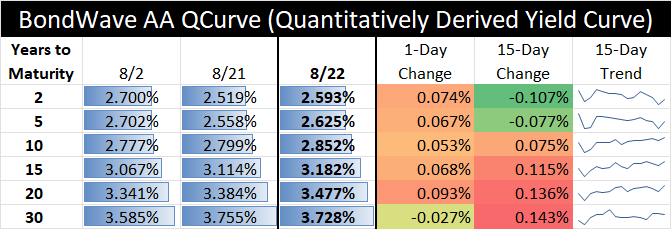
The interest rate table above illustrates recent changes in a sample of AA rated bond trades reported to the Municipal Securities Rulemaking Board’s EMMA® system. Every issuer’s credit is different, and other financing sources may be available. To obtain comprehensive Financial Advisory services for your local government, contact your Ranson Financial Municipal Advisor, Larry Kleeman, or Henry Schmidt.
This honeysuckle isn’t so sweet: Efforts are ongoing to save forest in an Olathe park
Johnson County Park & Recreation District has been fighting to restore plant diversity to Ernie Miller Park after shrub honeysuckle and other invasive plants like garlic mustard caused significant damage. For the the last five years, there’s been a strong effort to boot the shrub honeysuckle from the whole 116 acres of Ernie Miller. This is just the halfway mark for the plan. The invasive shrub had taken over the understory, or the underlying layer of vegetation, in the wooded park, said Matt Garrett, natural resource manager for Johnson County Park & Recreation District. “The shrub honeysuckle basically broke down an ecosystem, and we had no young trees. You couldn’t even see the topography in the forest. You didn’t even know where rocks were,” Garrett said. That can make it difficult for wildlife to traverse the area, but it also causes other issues. “When this invasive shrub takes over, you end up with a monoculture in the understory. You just have tall, mature hardwood trees. Since those invasives are shading out acorns, you end up not having any regeneration, so a forest becomes dead,” Garrett said. In addition to the Ernie Miller project, he said teams are removing hundreds of acres of the shrub honeysuckle at Shawnee Mission and Cedar Niles parks. It’s intense work, requiring chainsaws and brush cutters. Once an area is clear of the honeysuckle and any other invasive plants, they plant native seeds to repopulate the area and keep the honeysuckle from reestablishing quickly. Garrett said Bridging The Gap’s Kansas City WildLands program has helped with collecting and distributing seeds, in addition to the other tasks. A healthy variety of plants can help absorb stormwater and provide material for wild pollinators. The desired plants include bellflower, brown-eyed Susan, white snakeroot and golden Alexander. Garrett hopes by that point, the area will be in a maintenance phase, where all that’s needed is prescribed burn and occasional spray. “All of the corridors and a lot of the natural areas are just inundated with this invasive shrub. It’s not realistic we’re going to keep every single bad plant out of park,” he said. Every three to five years, they’ll have botanists come in to monitor how things are going and make sure the maintenance is helping things stay on the right path. Garrett said the project was born out of a 2019 natural resource plan for the Johnson County Park & Recreation District that took public opinion on where to invest their resources into account. “One of the areas that staff and the public wanted us to focus on was (on) making sure Ernie Miller Nature Park is a healthy, thriving place,” he said.
Source: Joco 913 News
Fed Chair Powell indicates interest rate cuts ahead: ‘The time has come for policy to adjust’
Federal Reserve Chair Jerome Powell laid the groundwork Friday for interest rate cuts ahead, though he declined to provide exact indications on timing or extent. “The time has come for policy to adjust,” the central bank leader said in his much-awaited keynote address at the Fed’s annual retreat in Jackson Hole, Wyoming. “The direction of travel is clear, and the timing and pace of rate cuts will depend on incoming data, the evolving outlook, and the balance of risks.” “Inflation has declined significantly. The labor market is no longer overheated, and conditions are now less tight than those that prevailed before the pandemic,” Powell said. “Supply constraints have normalized. And the balance of the risks to our two mandates has changed.” He vowed that “we will do everything we can” to make sure the labor market says strong and progress on inflation continues. The speech comes with the inflation rate consistently drifting back to the Fed’s 2% target though still not there yet. A gauge the Fed prefers to measure inflation most recently showed the rate at 2.5%, down from 3.2% a year ago and well off its peak above 7% in June 2022. At the same time, the unemployment rate has slowly but consistently climbed higher, most recently at 4.3% and in an area that otherwise would trigger a time-tested indicator of a recession. However, Powell attributed the rise in unemployment to more individuals entering the workforce and a slower pace of hiring, rather than a rise in layoffs or a general deterioration in the labor market. “Our objective has been to restore price stability while maintaining a strong labor market, avoiding the sharp increases in unemployment that characterized earlier disinflationary episodes when inflation expectations were less well anchored,” he said. “While the task is not complete, we have made a good deal of progress toward that outcome.”
Source: CNBC – Bonds
Crew clearing way for Topeka’s viaduct project digs up cistern
A Topeka Fire Department cistern built in 1878 was uncovered Tuesday by workers doing excavation for an underground water line project linked to the replacement of downtown Topeka’s Polk-Quincy Viaduct. … Topeka Fire Marshal Alan Stahl said he found an online Topeka Daily Commonwealth article dated June 28, 1878, telling of how construction was progressing rapidly on that cistern, which was intended to have a capacity of “1,000 barrels.”
Source: CJonline
Unhoused and unseen: homelessness in Hiawatha, Brown County and beyond
There is a group of people often not addressed in Hiawatha, Brown County and beyond. This group is unhoused and often unseen. Even those who are moving from house to house are also among the unhoused population. Kanza Director Jackie Feathers and Support Housing Team Lead Savannah Gibson provide support for those who are unhoused. They both gave an overview of the challenges that the homeless in Hiawatha and the rest of Brown County face and what is being done to address the issue.
Source: hiawathaworldonline.com
Report maps path for water resilience in western Kansas
Though water conservation has been an increasing priority for the Kansas agriculture sector, it has also been somewhat fragmented in its approach. The framework presented Tuesday at K-State is a novel approach at bringing stakeholders from each part of the value chain into its efforts.
Source: CJonline
What tuberculosis outbreak in Wyandotte County means for the rest of Kansas
The Kansas Department of Health and Environment on Thursday confirmed a tuberculosis outbreak in Wyandotte County, with more cases than the entire state recorded last year. … Overall, 75 people statewide have been treated this year for the lung disease and two people have died. Officials say the disease requires consistent contact to spread. “There is a very low risk of infection to the general public in these communities,” KDHE communications director Jill Bronaugh told the Kansas News Service in an email.
Source: CJonline
Johnson County, reStart meet with residents on homeless shelter plans
Johnson County residents packed a meeting in Olathe Wednesday night to find out more about plans for converting a hotel in a busy shopping area into a homeless shelter.
However, the $10.5 million plan for the LaQuinta Inn off I-35 on 95th Street still faces an uphill battle. At last count in January Johnson County had 250 people who were homeless, 58 without shelter. The county has an agreement to buy LaQuinta Inn and renovate it into a 50-bed shelter for single adults living in their own rooms. “We have a real chance to address this now when it’s manageable and functionally end homelessness in Johnson County,” Mike Kelly, Johnson County Board of Commissioners Chairman said. The money to purchase and renovate the hotel would use COVID-19 relief funds. Johnson County selected reStart to run the homeless services center. Last month they applied for a special use permit in the City of Lenexa, but staff are recommending it be denied. Details on why will be released on Thursday. Wednesday evening at a packed meeting in Olathe, reStart was addressing what it calls myths and fears. They say residents will receive referrals, and they won’t be lining up to get in. They’re also planning safety and security measures as well as mental health services. “It’s not going to increase crime, it’s not going to have a negative impact on neighborhoods or businesses,” Stephanie Boyer said. Lenexa has described more information about what staff considers when deciding on special use permits including how removing restrictions will detrimentally affect nearby properties and relative gains to public health, safety, welfare and property values. “I get it. This is a unique project that we haven’t seen anywhere in Johnson County before for a 24/7 365 shelter,” Kelly said. Johnson County will host another meeting with residents on Thursday from 5:30-7 p.m. in the Monticello Community Meeting Room at Monticello Library, 22435 W. 66th St., Shawnee. The homeless services center will go before Lenexa’s Planning Commission Monday, August 26 and Lenexa City Council September 17. Source: FOX 4 Kansas City WDAF-TV | News, Weather, Sports
Many warnings, but no citations, for violating Wichita water restrictions, city says
The city of Wichita has issued 165 warnings — but no citations — for violations of the city’s drought water-use restrictions. “Ideally, we won’t have to issue a single fine,” Gary Janzen, director of public works and utilities, said. “We don’t want this to be punitive. What’s more important is coming together collaboratively. . . . We really want to focus on education over enforcement.” The city has had Stage 2 drought restrictions — which limits outdoor watering to one day a week in each quadrant of Wichita — in place for two and a half weeks. Water levels at Cheney Reservoir continue dropping, despite recent rains in the Wichita area, and there’s less water in the lake now than there was at the start of August. As of Thursday morning, Cheney was 7.28 feet low, or 60% full — a 2% drop from Aug. 1. Cheney Reservoir is about 25 miles west of City Hall in downtown Wichita, and its river basin extends west into several counties that are in a severe drought. Much of the rain Wichita has received has missed the river basin that feeds Cheney Reservoir, where the city typically draws the majority of its raw water to be treated. The city is now pulling more water from the Equus Beds aquifer than Cheney as part of its drought response. Janzen provided an update on the city’s drought response at Mayor Lily Wu’s weekly briefing on Thursday. He said the city’s water use has dropped significantly since the restrictions were put in place, in part because of recent rain. Based on numbers captured at the city’s pump station, the city’s treated water use has fallen 34% compared with water use the week of July 22 to July 28. “We do want to urge caution,” Janzen said. “We do not want people to back off on water restrictions, nor will we do that.” The water restrictions started Aug. 5. City officials said they will be in place until at least Oct. 5 before they are reassessed. The city’s drought response plan calls for moving into Stage 2 restrictions, which limits outdoor watering to one day a week throughout the city, when the 12-month average lake level at Cheney is 69%. As of Aug. 1, the 12-month average was 68.4%. Stage 3 restrictions would be triggered by a 12-month average of below 50%. “Cheney Reservoir has a 600,000-acre basin that feeds it,” Janzen said. “Since 2022, we’re more than 23 to 24 inches below normal precipitation in the basin. We have estimated that if we get back to normal precipitation, it will take three years to fill it back to (full) conservation pool. That is why it is so important. We have got to keep moving forward.”
Source: Local News | Wichita Eagle
‘Remote workers have killed us’: Downtown Topeka businesses share challenges
…some small and locally owned businesses in downtown Topeka are still paying the price in the new hybrid work-experience. Angie Anderson, owner of Cashmere Popcorn, said she has seen a significant decline in walk-in traffic because of the work-from-home policies that many offices based in downtown buildings now have. “We are learning to adjust,” Anderson said. “This, of course, has been going on since 2020.”
Source: CJonline
Fed minutes point to ‘likely’ rate cut coming in September
Federal Reserve officials at their July meeting moved closer to a long-awaited interest rate reduction, stopping short while indicating that a September cut had Federal Reserve officials at their July meeting moved closer to a long-awaited interest rate reduction, but stopped short while indicating that a September cut had grown increasingly probable, minutes released Wednesday showed. “The vast majority” of participants at the July 30-31 meeting “observed that, if the data continued to come in about as expected, it would likely be appropriate to ease policy at the next meeting,” the summary said. Markets are fully pricing in a September cut, which would be the first since the emergency easing in the early days of the Covid crisis. While all voters on the rate-setting Federal Open Market Committee voted to hold benchmark rates steady, there was an inclination among an unspecified number of officials to start easing at the July meeting rather than waiting until September. The document stated that “several [meeting participants] observed that the recent progress on inflation and increases in the unemployment rate had provided a plausible case for reducing the target range 25 basis points at this meeting or that they could have supported such a decision.” One basis point is 0.01 percentage point, so a 25 basis point reduction would be equivalent to a quarter percentage point. In the parlance the Fed uses in its minutes, which do not mention names nor specify how many policymakers felt a certain way, “several” is a relatively small number. However, the summary made clear that officials were confident about the direction of inflation and are ready to start easing policy if the data continues to cooperate. The sentiment was twofold: Inflation markers had shown price pressures easing considerably, while some members noted concerns over the labor market as well as the struggles that households, particularly those at the lower end of the income spectrum, were having in the current environment. “With regard to the outlook for inflation, participants judged that recent data had increased their confidence that inflation was moving sustainably toward 2 percent,” the minutes stated. “Almost all participants observed that the factors that had contributed to recent disinflation would likely continue to put downward pressure on inflation in coming months.” On the labor market, “many” officials noted that “reported payroll gains might be overstated.” Earlier Wednesday, the Bureau of Labor Statistics reported, in a preliminary revision of the nonfarm payroll numbers from April 2023 through March 2024, that gains may have been overstated by more than 800,000. “A majority of participants remarked that the risks to the employment goal had increased, and many participants noted that the risks to the inflation goal had decreased,” the minutes said. “Some participants noted the risk that a further gradual easing in labor market conditions could transition to a more serious deterioration.” In its post-meeting statement, the committee noted that job gains had moderated and that inflation also had “eased.” However, it chose to hold the line on its benchmark funds rate, which is currently targeted in a 5.25%-5.50% range, its highest in 23 years. Markets rose the day of the Fed meeting but cratered in following sessions on worries that the central bank was moving too slowly in easing monetary policy. The day after the meeting, the Labor Department reported an unexpected spike in unemployment claims, while a separate indicator showed the manufacturing sector contracted more than expected. Things got worse when the nonfarm payrolls report for July showed job creation of just 114,000 and another tick up in the unemployment rate to 4.3%. Calls grew for the Fed to cut quickly, with some even suggesting that the central bank do an intermeeting move to head off worries that the economy was sinking fast. However, the panic was short-lived. Subsequent data releases showed jobless claims drifting back down to normal historical levels while inflation indicators showed price pressures easing. Retail sales data also was better than expected, assuaging worries of consumer pressure. More recent indicators, though, have pointed to stresses in the labor market, and traders largely expect the Fed to begin cutting rates in September.
Source: CNBC – Bonds
Developer clears hurdle for Olathe project with housing, industrial
Plans to build a massive mixed-use development along U.S. Highway 169 in Olathe could bring hundreds of new jobs to a fast-growing corridor. On Tuesday, the Olathe City Council unanimously approved a series of zoning changes for Ward Development to create Park 169 on 247 acres northeast of 167th Street and Highway 169. Park 169 includes plans for townhomes, apartments, single-family homes and more than a dozen industrial buildings. The site is surrounded by homes to the east, undeveloped land to the south and industrial business parks to the west and north. A right-of-way for Burlington Northern Railroad sits between Highway 169 to the west and the Park 169 project boundary. The developer has submitted a request for the City Council to issue $252 million in industrial revenue bonds and approve a 10-year, 50% tax abatement for the industrial portion. The City Council is scheduled to review the bond request on Sept. 3. Industrial tenants have not been disclosed. According to Ward’s bond application, the industrial segment is expected to create 1,033 new jobs over the next decade. Ward will work with Fogel-Anderson Construction Co. as the contractor and Powell CWM as the architect for the industrial portion. Along the property’s western half, to the east of Highway 169, the developer plans 1.5 million square feet of industrial space on roughly 140 acres. Ward plans to build 13 speculative industrial buildings, each ranging from 62,000 to 264,000 square feet. Forty-two acres at the northeast corner will house five three-story apartment buildings, each containing 30 units. Those apartments will be surrounded by townhomes configured into 33 two-story fourplex buildings. To the south of the existing Madison Place subdivision, the Grain Valley developer will build 113 single-family homes on about 29 acres along the project’s eastern boundary. Thirteen townhome buildings, each containing eight to 10 units, are planned to the west of the single-family homes. The developer wants to plat 94 lots to house 188 duplex units on 35 acres between the industrial buildings to the west and the townhomes to the east. A new north-south collector road, to be called Barker Road, will be built at the center of the site, between 159th Street and 167th Street. Landscape berms are proposed on both sides of Barker Road to divide industrial and residential components. The residential portion is split between two school districts. Once construction is complete, K-12 students living in the apartments and townhomes north of 163rd Street will attend the Olathe School District. Students living in the townhomes, duplexes and single-family homes to the south would attend the Spring Hill School District. Curt Petersen, a Polsinelli PC attorney representing Ward Development, told the City Council the project site has been vacant for over 13 years. Petersen said the biggest challenge for the undeveloped property is striking a balance between meeting demand for workforce development and creating a project that won’t disrupt the people who live nearby. “It takes a long time to try to be both responsible for all the adjacent land uses, but also put something on the screen that over the next decade, over these phases, can actually be financed, built and successfully operated,” Petersen said. Petersen said once the project is complete, market demand will influence if the residential units will be listed for sale or rent. Although there was not a public hearing, the City Council heard from one neighbor. Thomas Stalnaker has lived in his home on 164th Terrace for 24 years. He objected to having an industrial development near residential housing. “Nowhere within the city of Olathe does this exist. There is not this concentration of medium industrial and residential on one little feeder street. It doesn’t exist, it’s intense,” Stalnaker said. Park 169 is part of a growing number of industrial projects south Olathe. Northwest of 167th and Highway 169, construction continues for Walmart’s 330,000-square-foot beef packaging facility. The $257 million plant is expected to begin production by June 2025. BlueScope Properties Group also is working to develop its third industrial warehouse in Great Plains Commerce Center.
Source: Kansas City Business Journal
Despite more housing, Wichita seeing a 10% increase in rent
Last year, 800 new housing units were built in Wichita, a five-year high. Still, even with the supply going up, rent went up by 10%. A real estate expert at Wichita State University said the new apartments aren’t helping the market as much as you’d think because we’ve been in a deficit of new builds since the 2008 financial crisis. The need for housing goes beyond numbers in a report. According to local nonprofits, it’s directly impacting their operations. When you operate an emergency domestic violence shelter, you have to be able to admit people fast. “We don’t have a waiting list because if someone is in life-threatening danger, we want to make sure they have a place to stay,” said Amanda Meyers, Wichita Family Crisis Center executive director. “But what that looks like is if we don’t have the space, we’re calling community partners, we’re calling nearby communities, we’re looking at hotels, even.” The sooner emergency shelter tenants can move out to create room for others, the better. However, recently, with the lack of safe, affordable housing for who are often women with small children, it’s been more difficult. “That’s what keeps them here,” said Meyers. “They’re ready. They have a job, you know, they have childcare, they got their training, and it’s the housing that’s keeping them.” Mennonite Housing received three times as many phone calls from people looking for housing this summer compared to earlier this year. About 10% of people seeking help at Mennonite housing are coming from the city-owned affordable units sold off earlier this year. “We have been inundated with phone calls, there’s been changes with the city’s public housing seniors that are unable to afford the rental rates,” said Penny Heron, Mennonite Housing property manager director. With landlords’ insurance costs and property taxes going up, one expert said, new challenges are ongoing. “The apartment owners, when they get those increases in their property tax and insurance rates, that has to translate into higher rents that they charge,” said Stan Longhofer, Director of the WSU Center for Real Estate. Longhofer said the biggest impacts from that will show themselves in the next year or two.
Source: KSN-TV
Familiar barriers hinder city’s growth
A recent article in the Topeka Capital-Journal listed Pittsburg in the top 14 Kansas cities to lose at least 100 residents between 2022 and 2023. Three other southeast Kansas cities — Independence, Coffeyville, and Chanute — also made the list at the 11th, 12th, and 14th spots, respectively. Pittsburg ranked seventh with a loss of 154 citizens, leaving the city with 20,504 residents. Pittsburg City Manager Daron Hall said he reviewed the Capital-Journal’s data, going back as far as 2015. In that year, the Journal reported Pittsburg’s population as 20,394 and is now reporting 20,504 for 2024. That is an increase of one-half of one percent — statistically flat. “The source data can be speculative,” Hall said. “Over that nine-year span, CJ [the Journal] reports a decrease for each year but two, with growth in 2022 of 4 percent, which was enough to offset all of the decreases, which were each less than three-quarters of a percent.” Hall added that the city uses U.S. Census data, which reported a 2020 population of 20,646 while the Journal reported 20,050 — a difference of 600 people. “I can’t see any trend,” Hall said. “Those miniscule (less than 1 percent) fluctuations are why we don’t get too concerned over any number year to year, whether it is up or down. We of course like to see it up.” Article writer Jason Alatidd, citing the Kansas Division of the Budget’s population data from July 1, says the state’s population currently sits at 2.94 million, an overall increase of 3,396 from last year. Many communities, not just smaller ones, have experienced a recent population decline. Overland Park, with a current population of 197,089, topped the loss list last year with a loss of 637 residents. KCK was also near the top, with a loss of 412, leaving it with 152,933 residents. Meanwhile, other metro area suburbs — Mission, Shawnee, Leawood, Spring Hill, and Gardner — saw increases. On the flip side, some smaller cities gained population. According to the Journal, Emporia grew by 164 to 24,105. Louisburg, in Miami County just south of the Kansas City metro, added 113 new residents to top out at 5,170. Several small communities around the Wichita metro also welcomed new residents. Job growth, new businesses and amenities, and the quality of schools are some of the factors that can affect population shifts, positively or negatively. In Pittsburg, all of these factors are on “a positive trajectory,” according to Hall. “More and more small businesses are trying new things to make Pittsburg a great place to work and play,” Hall said. In the past decade, Pittsburg has experienced growth in art and entertainment as well as both large and small revitalization efforts downtown. Festivals such as ArtWalk and Paint the Town Red have complimented older celebrations like Little Balkans Days. Small, local developers such as Blue Spoon, LLC, Lorenz-Haus Development, and DVLP are committed to breathing new life into old downtown buildings alongside the larger, university-driven projects like Block 22 and Gorilla Rising. “We utilize numerous incentives to encourage growth,” Hall said, “including, but not limited to, the State of Kansas programs like Reinvestment Housing Incentive District and Moderate-Income Housing, as well as local programs like the Revolving Loan Fund, utility assistance, road assistance, and the Neighborhood Revitalization Program.” The three biggest barriers to substantial population growth in Pittsburg are housing, childcare, and access to a four-lane highway between Kansas City and Tulsa, according to Hall. Housing and childcare being the most immediate. “When people explain what they look for when moving to a community,” Hall said, “we hear jobs, housing, education and childcare.” Hall added that the city is seeing a continuation of projects to support commercial, educational, industrial and recreational growth, totaling $727 million and adding 1,700 jobs since 2013. “The community has several initiatives aimed at providing hundreds more childcare spots,” Hall said, “and while we are fortunate for these endeavors, the current plans will still leave us with a shortfall of all the spots we need to allow all the parents who would like to, to reenter the workforce.” At this time, according to Hall, housing inventory seems to be the area that could be stronger. There will be more than 251 new dwellings in downtown by 2025, and numerous builders are active in and around Pittsburg. The focus is on the larger, planned developments that produce neighborhoods with dozens of homes. “We continue to work on the market, where skilled contractors experienced in production building could have a significant impact,” said Hall. “We are also looking at zoning updates and creative funding sources to allow for infrastructure support.” The challenges are not unique to Pittsburg, but are repeated in cities large and small across the country. “It’s a problem we will continue to work on,” Hall said, adding that the city is currently under contract for a new Housing Needs Assessment, which will continue to guide our efforts and help grow Pittsburg. The third challenge is connecting Pittsburg to Kansas City and Tulsa with a four-lane highway. While the city has a stake in such a project, the ultimate timeline for construction is up to the Kansas Department of Transportation. Access to such a route would have a significant impact on growth and increase opportunities. The default route between Tulsa and Kansas City, that most GPS systems will pull up, is I-44 to I-49, which turns into Highway 71 as it enters the southeastern part of the Kansas City metro. “Imagine if you could stay in Kansas when you leave 44 instead of getting on 49 and making that drive into Missouri,” Hall said. “That would bring so many more people through our area and our state. It would have to have a positive impact on your economy.” While the Journal reports a population drop in the past year, it may just be ringing an alarm that doesn’t need rung. Pittsburg may not be growing by leaps and bounds, but it is not declining either. “The old adage is you are either growing or shrinking,” Hall said. “We have had basically the same population for decades. Our economy is growing, but creating new housing is proving to be difficult for the same reasons many communities are facing.”
Source: Morning Sun
Municipal Bond Trends for August 21, 2024
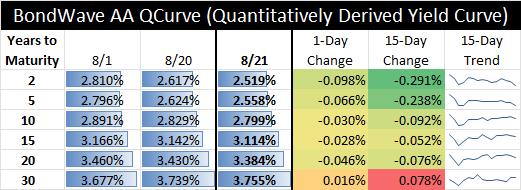
The interest rate table above illustrates recent changes in a sample of AA rated bond trades reported to the Municipal Securities Rulemaking Board’s EMMA® system. Every issuer’s credit is different, and other financing sources may be available. To obtain comprehensive Financial Advisory services for your local government, contact your Ranson Financial Municipal Advisor, Larry Kleeman, or Henry Schmidt.
Johnson County opens a facility for kids in mental health crises
A new Johnson County facility is opening with promises of a more sympathetic approach to helping kids in crisis. It has video games, basketball courts and weekly yoga. It offers couches and a TV — an improvement from the steel bars or hospital gowns at other locations.
Source: Johnson County Post