

Kansas Municipal News
‘Non-resident homeless’ people will be sent to their ‘place of origin’ under Lawrence policy
The City of Lawrence released new details Tuesday about its policy to serve primarily people who are from Douglas County with homelessness resources, and to send others elsewhere. Under the policy, the city provides “non-resident homeless individuals” with short-term assistance and helps them return to their “place of origin,” according to a city news release. Service providers working with the city are expected to follow suit. “We’re not servicing individuals long term that cannot prove that they’re residents, and that’s going to start going into our contracts, because we just don’t have the bandwidth to do that,” Misty Bosch-Hastings, director of the city’s Homeless Solutions Division, said during a meeting last month. The policy has been publicly discussed for at least a month, but the formal announcement of the policy comes a week after the Lawrence City Commission approved putting a question on the ballot to ask Lawrence voters to approve a sales tax to support homelessness services. The majority of people experiencing homelessness who agreed to answer the point-in-time count survey in January reported that they have lived in Lawrence or Douglas County for 12 months or more, according to data from Kristen Egan, Douglas County regional coordinator for the Kansas Statewide Homeless Coalition. Of the 414 respondents counted in this year’s survey, 289, or 71%, said they’d been in Douglas County for more than 12 months; 51, or 13%, said seven to 12 months; and 69, or 17%, said they’d been here for zero to six months. “Our new policy ensures that we prioritize Douglas County residents while offering short-term support to those from other areas,” Bosch-Hastings said in the city’s release. “By focusing on local needs and providing a pathway for non-residents to return home, we can manage our resources effectively and help more people find stability. This approach reflects our commitment to compassionate, practical solutions for everyone in need.”
Source: The Lawrence Times
Hesston told grocery store two years out
With a crowd of standing-room-only and overflow to the outdoors, several hundred people turned out to receive an update on a long-discussed grocery store project at a community conversation at Hesston’s Dyck Arboretum. Brad Heppner, chairman of the board and chief executive officer of Beneficient, was the featured speaker of the conversation, during which he gave a long talk about the history of grocers in Hesston, his vision for the store and revitalization of Main Street, before opening the floor to questions. Hesston has been without a grocery store since 2018. “I’m Hesston,” he said. “My family was one of the 26 founding families in Hesston.” Currently, Heppner said the project cannot move forward until Golden Plains Credit Union has a new building.
As of now, the engineers are in the design stage for the relocation of the bank to a corner of Old 81 Highway and Lancaster. One of Heppner’s Beneficient staff members stated they wanted to complete the design of the new credit union by November or December of this year, with the groundbreaking to begin in January or February of 2025. Once the bank is built, then the project can move into specifically grocery-store-related activity. The people in charge speculate the grocery store is probably two years away from opening, which puts the date sometime in 2026. “Right now, our main objective is to build Golden Plains a new building,” Heppner said. Heppner said he thought they were looking at around two years before the grocery store project could be completed. Heppner is the CEO of Beneficient, which will provide funding for the store through the Technology Enabled Fiduciary Financial Institutions Act, passed in Kansas in 2021.
In exchange for a charter to operate within the state, the law requires Beneficient to dedicate 2.5 percent of the value of its transactions for the benefit of the Hesston area, as well as the Kansas State Department of Commerce. The Beneficient Heartland Foundation is to oversee the portion allocated to Hesston. According to information at Tuesday’s event, the money available to Hesston currently totals $13.9 million. This money is in the form of assets and not cash. “As long as the TEFFI makes money, we should be able to get to projects on the other side of the street,” Heppner said. “If there’s someone who wants to open a business, there are buildings available.” White’s Foodliner is still on board to operate the grocery store once it opens. They estimated it would bring 50 jobs to Hesston of both full- and part-time opportunity. The store will offer a mobile app, loyalty rewards and an endowment for 100 low-income families to be able to purchase groceries. Jordan White said their stores can offer as much inventory as Dillons and will have a deli. Heppner also spoke of plans for an underground parking garage with air conditioning, heating and elevators for the grocery store. Parking will still be offered along Main Street, as well, with a revitalized rustic store front on the east side of Main Street. A website will be launched and linked through the City of Hesston’s website so the general public can see the drawings and track the progress of the project.
Source: Harvey County Now
Newton Fire/EMS receives $500,000 grant
After resourcefully building their own tender to haul water years ago, the Newton Fire/EMS department received just over half a million dollars toward a new fire tender. This will be the first time in nearly 10 years the department has a traditional tender. In 2015, when the engine that hauled 1,000 gallons of water was replaced, the new one only carried half as much. For three years, the department went without a tender. “The city couldn’t afford it,” Deputy Chief Cory Lehman said. In 2018, the department worked together and transformed an old 1983 military truck into a new water tender. “We’ve got a bunch of talent in our department that put it together,” Lehman said. The department applied for the Assistance to Firefighters Grant from the Department of Homeland Security last year, as well, but didn’t get it. This year, they were awarded $518,000. Lehman said they were happy to get it this year, because recipients are rare. “For all the apparatus, only about 10 percent get vehicles they requested,” Lehman said. The old tender no longer met National Fire Protection Association standards for water carrying capacity. Lehman said the city areas aren’t a problem because there are plenty of hydrants, but in the rural areas, it becomes an issue. “In town, you’ve got hydrants all over. Out of town, there’s no hydrants,” Lehman said. He said it would be used for this more. “It’s used a lot more for incidents out of town,” Lehman said. “For rural structure fires.” A release from the city added that the old tender didn’t have the dump valves needed to shuttle water in rural fires. The release said the city was responsible for covering a 10 percent match of $51,818.
Source: Harvey County Now
Washington School’s new lease on life
First built in 1887, the Washington School heard the pitter-patter of young feet for nearly 100 years. The original three-story building was replaced in 1937 with the current one-story structure that served Kindergarten through sixth grade until 1980. For a short while after, it was an adult reading center, then used for storage. In 2008, then-owner Randy Vilela had the building registered as a national historic landmark. In August 2023, Washington School got a new lease on life. Purchased by Point Forward, a local non-profit, the school is currently undergoing a radical remodeling and transformation into a childcare facility. On Tuesday, Point Forward Chairman Ron Scripsick gave a tour of the ongoing work to members of the Point Forward Board, Crawford County Commission, and the press. The transformation is immediate. What had been a deteriorating building is being revitalized into a modern childcare facility. Despite the water damage from a collapsing roof, the building’s masonry skeleton has withstood the years of neglect and has remained solid and firm. An entirely new roof now covers the old school. Inside, metal studs are spaced along exposed brickwork, waiting for the windows to be installed so the drywall can be hung. The new facility isn’t so much a single-building school, but more of a campus. Childcare will be in the old school while a second building is being constructed to the north for pre-K children whose next stop is Kindergarten. A pair of playgrounds will flank the old school and the alley behind it will be converted into a one-way drive for pick-up and drop-off with a parking lot to the east for faculty and parents. The old building, roughly 14,150 square-feet, will feature nine classrooms for children ranging in age from infant to three-and-a-half. The front entrance is flanked by the administrative office and a clinic with a nurse’s station at the south end of the main north-south hallway. Two parallel hallways, running east-to-west, branch of the main hall, bracketing an auditorium between them with the northern hall accessing the kitchen. The auditorium can double as a playground during inclement weather. The new 5,790-square-foot building, situated to the north, will feature five classrooms for children 3-5 years old. The two buildings will be connected by a covered walkway. The total capacity for the school is 256 students. Each class will have two sessions — one morning, one afternoon — with 20 children per session. In all, the project is estimated to cost $5.7 million. To build a similar, newer facility could cost upwards of two to three times as much, according to Point Forward. There are tentative plans to partner with Pittsburg State once the center is up and running. With the main campus a few blocks to the south and the new Gorilla Rising just to the north, Shawn Naccarato, vice president for Economic Development and Community Engagement at Pittsburg State, said there is opportunity for the two to work together, especially with the Reading Center being moved downtown to the Besse. “Many kids without pre-school take until third grade before they catch up to those with pre-school,” Naccarato said. “With the university’s reading center just down the street, we can introduce those programs at an earlier age to increase outcomes.” Naccarato also pointed out possible collaboration with the Kelce School of Business. “You never think about these things until they are right across the street,” he said. Those involved with the project said it will be nice to have children running down the halls of the historic building again. Source: Morning Sun
Debate on Brown County map at commission meeting, NIETC resolution discussed
The Brown County commissioners discussed a press release by Kansas Senator Jerry Moran about opposing the National Interest Electric Transmission Corridor (NIETC) line and also discussing the Brown County map. Commissioner Richard Lehmkuhl was present during the meeting via Zoom video call. Commissioner Lamar Shoemaker brought up the subject of Senator Moran contesting the NIETC proposal and that there would be legislation created to go against the proposal, with the legislation involving banning federal funds to stop the line from going through private property. “The decision will be up to Kansas, not Washington,” Shoemaker said. Pollock asked if there was a moratorium regarding the NIETC line, with Shoemaker stating that a letter would be sent. Hill said that a letter or resolution of support could be done, and that a copy of either could be drafted and reviewed. Lehmkuhl also agreed that a resolution was needed to help give landowners a fighting chance in court against the NIETC line and even said there was a resolution from another county that they could look off and reference from. The next topic was about the land use map. Brown County Attorney Kevin Hill expressed puzzlement why Dick Horton Consulting was having trouble with the Brown County map and that more exploration was needed with the comprehensive plan. Lehmkuhl pointed out that there were volunteers in the Brown County Planning Commission involved in the map planning and said, “I think we already wasted more than $500 dollars talking about it every week and sending things back and forth. Those people come and volunteer their time for free. I think we need to get this accomplished.” Hill argued that the county did not waste any time as this issue as brought to Dick Horton himself three months ago. “The time wasting is not on the county, it’s on them,” Hill said. “I understand what’s everybody’s saying,” Lehmkuhl replied. “I’m just saying for a $35,000 project, we’re here holding up $500 for several weeks and we need to move forward so we can get our comprehensive plan doing. That’s all I have to say.” Hill argued again that the dilemma with the map was reflective of Horton, not on the Planning Commission and that Horton was working for the Planning Commission; he recommended using the map KDOT had and submit that map with towns missing written in. Shoemaker said that the Planning Commission needs to send a letter in written format to follow up and state that they were not using Dick Horton Consulting’s map. The next Brown County meeting will take place on Aug. 30 and it will involve the final decision on the budget for Brown County.
Source: hiawathaworldonline.com
Why is there a tuberculosis outbreak in Wyandotte County?
Nearly 50 cases of tuberculosis have been confirmed in Wyandotte County — more than the total number of cases in the state of Kansas last year. Still, experts say overall public risk is low. Health officials have confirmed 49 cases of the respiratory disease tuberculosis in Wyandotte County, more cases than the entire state of Kansas had last year. Tuberculosis is not widespread in the United States, but 40 states and Washington, D.C., reported increases in 2023. KCUR’s Steve Kraske spoke with Dr. Dana Hawkinson of the University Kansas Health System about the disease, how to treat it and why public risk remains low amid the latest outbreak.
Source: KCUR News
63% of rural hospitals in Kansas at risk of closing
Kansas has seen eight hospitals close since 2015. Now more than 90 hospitals in the Sunflower State are at risk or immediate risk of closing. The Center for Healthcare Quality and Payment Reform (CHQPR) keeps track of rural hospitals that are at risk of closing. Last year, the organization found 600 rural hospitals were at risk of closing. This year, CHQPR is reporting 703 hospitals at risk across the nation. Kansas makes up 8% of the nation’s at-risk rural hospitals and 8% of those at immediate risk. CHQPR cited losses in patient services, insufficient revenue and low financial reserves as factors contributing to hospital closures. “Many hospitals have managed to remain open despite losses on patient services because they receive local tax revenues or state government grants. However, there is no guarantee that these funds will continue to be available in the future or that they will be sufficient to cover higher costs,” CHQPR wrote in the report. Last year, 27 News looked into rural hospital closings and found 58% were at risk of closing. Kansas has had eight rural hospital closures since 2015 and currently has 98 rural hospitals, down from 104 last year. In total, 84% of rural hospitals in Kansas are operating at a median loss with 84 hospitals impacted. There are 62 rural hospitals at risk of closing in Kansas with 63% of hospitals impacted, a 5% increase since last year. There are 31 hospitals at immediate risk of closure impacting 32% of rural hospitals in Kansas, according to the report. Since last year, three additional hospitals were added to the list of those at immediate risk. Expanding the Medicaid program in Kansas,” Senior Vice President for the Kansas Hospital Association Cindy Samuelson said. “That would not only help every hospital in the state, but also thousands of Kansans would have access to healthcare coverage. If we have more hospitals closures and more communities that don’t have close access to care, that really just hurts Kansans.” In 2023, Governor Laura Kelly cited the rural hospital closures as part of her efforts to expand Medicaid: “Already, too many rural hospitals have shut their doors. When that happens, the communities have been devastated. These Kansans have to drive hours now to receive their basic care. There is an obvious way to stop the bleeding: Expand Medicaid.” The last hospital to close down was in Herington last October. Residents in the area now need to travel more than 20 miles to receive emergency care. Last year the HQPR report said increasing payments to prevent closures of at-risk rural hospitals would cost about $4 billion per year and represent only a 1/10 or 1% increase in national healthcare spending. The report said spending would likely increase if more hospitals closed because care would cause residents in rural communities to be sicker and need more future services.
Source: KSNT 27 News
Ordinance discussed for electric vehicles
Chief Wahwasuck also discussed a potential ordinance needed for the electric vehicles around town. “We are looking at working on an ordinance for all the electronic vehicles around town… All the major municipalities have put one in place,” Chief Wahwasuck said. “From what I have gone through looking at them, you have to operate them just like you would a bicycle… Right now, they are restricted on roadways, but a lot of people don’t want them on sidewalks, so it comes down to what do we want? Do we want to keep them on the sidewalks for certain things? Do we want them on the streets? What do we want on the streets?” Wahwasuck said he would recommend possibly restricting electric vehicles from certain streets like Old Highway 75 and Main Street. Edelman also mentioned Oregon being considered as well. Wittmer and Aberle agreed that while rules are becoming necessary, they were hesitant about putting too many restriction on the electric vehicles. “The handful of kids that I know use them as their transportation,” Aberle said. “I think everyone is in agreeance that we don’t want too many rules and regulations, but helmets would be a key one. I think that makes them more visible as well,” Bletscher said.
Source: Sabetha Herald
Municipal Bond Trends for August 27, 2024
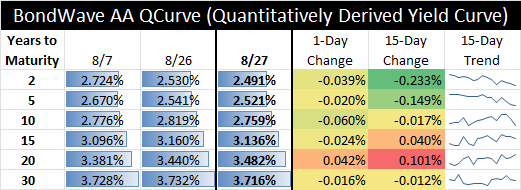
The interest rate table above illustrates recent changes in a sample of AA rated bond trades reported to the Municipal Securities Rulemaking Board’s EMMA® system. Every issuer’s credit is different, and other financing sources may be available. To obtain comprehensive Financial Advisory services for your local government, contact your Ranson Financial Municipal Advisor, Larry Kleeman, or Henry Schmidt.
Municipal Bond Trends for August 26, 2024
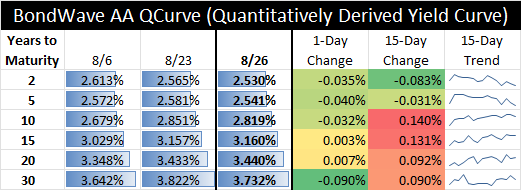
The interest rate table above illustrates recent changes in a sample of AA rated bond trades reported to the Municipal Securities Rulemaking Board’s EMMA® system. Every issuer’s credit is different, and other financing sources may be available. To obtain comprehensive Financial Advisory services for your local government, contact your Ranson Financial Municipal Advisor, Larry Kleeman, or Henry Schmidt.
Lenexa unveils new $73M Justice Center — Here’s a sneak peek inside
After five years of planning and construction, the Lenexa Justice Center opens Monday to the public, with the city’s hopes that it will take Lenexa law enforcement into the future. … In the works since 2019, the $73 million project includes two new buildings with several features aimed at streamlining both police and Lenexa Municipal Court operations.
Source: Prairie Village Post
This JoCo city is the latest to slap new rules on AirBnbs
The Mission City Council last week unanimously approved a new rule imposing a $500 license fee on short-term rentals, as well as a separate nuisance party ordinance that applies citywide. These new regulations follow similar actions taken in other Johnson County cities like Fairway, Merriam and Shawnee, all of which have adopted stricter rules for short-term rentals this year.
Source: Johnson County Post
Forging a new identity: Little Balkans Days turns 39
Next week, for the 39th time, residents of Pittsburg and the surrounding region will engage in a celebration of its colorful and unique heritage. Little Balkans Days is now one of the largest festivals in the area and has become synonymous with the region. It began as an attempt to change the image of southeast Kansas.
Source: Morning Sun
Overland Park Mayor Curt Skoog hospitalized, ‘doing well’ following car accident
Overland Park Mayor Curt Skoog was hospitalized over the weekend following a car accident. … “Mayor Skoog is doing well, recovering in a local hospital, and has a path forward working with his medical providers,” the news release continues. “He is expected to make a full recovery.”
Source: Johnson County Post
Lenexa staff recommend against homeless shelter permit — Here’s why
A Johnson County homeless shelter at a repurposed Lenexa hotel would place an “unreasonable financial burden” on the city and negatively impact properties nearby, city staff say. That, plus the “extremely abbreviated timeline” by which the county is seeking to get the shelter proposal approved, makes up much of the reasoning behind the staff’s recommendation that the Lenexa Planning Commission deny a key permit for the shelter at its meeting this coming Monday.
Source: Johnson County Post
Municipal Bond Trends for August 23, 2024
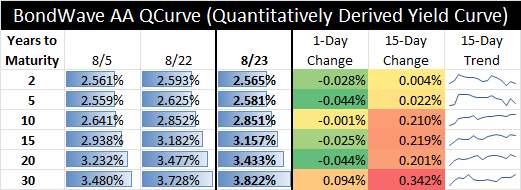
The interest rate table above illustrates recent changes in a sample of AA rated bond trades reported to the Municipal Securities Rulemaking Board’s EMMA® system. Every issuer’s credit is different, and other financing sources may be available. To obtain comprehensive Financial Advisory services for your local government, contact your Ranson Financial Municipal Advisor, Larry Kleeman, or Henry Schmidt.
Arkansas City Fire Department mourns loss of firefighter
The Arkansas City Fire Department is in mourning after the death of firefighter and EMT Trevor Rusk. The ACFD said in a news release Rusk was off-duty at the time of his death. He was a valued member of the ACFD, known for his commitment to the safety and well-being of others. The release said Rusk joined the department on June 5, 2023, and quickly became a beloved colleague. “Trevor was not only a dedicated firefighter but also a friend to many. His courage, professionalism, and selflessness will never be forgotten. We extend our heartfelt condolences to his family, friends, and fellow firefighters during this difficult time,” Fire Chief Stuart Cassaboom said. “Trevor Rusk was an exemplary firefighter whose contributions to the safety of our community were invaluable,” City Manager Randy Frazer said in the release. “His loss is deeply felt not only within the department but across the entire city. We are mourning alongside his family, friends, and colleagues, and we will ensure that his legacy of service is honored in the days to come.”
Source: KSN-TV
Pratt entering Stage 1 of water conservation due to drought
The City of Pratt announced it is entering Stage 1 of its Water Conservation Plan. Stage 1 is voluntary. The city said due to drought conditions, on top of a well failure, it must take steps to prevent loss of drinking water for basic health and safety services. The City of Pratt shared several ways residents can help limit excessive water usage: Only run the dishwasher and washing machine when full, Turn off the faucet while washing hands, shaving or brushing your teeth, Avoid washing cars, boats or other outdoor equipment, Only water lawn or flowers when needed (evening or morning times), Avoid recreational toys that require a constant stream of water, Discontinue water use for non-essential purposes. If you see water leaks, you can report them to the City of Pratt at 620-672-6446, or after-hours at 620-672-3831.
Source: KSN-TV
Garden Plain playground getting new equipment
A playground in Garden Plain will soon have a couple of new items for children to try out. Garden Plain State Bank is giving the city $3,500 in Community Reinvestment Funds to purchase playground equipment for Ternes Park. The money will go toward monkey bars and 12 pebble-path pods, both sized for children ages 2 to 12. The pebble-path consists of individual step climbers that can be adjusted in height. Children jump from pod to pod, improving strength, coordination, and balance. “Our citizens continue to request new amenities, but public funds are very precious and limited,” Mayor Kevin Hammond said in a statement. “It’s often difficult to prioritize recreational projects over mandatory public services such as streets, utility lines, maintenance. Generous contributions such as this help us provide for both services and recreation.” The new equipment is expected to be installed in the next few months.
Source: KSN-TV
Wichita’s emergency shelter poised to open by Thanksgiving
Wichita’s emergency winter shelter aims to open around Thanksgiving, which will be the first project of three for a fully developed multi-agency center, according to announcements during last week’s Homelessness Task Force meeting. Assistant City Manager Troy Anderson said the development of the former Park Elementary school site is being planned as three sequential projects: the emergency winter shelter, the multi-agency center, or MAC, and then the build of low-income housing. Anderson also announced that the state legislature didn’t act on their first right of refusal of the Wichita USD 259 property, meaning that negotiations are officially underway between the school district and the city on the purchase agreement. It should go in front of the city council in the “very near future,” he said. In addition, Anderson said that a request for proposals will soon be posted for who will run daily operations of the emergency shelter from Thanksgiving through the end of March. “(It’s) probably a whole other conversation around the multi-agency center and the ultimate operator of that,” he said. Misty Bruckner, a project director with Wichita State University’s Public Policy and Management Center, said the intention is to develop the MAC as a 501(c)(3), granting it nonprofit status. “Homelessness and people experiencing housing insecurity is a community issue. It’s going to be a community development, so thinking from that governance perspective, the intention is to create a 501(c)(3),” she said at the meeting. “That’s part of the effort — that we provide a governance structure with representatives of the community engaged in helping provide direction, policy efforts and make a connected effort to make this map a reality.” Robyn Chadwick, chair of the Mental Health and Substance Abuse Coalition, presented a draft plan of the MAC’s daily operations. Intake at the MAC will screen each individual for weapons or drugs, she said, with plans to transport someone that could present a safety concern for other shelter clients. “They can be high or drunk, but if they are incapacitated and unable to participate in the services, then we will get them to (the Substance Abuse Center of Kansas) or to the hospital, depending on the level of severity,” she said. “If they’re in a psychiatric crisis, we’ll be transporting them.” The most recent MAC plans also include an onsite pharmacy, laundry and pet kennels. Case management will be onsite, available in the day center.
Source: Local News | Wichita Eagle