

Kansas Municipal News
Salina remains proactive with ‘forever chemicals’
Substances that are commonly referred to as “forever chemicals” show up in everyday items and as they are now being found in drinking water systems across the United States, cities like Salina are taking steps to figure out what’s next. … Martha Tasker, director of utilities for the City of Salina, said the city’s public water supply system was first tested for PFAS in 2014, with results returning as “non-detect,” but at the time, they were testing in parts-per billion, and since then the standards for testing have changed.
Source: Salina Journal
Smallville may be fictional, but the names of these Kansas cities highlight the ‘ville
In celebration of Kansas Day, here are the 24 incorporated Sunflower State cities identified in U.S. Census records as having names that end in “ville,” listed in order of population, plus one in Nemaha County that’s unincorporated but nevertheless has 182 people. The list doesn’t include “Larryville,” a common nickname for Lawrence, or “Aggieville,” the Manhattan bar district.
Source: CJonline
Chapter closes on JoCo’s oldest library branch, but patrons can visit new spot soon
Vaughnie Tinsley and Darline Cyre are eager to turn to the next chapter of their storied love for a library in Merriam. The two friends are among the readers preparing for the permanent closure of the Antioch Library at 5 p.m. Sunday, Jan. 28. With six decades of operation, the library, at 8700 Shawnee Mission Parkway, is the system’s oldest branch. It is being replaced with the new Merriam Plaza Library at 6120 Slater St., scheduled for an official opening on March 20.
Source: Joco 913 News
Overland Park launches effort to address changing College-Metcalf area
Overland Park will study ways to support reinvestment in the busy College Boulevard and Metcalf Avenue “employment hub.” This week, the city is starting the public engagement leg of a months-long process to develop a College & Metcalf Overlay District Study. The resulting document will focus on possible reinvestment in the corridor in the area bounded by I-435 and 119th Street on the north and south and Nall and Metcalf avenues on the east and west
Source: Johnson County Post
Can Johnson County residents vote on controversial city park sale? A judge will decide
The city of Westwood is asking a judge to rule that it can move forward with the sale of its only city park for new development — a move that several residents have hoped to stop at the ballot box with a public vote on the matter. The city last week filed a suit in Johnson County District Court, asking a judge to decide whether a resident petition aimed at preventing the sale of the park is legally sufficient to be placed on the ballot. Residents filed the petition after the Westwood City Council in October, following months of debate, voted 5-1 approving plans for a mixed-use development on 8 acres, including the 1-acre Joe D. Dennis Park at Rainbow Boulevard and 50th Street. Johnson County-based Karbank Real Estate Company is looking to build an office and retail development on the land, which also includes the former Westwood View Elementary School, as well as a piece of vacant city property, previously occupied by the Westwood Christian Church. Karbank has agreed to pay off a $275,000 debt the city still owes on the church property, and has offered the city $2.65 million to purchase the school property from the Shawnee Mission district. It would demolish the building and grade much of the land for the city to build a new 3.8-acre park to replace Joe. D Dennis.
Source: Joco 913 News
BAK riders get set for 50th trip across the state
The 50th Biking Across Kansas tour, the annual celebration of bicycling and the Sunflower State, will hit the highways and byways Saturday through Saturday, June 8-15. BAK organizers revealed this special golden anniversary route at 2 p.m. Saturday, January 20. Online registration will open at 6 a.m. Monday, Jan. 29 at bak.org. “This year marks an amazing half-century for our annual bike tour across the state of Kansas,” said David Rohr, BAK board president. “As we pedal into our 50th year, we want to invite new and veteran BAK cyclists to help us celebrate this milestone. Whether you crossed Kansas with us fifty years ago, last year, or sometime in the decades in between, we welcome you back to ride in 2024. Participants will enjoy the fun of traveling with this friendly community of bicyclists, taking in the beauty of the Kansas landscape, and experiencing the warm hospitality of the Kansas towns and people.” The 2024 route begins just west of Tribune, KS where the first tour began in 1975. Riders will cover approximately 489 miles in the span of a week, staying overnight in Scott City, Ness City, Hoisington, Lincoln, Concordia, Frankfort, Holton, and concluding in Atchison, KS on the banks of the Missouri river. Riders pedal between 50 and 80 miles each day. With this many cyclists on the roads, BAK organizers urge motorists to be vigilant and share the roadways, said Executive Director Bryan Toben, noting state and local law enforcement will be helping keep everyone safe. Riders may be in groups or alone, and they may be strung out over several miles.
Source: Dodge City Daily Globe
Pittsburg Fire and Police Departments participate in Battle of the Badges
The Pittsburg Fire and Police Departments participate in another year of Battle of the Badges Chili Cookoff with the American Red Cross. People donating blood today and tomorrow can try both types of chili and then vote for their favorite. Organizers say the event has brought in more than a hundred sign ups for donations. The Fire and Police Departments both say the competition is heating up this year.
Source: KOAM News
City of Emporia begins community survey process on priorities, programs and services
The city of Emporia is into a community survey designed to get “crucial information and feedback” on city priorities, programs and services. The city effort follows a 2022 collaboration with the ETC Institute on a similar survey. The goal with this survey is to compare perspectives on items including but not limited to communications, facilities, streets and sanitation. The city is requesting “candid feedback” for “a deeper understanding of areas for improvement and concerns,” saying survey results will have a big role in upcoming city decisions. Several residents have already received a mailed survey. The survey will go online at a later date. Word on when results will be posted is pending.
Source: KVOE Emporia Radio
School bond approved
Hillsboro schools will get infrastructure improvements after a 464-59 vote Tuesday to approve a $13.35 million bond issue.
Among items to be funded will be a tornado shelter, heating and air conditioning upgrades, a new stage and auditorium sound system, new plumbing, secured entrances, new gym bleachers and new fire alarms, new roofs, and a greenhouse.
Source: Marion County RECORD
JoCo Library’s original branch is closing. Here’s a look back at its nearly 70-year history.
The original branch in the Johnson County Library system is getting set to permanently close its doors after nearly 70 years in operation. Antioch Library, 8700 Shawnee Mission Pkwy., will cease operations after Sunday, Jan. 28, in order to make way for the new Merriam Plaza Library branch nearby. The Antioch branch first opened in 1956 as Johnson County Library’s first official branch and served as the county library system’s headquarters for decades before Central Resource opened in the mid-1990s. “Everybody just loves this branch,” Assistant Branch Manager Sheida Bates is quoted in a post to the library’s website. “And the people who grew up coming to the branch are now bringing their kids here.” Its replacement, Merriam Plaza, is set to open its doors for the first time on March 20 next to the Merriam Community Center just a few blocks away from the Antioch branch. No patron services will be available at either Antioch or Merriam Plaza branches during the transition. A new library branch co-located on the same site as the community center is several years in the making, and it’s a concept also being explored in Prairie Village with the county’s second-oldest library branch at Corinth.
Source: Johnson County Post
City says approach to housing needs should be ‘flexible’
Manhattan city commissioners on Tuesday agreed housing incentives should be as flexible as possible. In an initial discussion about how to use sales-tax revenue to develop workforce housing, the commission acknowledged Manhattan is in a housing crisis and that it needs to take steps to address that. “We do a lot of studies at the city,” mayor Wynn Butler said. “We do a lot of talking at the city, and now it’s time to take some action on the housing. So I think that’s where we are going. I think the commission all agrees with that philosophy.” City staff asked the commission for direction about how to use funds from the 0.5% economic recovery and relief sales tax, which voters passed in 2020. Seventy percent of that revenue is dedicated to paying down city debt and fixing infrastructure, 20% to creating new jobs and 10% to workforce housing. Kristen Dolf, assistant to the city manager, said the city projects a total revenue of $80 million between 2023 and 2033. That means an estimated $8 million will be available for workforce housing. Over the past year, the Workforce Housing Steering Committee has reviewed the housing market challenges and discussed the “workforce housing initiatives” portion of the sales tax. Some of the committee’s recommendations include incentives on projects like higher density housing, prioritizing housing projects over parking developments, avoiding repetitive actions like studies and avoiding specific requirements for the sales tax funding.
Source: themercury.com
Municipal Bond Trends for January 25, 2024

The interest rate table above illustrates recent changes in a sample of MBIS “investment grade” yields. Every issuer’s credit is different, and other financing sources may be available. To obtain comprehensive Financial Advisory services for your local government, contact your Ranson Financial Municipal Advisor, Larry Kleeman, or Henry Schmidt.
Former Wilson Czech Opera House to become open-air theater
The Wilson Czech Opera House has made strides in restoring the property after a fire that burned most of the building. Constructed in 1901, the opera house, 415 27th St. in Wilson, was initially called Turner Hall, made from quarried stone from five miles outside of Wilson…. In November 2009, a fire from a neighboring building spread to the opera house, reducing the venue to ruins despite attempts to extinguish the flames. … Fully rebuilding the opera house proved to be an unachievable task, as Ford said the expenses could exceed well over $10 million. To preserve the remnants of the opera house, the choice was made to transform the property into a distinctive location. “It would be a unique venue for Wilson to have an open-air theater, we would still get to see the beauty of these stone walls,” Ford said.
Source: Hays Post
Students name new Valley Center subdivision
The Valley Center City Council last week approved the final plat for Harvest Place near 93rd North and Meridian…. The subdivision and the roads in it were named by Valley Center school district students during a contest initiated by the city. The middle school contributed Spirit Court, the high school Stinger Avenue, Abilene Elementary Sunflower Drive and Sunflower Court, Wheatland Elementary Hornet Lane and Hornet Court, the intermediate school Chance Avenue and West Elementary Harvest Place. “It was fun to have the school district involved through the naming process of the subdivision and some of the streets that will lie therein,” said Ryan Shrack, the city’s development director.
Source: AV News
Municipal Bond Trends for January 24, 2024

The interest rate table above illustrates recent changes in a sample of MBIS “investment grade” yields. Every issuer’s credit is different, and other financing sources may be available. To obtain comprehensive Financial Advisory services for your local government, contact your Ranson Financial Municipal Advisor, Larry Kleeman, or Henry Schmidt.
Topeka’s welcoming nature drawing attention of large media outlets, mayor says
A Wall Street Journal reporter was in Topeka on Tuesday working on a story expected to highlight its welcoming nature, after the city benefited from a Telemundo story that did the same thing last October, Mayor Mike Padilla said. The Wall Street Journal story is anticipated to focus on a family of Colombian immigrants who live in Topeka and hope to stay here permanently, Padilla said at his monthly news conference with interim city manager Richard U. Nienstedt.
Source: CJonline
Overland Park is overhauling its long-range development plan. Where do things stand?
Overland Park is getting closer to adopting its first new long-range land use plan in decades, which will serve as the roadmap for development into the future. The much-anticipated draft plan was recently handed over to city planning staff for a preliminary review, Overland Park’s Strategic Planning Division Manager Erin Ollig told the Overland Park Planning Commission earlier this month. Right now, city planners are going through some edits and revisions with the consultant. That puts the Overland Park City Council on track to finalize the plan — dubbed FrameworkOP — in the next few months, likely early in the summer. The city’s existing comprehensive plan is roughly 40 years old, adopted at a time when Overland Park was home to fewer people and its overall footprint was smaller.
Source: Johnson County Post
City leaders give update on Topeka’s city manager search
City leaders are getting closer to selecting Topeka’s next permanent city manager. Richard Nienstedt has served in the interim position since June, 2023 when former City Manager Stephen Wade took an extended leave of absence and was ultimately fired. Alongside Mayor Mike Padilla at a city briefing Tuesday, Nienstedt said the city is working with a consultant to hire a long-term city manager. He said he anticipates the city council will have a list of candidates by mid-February or the first of March. Nienstedt said finding the right city manager for this city will take time. “This is an important city in the state. This is the Capitol City, one of the largest cities, and it deserves the best city management that the council can get. So, taking their time helps ensure that.” A city spokeswoman told 27 news Wade was fired for having an inappropriate relationship with a subordinate. Wade is demanding $100 million from the city for wrongful termination.
Source: KSNT 27 News
New Johnson County assistant county manager Adam Norris begins work
Johnson County Government is proud to announce that Adam Norris, who has 20 years of executive leadership and management experience in government, has joined its leadership staff as assistant county manager. Norris began his duties on Jan. 22. Most recently, Norris was deputy city manager and assistant city manager in Independence, Missouri, though his career in public service had its start in Johnson County. While still in school, Norris worked for the Overland Park Public Works Department where he repaired potholes, served on chip and seal teams, and even provided traffic control. “From an early age, I knew I wanted to dedicate my life to making communities and the lives of others’ better,” Norris said. “Serving local governments is a passion that has enabled me to fulfill both of those goals and so much more.” Norris’ achievements at Independence included developing and implementing a five-year financial forecast, overseeing economic development projects, leading several organizational restructures/department mergers and creating the city’s health department and local public health authority. After Norris’ departure, Independence restructured and appointed two people to replace him. Norris received a Bachelor of Arts in Interdisciplinary Studies from the University of Missouri – Columbia and his Master’s in Public Administration from the University of Kansas. After graduating from college, Adam began to build a career in local government by working in city manager/administrator offices in Blue Springs, Overland Park and Mission Hills in the Kansas City metro area as well as in Dallas, Texas. “We’re thrilled to have someone of Adam’s caliber and experience working in Johnson County Government,” said County Manager Penny Postoak Ferguson. “He knows the Kansas City area and has worked hard to improve every community in which he’s been employed. His experience navigating complex projects and situations aligns well with the work we do every day, and he is a proven and dedicated public servant.”
Source: Johnson County Kansas |
Leawood weighs reducing office space quotas required in mixed-use projects
Revisions to Leawood’s zoning requirements soon could reshape how developers approach mixed-use projects. Leawood’s current mixed-use zoning requires developers to dedicate a certain percentage of a project for specific uses, setting quotas of 15% for office space, 5% for retail and at least 15% for residential. In an effort to keep up with economic trends in commercial real estate, city leaders will review an amendment to the Leawood Development Ordinance softening those ratio requirements for mixed-use projects. The change has been prompted by feedback from local developers representing projects along the 135th Street Corridor. Last fall, the City Council received a letter from area developers voicing concerns about the use percentages set in the city zoning requirements, amid a stiff decline in demand for office space. The planning commission now will consider a revised proposal, scaling back some of the ratio quotas for mixed-use projects. Under the proposed revision, at least 20% of a mixed-use project must be committed to commercial space, with at least 5% set aside for retail and 5% dedicated to office. Residential uses in mixed-use zoning would remain at 15%. The proposed change would prohibit all commercial uses in a mixed-use project from being solely office or retail space. The Leawood Planning Commission will review the latest proposed revision to the zoning code and host a public hearing on the matter at 6 p.m. Tuesday.
Source: Kansas City Business Journal
How many Wichita schools could close? Superintendent answers that and other questions
Source: Local News | Wichita Eagle
Healthcare tops concerns for rural Kansas townsfolk
Rural Kansas communities are critical to the future of our state. We know that for our communities to thrive, rural Kansans require core services to raise a family — access to early childhood services, high quality education and health care. Our two organizations — Thrive Kansas and United Methodist Health Ministry Fund — are based in rural communities and are invested in improving the health and future of all Kansans. We are committed to improving the health of rural communities and support innovative policies that sustain health care and encourage the development of vitally important services. To better understand rural Kansans’ concerns and ideas, late last year we hosted community conversations on the future of rural health care and Medicaid expansion in Atchison, Dodge City, Colby, Hays and Pittsburg. The events drew community members, local and state leaders, businesses and health care providers. Five key topics — Medicaid expansion, behavioral health, workforce, child care and financial pressure on providers — were raised in each community. Here are our takeaways. The top issue raised was Medicaid expansion. Meeting attendees expressed frustration that many of their working neighbors are uninsured. They recognized that one reason for this is because Kansas has not expanded Medicaid and that by not participating in this program, the state is contributing to higher uninsured rates in Kansas’ rural counties. The biggest factor driving our high uninsured rates is the strict limits on who can qualify for Medicaid, the state’s health program for low-income families. For example, an uninsured single parent with two children must earn less than $4.75 an hour to qualify for Medicaid. If you don’t have children you cannot qualify at all, no matter how little you make. Expanding Medicaid would increase eligibility for health care from $9,446 to $34,307 yearly income for a family of three and help provide access to health coverage to an estimated 150,000 residents. We heard stories about how these strict income limits prevent hardworking rural Kansans from getting care — such as a farmer who could not afford to treat his diabetes and lost his foot. We heard about others who put off care, resulting in missed cancer diagnoses that had devastating impacts. At each meeting, attendees understood that expanding Medicaid meant their uninsured neighbors, as well as tens of thousands of Kansans, would be able to go to a doctor when they’re sick and pay for prescription drugs. Rural Kansans know that we all benefit when our neighbors can get the care they need. Community members, business owners and health care providers who attended these conversations quickly highlighted that the growing uninsured rate in rural Kansas was not just negatively impacting their neighbors’ health but was negatively affecting the bottom lines of health care providers, putting them at financial risk. Kansans know that more uninsured Kansans means more unpaid bills for providers. When patients can’t pay for care, it is categorized as uncompensated care. When providers have uncompensated care, it challenges their ability to remain financially viable and also means that we all — individuals, families, businesses — end up paying more for health care. In rural Kansas, it also means increased local taxes. With increasing rates of uninsured residents and high levels of uncompensated care, Kansas has 59 financially vulnerable hospitals, more than any other state. In Kansas, 44% of the uncompensated care at rural critical access hospitals could be eliminated if we expanded Medicaid.
Source: The Iola Register
Council members agree to ‘start small’ during debate over city-run recycling
Heeding the warning of “start small,” Iola Council members agreed to a phased approach to recycling Monday evening. Members discussed the potential of establishing a city-run recycling utility, agreeing it would be best to start small and gradually expand the initiative. The ultimate vision includes weekly residential curb-side pick-up of recycling materials and would require a three-person crew for pick-up; two-person crew for sorting and baling. A monthly fee of $15 would be necessary to pay for the additional service. A substantial portion of the proposed initial costs would be dedicated to the construction of a building modeled after Nemaha County’s recycling center. The projected initial infrastructure investment of $585,000 would go towards the sorting center, a truck, and baler. The utility would have a projected annual cost of nearly $384,000. Council member Jon Wells expressed reservations about the financial feasibility of the project, citing the city’s current inability to fund the 54 Highway rebuild. He suggested the council explore grant opportunities before committing to a significant initial investment. “There’s a lot more needs elsewhere in this community that we could spend that money on,” said Wells. “It could go towards two or three splash pads, essentially. I think we could do better for the community with that money.” City Administrator Matt Rehder noted there currently isn’t a location where the material would go after baling, with the exception of cardboard and No. 9 plastics which would go to the Allen County landfill. City administration recommended the council not establish the new utility but, if they do, recommended a year-long ramp up to establish working capital and to try to find a home for material. The first step in this ramp-up would be to amend the solid waste fee to $30 per month, or add a line item to the monthly utility fee for recycling at $15. Council member Joelle Shallah expressed concern about the potential impact on residents, particularly in terms of utility bill increases. “I cannot even, in my own conscience, think to raise somebody’s utility bill $200 a year,” she said. She advocated for a county-led effort with city collaboration and proposed exploring drop-off containers as a starting point. Shallah emphasized the importance of researching and assessing the community’s response before moving forward. “All these other recycling facilities in surrounding communities are under water,” she added. “They’re struggling. Fredonia is another one — they had a program and they shut it down.” Mayor Steve French provided insights into the county’s recycling efforts, highlighting the cautious approach they have adopted, starting with small-scale initiatives at the landfill.
Source: The Iola Register
Fast food hamburgers are helping Kansas ranchers save dwindling native grasslands
Kelly Anthony, a cattle rancher in southwest Kansas, drives through his pasture, blaring a siren he uses to get the attention of the herd. As he flicks it on and off, the cattle surround the truck. Cattle ranching has been Anthony’s way of life for 25 years. Cattle ranches fuel the beef industry and the western Kansas economy. People like him also own much of the remaining native grasslands that once covered 71 million acres of the southern High Plains. Now, 80% of those native grasslands in Kansas are lost, and cattle ranchers like Anthony could be the key to saving what’s left. A new program backed by conservation groups and the beef industry hopes to work with ranchers to conserve and restore more land. “I really think that ranchers as a whole are the best stewards of the land, because the capital requirement to be in the cattle business is so high, the biggest portion of that is land,” Anthony said. The native grasslands lost out to profitable fields of corn and other crops, while also being crowded out by invasive species. Anthony hops on his horse and rides in front of sloping hills to count his cattle. Just past the hills are acres of untouched native grasses vital for a variety of species, like pronghorn deer and grassland birds including the lesser prairie chicken. Last year, The Nature Conservancy started the Southern High Plains Initiative, backed by big brands connected to beef like Burger King and Cargill, which each contributed $5 million. Ultimately, the program so far has $42 million invested across five states to preserve or restore nearly 30 million acres of intact grasslands. The program is using market-based incentives, basically payments, to ranchers who will preserve grassland or convert crops back to grass. Agreements could last up to 15 years in some cases with annual payments of $45 per acre. But success will mean convincing ranchers in Kansas and elsewhere to get on board. Some, like Anthony, are a little skeptical. Ranchers are often careful who they support and protective of their lands. Sometimes, conservation groups also come with negative connotations. Matt Bain is the Southern High Plains Grassland project manager for The Nature Conservancy. He said overcoming that skepticism will be key to making this work. “Part of this process is to identify the barriers and to quantify them in a way that really hasn’t been done,” Bain said. The southern high plains cover parts of Kansas, Colorado, New Mexico, Texas and Oklahoma.
Source: KAKE – News
Liberal repeals ordinance on color of buildings after pink building controversy
On Tuesday, the Liberal City Commission repealed the ordinance requiring color changes in the Kansas Avenue Overlay District to get approval from the zoning and planning commission. The vote to repeal the ordinance passed 5-0. “[If] someone wanted to do something as minor as paint, paint the building, right? They could add a month to their project, just waiting for the proper approval. And that’s the kind of thing we’ve been trying to get to get away from,” said Liberal Vice Mayor Jeff Parsons during the City of Liberal Commission Meeting on Tuesday. The repeal comes after a local business, Chikas Fresas, was forced to stop painting the exterior of their building pink. They were later allowed to finish the exterior renovations until the city’s planning and zoning commission came to a decision. On Jan. 11, the city’s planning and zoning commission held a work session where they voted to approve the color. In 2023, the owners of Chikas Fresas purchased a building on Kansas Avenue in Liberal to expand their business. They received approval for their interior renovations but said that the city inspector told them that they didn’t need any permits for the exterior. The owners decided to paint their building pink, the business’ signature color. Midway through the process, the city issued a correction notice to stop immediately with the color and all exterior renovations. Jose Lara, the Mayor of Liberal, said that the city doesn’t follow a specific color scheme and decided to push for a repeal of the almost 20-year-old ordinance. Chikas Fresas hopes to open in early February.
Source: KSN-TV
Counties where children have the best opportunity for economic mobility in Kansas
Americans have long understood that their birthplace can significantly affect their futures, and academics have increasingly been able to connect tangible early life factors like where they live and the friendships they’ve cultivated with potential future income. Among the most recent studies shedding light on what’s known as economic mobility—a person’s ability to move themselves and their families up the socioeconomic ladder over their lifetime—are a series of papers authored by Harvard University researchers leveraging vast troves of social networking data. As part of a national analysis, Wealth Enhancement Group used data from Harvard University’s Social Capital Atlas project to identify where in Kansas children have the best (and worst) chances at upward economic mobility. The research draws on a privacy-protected dataset representing 21 billion friendships from Facebook made public through its parent company Meta’s Data for Good project. It also uses anonymous tax records, according to the authors. The scholars assigned a score to locales according to how economically connected low- and high-income people living in the area have historically been over at least a decade, per that data. The dataset does not include scores for about 180 of the 3,000 or so counties in the U.S. The research attempts to fill in the gaps of previous efforts to study American economic mobility that did not consider a person’s vast social networks nor their importance in creating better lives for themselves and their children. It turns out the ability to cultivate friendships linking people of different socioeconomic backgrounds with one another is the strongest factor in determining whether a child can surpass the earning potential of their parents, Harvard researchers found. They call this economic connectedness. Click the source link to find out where economic connectedness is strongest in your state.
Source: Local News | Wichita Eagle
‘Chicken on the lam’: Junction City cops nab rogue chicken after weeks-long pursuit
The Junction City Police Department (JCPD) says a feathered fugitive has been taken into custody on Thursday. On Jan. 18, the JCPD took to social media to share with the public that the local “chicken on the lam” was successfully captured by an animal control officer. This chicken was on the loose for weeks in the Junction City area, with numerous locals and organizations reporting sightings on social media in late December, 2023 into January, 2024. “We’re thrilled to report that she’s now pecking around happily in a loving home outside the city limits, where she can cluck to her heart’s content,” JCPD social media statement excerpt. While the situation is humorous, the JCPD took the opportunity to remind locals that owning chickens in city limits is not allowed. Under section 215.040 of Junction City’s municipal code, it is unlawful for anyone to keep or harbor fowl within the corporate limits of the city.
Source: KSNT 27 News
Overland Park lands College Baseball Hall of Fame. And Patrick Mahomes helped.
Prairiefire in southern Overland Park will be the new home of the first-ever permanent College Baseball Hall of Fame. State and local leaders, as well as representatives from the College Baseball Foundation which oversees the Hall of Fame, announced the decision on Tuesday at an event at the Museum at Prairiefire on 135th Street. The new Hall of Fame is expected to open late next year in a space in the museum previously set aside for traveling exhibits. Warren Wilkinson, president and CEO of Visit OP, the city’s tourism bureau, called it a “historic milestone” for the city. “Prairiefire was built for this moment,” Wilkinson said during the announcement event Tuesday. “Working together we have not only secured a permanent home for the College Baseball Hall of Fame, we’ve intentionally created a unique place that elevates our destination and supports our tourism strategy.” In a news release that accompanied Tuesday’s announcement, College Baseball Foundation officials said they selected Overland Park after an “extensive search” for a permanent home for its Hall of Fame, which has been inducting classes of honorees since 2006. The College Baseball Foundation said Kansas City Chiefs quarterback Patrick Mahomes played an “instrumental role” in finalizing the deal to settle on Overland Park. Mahomes played college baseball at Texas Tech and is also the son of a former Major League Baseball pitcher. “Mahomes’ commitment mirrors a love for the game fostered by watching his father play professional baseball, a steadfast dedication to preserving the heritage of college baseball and a genuine enthusiasm for providing a space where budding athletes can envision a promising future,” the Foundation’s release said. “Baseball has been a huge part of my life, and I was fortunate to play the game in college,” Mahomes is quoted in the release. “I’m excited for the College Baseball Hall of Fame to call Overland Park home and join the community that I love so much.” It’s the latest involvement for the two-time Super Bowl-winning quarterback in a Kansas City area sports venture. He is also part owner of the Kansas City Royals, Sporting KC and the KC Current. Overland Park and state officials promised immediate financial returns once the College Baseball Hall of Fame opens in 2025. “Bringing a cultural gem such as the College Baseball Hall of Fame to Overland Park will add to our state’s strong array of top-notch tourist attractions and will provide a solid boost to both the local and state economies,” Democratic Lieutenant Gov. David Toland said. Overland Park officials forecast a “multi-million dollar impact” once the Hall of Fame opens next year. Wilkinson said Tuesday 150,000 visitors are expected in the first year, with an estimated economic impact of $25 million over five years. The College Baseball Foundation’s annual Night of Champions, meant to honor collegiate baseball’s top performers and stars, is already set for Feb. 15, 2024, at The Marriott Overland Park hotel.
Source: Johnson County Post
Celebrating four decades of fire service
Longtime Osawatomie Fire Chief Brian Love has had a passion for fighting fire ever since he was 12 years old and going on fire runs with his dad, Bob, in Hiattville, Kan. Bob was a volunteer firefighter and farmer in the rural community southwest of Fort Scott, and Brian has childhood memories of the fire phone ringing in the house when there was a fire. “It would sound one solid ring until someone answered,” Brian said. “When we picked it up, we would just listen to get the details of the fire. It was like a party line.” After high school, Brian followed his passion to the Fort Scott Fire Department, where he worked full-time for two years before joining the South Johnson County Fire Department covering Aubry, Stilwell and Spring Hill. He worked there for 10 years, working his way up to captain. In 2003, Brian built a home in Osawatomie and started volunteering with the Osawatomie Fire Department. He also started working for the Kansas State Fire Marshal Office as a fire prevention inspector. He steadily moved up the ranks at the Osawatomie department, and he was named chief in 2013. Brian has spent the past 20 years of his 40-year career fighting fires in Osawatomie and training the next generation of firefighters, but he has decided it is time to retire and move on to the next stage of his life. “My brain and my body tell me it’s time,” Brian said. Members of the community were able to wish Brian well and thank him for his service during a retirement reception that took place Saturday, Jan. 20, in Osawatomie. Brian said when he looks back on his career, it’s not individual honors or specific fires that stand out to him. “I’m more proud of the people that I’ve trained who are now officers in other departments,” Brian said, adding that he has worked with firefighters who are ow officers in Kansas City, Mo., Johnson County, Lawrence, Topeka and other areas. Brian also is appreciative of the officers who trained him, and all of firefighters who have been by his side over the years.
Source: Local News | republic-online.com
Westwood wants judge to rule in legal back and forth over controversial project
The city of Westwood has filed a lawsuit seeking a judge’s ruling on whether a state law applies to the sale of Joe D. Dennis Park to make way for a much-discussed new office and park development on Rainbow Boulevard. The city last week filed the lawsuit in Johnson County District Court seeking a declaratory judgment on three items — including whether the law, K.S.A 12-1301, applies to the sale of Joe D. Dennis Park at the corner of 50th Street and Rainbow. That statute specifically deals with the sale of public park land, and a group of Westwood residents has argued the city should have followed it when going through with the sale of Joe D. Dennis Park to clear the way for the development. Mission Woods-based Karbank Real Estate Company plans to build multiple office and retail buildings where the park currently sits along Rainbow. In exchange, the company also plans to create a new, bigger park on adjacent land nearby where the current Westwood View Elementary sits. Residents, who have organized under the banner Friends of Westwood Parkland, have pushed back on the proposed development for months now. The city’s latest lawsuit comes after the Westwood City Council unanimously invalidated a resident-led protest petition. That petition called for the city to apply K.S.A. 12-1301 in proceeding with sale of the park, and also called for a public vote on the Karbank project.
Source: Prairie Village Post
Municipal Bond Trends for January 23, 2024
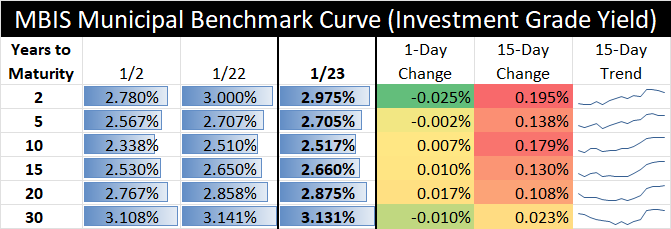
The interest rate table above illustrates recent changes in a sample of MBIS “investment grade” yields. Every issuer’s credit is different, and other financing sources may be available. To obtain comprehensive Financial Advisory services for your local government, contact your Ranson Financial Municipal Advisor, Larry Kleeman, or Henry Schmidt.
Topeka and police chief seek suit dismissal
Topeka’s city government and Police Chief Bryan Wheeles filed a motion for summary judgment Friday seeking the dismissal without trial of a gender discrimination suit filed last January by three female Topeka police administrators. The motion includes explanations of Wheeles’ reasoning behind key decisions in which he chose to promote men instead of the women who filed the suit, Major Jana Harden and Capts. Colleen Stuart and Jennifer Cross. In each case, the document says, Wheeles picked the best person for the job. “The Plaintiffs have been promoted by males and over males for the entirety of their careers,” the motion said. “COT (the City of Topeka) and Chief Wheeles had legitimate, non-discriminatory reasons for the promotional decisions and Plaintiffs were not otherwise similarly situated in all material respects to those promoted.” The motion includes a 60-page document outlining the arguments of Wheeles and the city as well as more than 400 pages of attachments, including statements from Wheeles; Stuart; Harden; Cross; Topeka police administrators Jamey Haltom, Steven Purney and Jerry Monasmith; former Topeka city manager Brent Trout; former Topeka human resources director Jacque Russell; and former Topeka Police Chief and interim city manager Bill Cochran. What does the lawsuit allege? Attorneys representing Stuart, Harden and Cross filed a three-count federal civil suit in January 2023 in U.S. District Court against Wheeles and the city. The three remain with the Topeka department. The suit alleges the city “treats female officers differently than male officers to the detriment of those female officers and the department.” It contends the city passed Stuart, Harden and Cross over for promotion because they are female. Both sides are asking for a jury trial, which is expected to last about 10 days. The location hasn’t been set. Wheeles and the city ask that the trial be held in Topeka, while Stuart, Harden and Cross ask that it be held in Kansas City, Kansas. Stuart, Harden and Cross are asking for more than $7 million in damages between the three of them, plus whatever amount a jury may decide to award for punitive damages they are seeking. They’re also seeking payment for attorney’s fees, which a pretrial order said totaled $518,155 as of last month. Have any of the three officers been promoted since the suit was filed? When Stuart, Harden and Cross first filed the lawsuit, Harden and Stuart were Topeka police captains and Cross was a lieutenant. The city effective April 1 promoted Harden to major and Cross to the captain’s position being vacated by Harden. Stuart, Harden and Cross consider those to be “sham promotions,” made only because they sued the city, the pretrial order said.
Source: CJonline
Kansas Attorney General Opinion 2024-1: Zoning beyond city limits
Synopsis: Although the Kansas Legislature may legally permit a city to impose its land subdivision requirements on county residents within three miles of city limits, it should be cautious when granting cities extraterritorial authority. Cited herein: K.S.A. 12-749.
Read more: Opinion No. 2024-1
Municipal Bond Trends for January 22, 2024
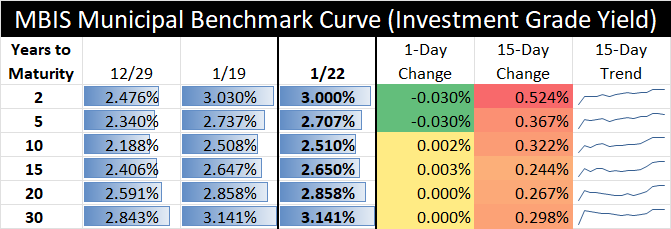
The interest rate table above illustrates recent changes in a sample of MBIS “investment grade” yields. Every issuer’s credit is different, and other financing sources may be available. To obtain comprehensive Financial Advisory services for your local government, contact your Ranson Financial Municipal Advisor, Larry Kleeman, or Henry Schmidt.
Planning Commission advances new wind energy regulations for Douglas County
The Lawrence-Douglas County Planning Commission voted 6-3 early Tuesday morning to move forward with a new set of wind energy regulations at the end of a meeting that stretched six hours. … Commissioners aimed to balance the need for rigorous regulations that protect Douglas County against the need to allow continued renewable energy development. The result was a set of new regulations with a series of modifications derived from public comments and commission discussion over the last few months.
Source: The Lawrence Times
Wichita plans to close a number of elementary, middle schools at end of school year
An unspecified number of Wichita schools will be closed at the end of the school year to help offset a looming $42 million budget shortfall. Staff will make recommendations on which schools should be closed and why at the next school board meeting on Feb. 12. Decisions will be finalized by spring break, after ample opportunity for public input, Superintendent Kelly Bielefeld said. Closures will be limited to elementary and middle schools because of the logistical challenges of relocating 1,000 to 2,000 high school students.
Source: Wichita Eagle
Pickleball noise has become nuisance at this Prairie Village park. Is there a fix?
Prairie Village residents who live near Windsor Park will need to wait on any pickleball noise relief. The Prairie Village City Council on Tuesday voted 9-2 to send the pickleball noise issue at Windsor Park back to the city’s parks and recreation committee for a solution. Some residents near Windsor Park have complained about pickleball noise — what has become both a national and local uproar — since six courts were installed in June.
Source: Johnson County Post
How costly will the boil water advisory be for Topekans?
Topekans will see only a trickle of additional costs, if any, due to the problem that forced the city last week to declare a boil water advisory, city officials say. The city, which uses about 20 million gallons of water on a normal day, was able to flush the entire 60 million gallons involved through its distribution system in about three days, co-interim city communications director Rosie Nichols told The Capital-Journal Friday.
Source: CJonline
County Commission approves state of emergency from Jan. 8-9 storm
The Finney County Commission approved a severe winter weather emergency declaration for the Jan. 8-9 blizzard at its regular meeting on Tuesday. During the week of the storm, Commission chairman Gerry Schultz declared the emergency, but it needed to be confirmed by the Commission Tuesday’s meeting. Paul Resley, Finney County Emergency Management Director, said the emergency declaration was needed because they got inundated with the snow and wind from the storm. “We had so many people stranded that we were losing resources faster than we could find them,” he said. “So, we were reaching out for some help. The governor eventually did declare an emergency as well, that helped a bunch.” Resley complimented the county residents, that they stepped up to help people, especially people they couldn’t get to. “We had no injuries or deaths throughout all this, so, we were very, very fortunate there,” he said. Over 60 people that were stranded were picked up during the storm, Resley said. The furthest they went to help pick up somebody was 27 miles east of Garden City. It was a bit difficult to get to that person due to the vehicles already blocking the road, Resley said. Thankfully, a farmer helped them out and took them to where they get out a brush truck and bear cat out to rescue them. During the rescue, they checked in with the person every half an hour, seeing how they were doing and how much gas they had. A lot of phone calls were made that day trying to find resources, Resley said. County road employees were a bunch of help, especially when they had to dig through snow drifts to get people out from vehicles. “All-in-all, I can’t say enough about everybody that worked through all this with us,” he said.
Source: Garden City Telegram
‘Some days, you just might have to rescue a swan’: Wichita firefighters trek onto ice
Source: Local News | Wichita Eagle
WFD welcomes new recruits following graduation from training
After 14 weeks of training, the Wichita Fire Department welcomed a new batch of recruits on Friday. The class was the third class of 2023. Class instructor and WFD lieutenant Clint Gifford said they’re not starving for candidates, so they find the best of the best. “That would be our third class of the year 2023,” Gifford said. “A lot of participants would like this job. So it’s something that we haven’t struggled with. We still get the candidates that we need that are top-notch.” New WFD graduate Reed Norris said he’s taking up the mantle his grandfather had in Wisconsin as a firefighter, and he’s excited to serve Wichita. “My grandfather was a fireman back home in Wisconsin, where I came from,” Norris said. “But getting the opportunity to go to the firehouse and experience the difference that these individuals were making for the community was something that I found at a young age and that I found to be important. Something that I wanted to continue.” Norris also said he’s ready to hit the ground running to help people. “What I’m looking forward to most is getting the opportunity to take all of these skills and knowledge and experience that we’ve gathered from the instructors and use it to actually make that difference in someone else’s day,” Norris said. Wichita Mayor Lily Wu was also on hand to speak. “They respond with skill and swiftness,” Wu said. “Help those in need or in danger.” Brent Fischer, another graduate, said he appreciates the support of his family. “It feels like a great accomplishment,” Fischer said. “The training is one thing, but now we’re about to be on the floor and actually doing the job. You can’t do this job for a full career without the support of your family. It means everything.”
Source: KSN-TV
Where will the city find housing for thousands of new students in one area?
The new biomedical campus is on the way to downtown Wichita, and it will eventually bring up to 3,000 students and hundreds of faculty and staff to consolidate into one complex. It’s a collaboration between Wichita State University and the University of Kansas. While it’s being hailed as great for the ICT, some are asking where the housing will come from to meet the new demand. “Affordable housing is so important for just the stability and the quality of life of our community,” said Danielle Johnson, the Executive Director for Habitat for Humanity. Johnson says Wichita already needs up to an additional 50,000 housing units before the announcement of the new biomedical campus. “Many folks are excited about the number of folks that will help grow our population,” said Johnson. “With the biomedical center and all of the students, but that also just brings in a whole group of folks finding a place to live.” Johnson says different groups have been working to find and build affordable housing. The biomedical campus adds a new wrinkle to an already tight housing market. “First off, I’m excited for the opportunity and the collaboration between Wichita State and KU and Wichita Tech,” said Reverend Dr. Kevass Harding with Hope Builds Community. “I would love to collaborate, talk, and to help in that process for housing. Because there is a great need. There’s going to be a need. There’s already a shortage.” Dr. Harding says his Hope Builds Community group works to find good housing options for low to middle to moderate incomes. “Not just for low the moderate-income families but really for the workforce,” said Harding. “That’s going to be quite a few people coming to our community looking for housing.” Some former city council members say they have been looking to find new developers and find incentives for some time to build more housing, from single-family homes to apartments and duplexes. “This is something I’ve pushed all along,” said former city council member Jeff Blubaugh. “We’ve got all this great growth. We’ve got the biomedical center coming here. Everything is happening for Wichita except for the affordable housing. And it’s very unfortunate. We’re starting to see some more spur up, but it’s not going to be near enough for the students we are going to see bringing in to Wichita.” Some current city council members say they are having workshops to move on housing issues.
Source: KSN-TV
Kansas universities finding ways to bring in more nursing students
Wichita State University released a new rendering of the eight-story building that will house classrooms and labs for WSU and the University of Kansas School of Medicine. Many factors have fueled the shortage of nurses over the years, including burnout, people retiring, and the COVID-19 pandemic. Another contributor is the cost of nursing school. Debra Pile, Chair and Associate Dean of Nursing Practice, said this new facility will help bring more students to WSU. “Having one to meet the needs of pharmacists and nurses physicians, all of those entities involved in the biomedical center is really exciting,” said Pile. She hopes that the new facility will also help to retain faculty in the medical field. Another effort is to train more nurses coming from Fort Hays State University, which has partnered with 11 Kansas community colleges. FHSU is guaranteeing admission for community college nursing graduates. “We make our tours to our community colleges. We really try to emphasize that these courses are not overwhelming. It’s going to be a lot of reflection, a lot of group discussion, and we want to make sure that they don’t feel overwhelmed,” Assistant Department Chair of Nursing Tanya Smith said. The WSU downtown facility in should be completed by the end of 2026.
Source: KSN-TV
City water exceeds standard for HAAs
The city of Parsons sent out a public notice recently about haloacetic acids being found in drinking water samples at levels greater than the state allows. The water was sampled on Nov. 13 and tests showed that the water exceeded the Kansas Department of Health and Environment standard for the HAA5s, a group of five haloacetic acids. The standard for any one HAA is 60 ug/L. Results for samples the city collected showed that Parsons’ water plant exceeded the standard or maximum contaminant level (MCL) for HAA. Three of the samples were 72 ug/L, 79 ug/L, and 71 ug/L, respectively, according to the city notice. Derek Clevenger, director of utilities for Parsons, said this was the third notice about the city exceeding HAAs and likely will not be the last notification the city sends out on this issue. The city has been working with KDHE to resolve the matter. The city ordered a new carbon feeder, which KDHE believes will solve the problem. For now, city workers are manually feeding carbon into the water to try to reduce HAA5s, he said. When disinfection (such as the use of chlorine) is used in the treatment of drinking water, disinfectants combine with organic and inorganic matter in water to form compounds called disinfection byproducts (DBP). The U.S. EPA sets standards for controlling the levels of DBP in drinking water, including haloacetic acids (HAA). Compliance is based on the four-quarter average of sample results for each location where HAA samples are collected, called a locational running annual average (LRAA). Clevenger has updated city commissioners about the issue periodically and said he is working with KDHE to resolve it.
Source: Parsons Sun
Thousands of students in Kansas and Missouri have left public education. Here’s why
Thousands of students in Missouri and Kansas have left public school in the last four years, in line with a national trend of more families disengaging from public education. An analysis by the Associated Press, Big Local News and Stanford University economist Thomas Dee found enrollment in Missouri’s public schools dropped by 2% from the 2019-2020 school year to the 2022-2023 school year — making up nearly 18,000 students. Public school enrollment in Kansas is down about 16,000 students from its peak in 2015. Statewide enrollment numbers just released for 2023-2024 show 505,515 students in school this year, a 3% drop from the 2014-2015 school year. Nationally, the AP’s study found private schooling grew nearly 8% and homeschooling grew by nearly 27% during the same time period among more than 30 states with credible private, public or homeschool enrollment data. Collin Hitt, executive director of the PRiME Center, which studies education in Missouri, said it’s been an open question if that state’s homeschooling jump was temporary. “Given the fact that we’re seeing public K through 12 enrollments stay relatively flat, it probably suggests this is something that’s going to continue for some time, which is a major development,” Hitt said. Thousands of students across the country still haven’t returned to the classroom since the pandemic shut schools down for months. An estimated 230,0000 students were considered “missing” in fall 2021, meaning demographic changes or increases in private school or homeschooling couldn’t account for their disappearance from public education. Students have since slowly made their way back to varying forms of education or aged out of school, leaving only 50,000 kids unaccounted for. Missouri doesn’t track private school data and doesn’t legally require parents to notify when they homeschool their child. However, most parents will notify their public school district if they switch to homeschooling. Based on that limited data, Missouri has seen a 34% increase in homeschooling since 2019 — but that doesn’t include children who never attended public schools to begin with. Education leaders anticipated a drop in enrollment across the country because of declining birth rates. U.S. birth rates have been on the downswing for more than a decade, hitting a record low in 2020. The AP found there are 3,000 fewer school-aged children in Missouri compared to when the pandemic began.
Source: The Lawrence Times