

Kansas Municipal News
Kansas maternal health care deserts mean hardships on mothers, communities and providers
Thirteen counties in Kansas ceased to offer obstetric care services from 2013 to 2023 — a statistic that points to a shrinking availability of maternal care in Kansas, the lack of which can cause poor outcomes in pregnancy and delivery, overburdened hospitals and long drives for women seeking adequate care. Jennifer Cunningham drove more than six hours for care at the University of Kansas Health System for two of her four, high-risk pregnancies because she didn’t feel the limited obstetrics department in her home area of Garden City could take care of her. Garden City, with a population of about 30,000, serves as a local hub for shopping and other services in southwest Kansas. But with a declining number of providers who can deliver, Cunningham said, many of the women she knows are driving to Wichita, or further, to seek adequate care during their pregnancies and for deliveries. It makes her worry for the future growth and prosperity of the town. “If we can’t provide those basic services, we can’t continue to survive in general,” Cunningham said Tuesday during a KU Health news briefing on rural maternity care. “Local professionals, who are lawyers or other doctors or other professionals, they aren’t going to choose to come and live here if they can’t even have a baby here.” Obstetric and family medicine providers are searching for solutions to the maternal health care deserts in everything from telehealth to student loan repayment incentives. Bob Moser, executive director at the Kansas Center for Rural Health, said it is difficult for a rural hospital to retain or attract an OB-GYN doctor or someone who can provide those services. “It’s challenging if you go out there and you’re the only provider providing obstetrical services, because you’re basically on call 24/7,” Moser said. Additionally, these hospitals often lack consistent anesthesia services and wraparound, pre- and postnatal care. “As more (communities) are dropping (obstetrical services), it falls to those who are remaining to take on that added burden,” Moser said. Patients are driving further, sometimes an hour or more, to seek care throughout their pregnancies, which means more time off, additional child care and increased expenses. Moser said the travel distance also increases the risk of roadside birth or a person in labor walking into the nearest emergency room, to be met with a nurse who maybe hasn’t delivered in 10 or more years. Marc Parrish, a maternal-fetal medicine specialist at KU Health, performs telemedicine services with patients across the state. Parrish was Cunningham’s caregiver and performed some of her check-ups via telehealth and a partnership with an ultrasound clinic in Garden City. Parrish said it’s like being “in a fight with one hand tied behind your back.” Telehealth can only be as good as what the local partner is able and willing to provide, he said. Michael Kennedy, a family medicine physician and rural health expert with KU Health, said he also sees a lack of obstetric exposure during residency programs and not enough effort to get doctors in training to experience rural hospitals. There are several loan repayment programs on a state and federal level that incentivize doctors who specialize in OB-GYN services or choose to serve in health professional shortage areas. Kennedy and others on the panel said these programs could be an effective way to alleviate some of the maternal care shortages. Maternal care deserts exist throughout the country, including in urban areas. Sandra Stites, an OB-GYN and chief medical officer at Vibrant Health in Kansas City, Kansas, said if care is not culturally accessible, even folks in an urban setting can be in a care desert that can endanger their pregnancies. Medical professionals on the panel said solutions for all of these shortages will require collaboration across local, regional, state and national advocates. Carrie Wieneke, OB-GYN clinical service chief for KU Health, said access to maternal care is on the 2024 list for the top 10 patient safety hazards. “We’re going to have to work together with lots of people at lots of levels, not only in Kansas City but Topeka and D.C., to really be able to provide the care that people deserve,” Wieneke said.
Source: Garden City Telegram
City announces 2024 street improvement plan
The City of Great Bend Public Works Department has released information about this year’s projects pertaining to driving surfaces. A news release from the department notes that streets and projects are chosen each year based on condition assessment and what can be done within the budget. Projects for this year are highlighted on three maps. The first map shows select alleyways scheduled for resurfacing, pending City Council approval, at a cost of $145,000. At the upcoming council meeting on Aug. 5, staff will present select asphalt alleyways with ongoing issues. The majority of them are in residential areas. This work will involve alleys that have been patched and repaired multiple times throughout the years. Overlaying these will alleviate the need to continue patching and making repairs for years to come, allowing the department to focus its attention on other areas of concern. The second map, labeled “asphalt resurfacing,” shows streets targeted for removing and replacing asphalt driving surfaces. The cost is dependent on the bid and approval of $800,000 to $950,000. The largest component of this year’s improvement will be the upcoming bid for work involving asphalt resurfacing. This is the part of the plan where the work is more involved. The City will bid out areas of repair that are not suitable for maintenance but will need to have a complete resurfacing. These areas still have a good base, but the surface needs to be removed and redone The third map is for streets targeted for chip and seal maintenance, to extend the life of those streets, at a cost of $312,000. In June, the council approved chip and seal with a fog seal topcoat maintenance plan that will begin within the next few months. Chip and seal is a process that provides a wear surface on top of streets that need an extra layer to extend the overall life of the street. This year the City will do 60 blocks of streets of chip and seal with a fog seal topcoat. “These projects are in addition to the work that our crews do every day,” the news release states. “They include but are not limited to asphalt patching, pouring concrete intersections, curb and gutter, alley approaches and storm boxes. Each year we continue to work doing as we can to improve and preserve our infrastructure. We are committed to staying within budget, enhancing safety, functionality, and overall quality of our infrastructure.”
Source: Great Bend Tribune
10-year Treasury yield dives to the lowest since December after weak jobs report
The 10-year U.S. Treasury yield dropped to its lowest since December after a weaker-than-expected jobs report for last month added to fears that economic growth is slowing. The yield on the benchmark 10-year Treasury was last at 3.853%, down 12 basis points, or 0.12%. Earlier, yields hit a low of 3.79%, the lowest level since December 2023. The 2-year Treasury yield was last at 3.966% after dropping more than 19 basis points. Yields and prices have an inverted relationship and one basis point equals 0.01%, or one one-hundredth of a percent. Treasury yields tumbled after the July nonfarm payrolls report showed an increase of 114,000 jobs last month, far less than expected the 185,000 that economists had expected, according to the last survey by Dow Jones. Meanwhile, the unemployment rate rose to 4.3%, the highest in nearly three years, since October 2021. The cooler labor market data — first-time claims for weekly unemployment benefits jumped to 249,000 on Thursday, and continuing claims rose to their highest since late 2021 — has investors concerned the Federal Reserve should have acted sooner to head off a possible recession. Earlier in the week, the central bank kept rates unchanged at its latest policy meeting but hinted that a September rate cut was on the table, sending Treasury yields lower. “The Fed will need to go into economic protection mode moving forward to calm markets,” wrote Byron Anderson, head of fixed income at Laffer Tengler Investments. “We should see rate cuts shortly.” Markets are now pricing in a 58.5% likelihood of a half percentage point rate cut in September, up from only a 22% chance one day ago, according to the CME FedWatch Tool.
Source: CNBC – Bonds
Kansas v. Missouri stadium battle shows how states are reigniting border wars
For decades, academic research has been clear: Taxpayers almost never get their money back on subsidized sports stadiums. And yet, over and over again, U.S. cities and states find themselves locked in lopsided negotiations with beloved football, baseball and basketball teams, hoping to keep them from jumping to a new market. In the newest bidding war, Kansas aims to spend hundreds of millions of dollars to lure the NFL’s Kansas City Chiefs or MLB’s Royals from their side-by-side stadiums in Missouri just a few miles away. It could be one of the most expensive stadium deals yet, according to Victor Matheson, a researcher who studies stadium subsidies. “This is wildly destructive,” he said. “This is in some ways significantly worse than intercity competition, because you’re just spending billions of dollars to just move economic activity from one point in the metro area to another.” Matheson, an economics professor at College of the Holy Cross in Massachusetts, watched closely in June as lawmakers in Topeka, Kansas, approved an expansion of an often-criticized tax incentive program with the aim of subsidizing a new stadium for one or both teams. The bidding war for the teams is being viewed as particularly irresponsible by those who hailed a 2019 compact between Kansas and Missouri that some had hoped would set a new model for states across the country to curb corporate tax incentives. Five years ago, the Democratic governor of Kansas and the Republican governor of Missouri celebrated an end to the so-called economic Border War, a long-standing practice in which governments would offer lucrative subsidies to lure companies back and forth across state lines in the Kansas City area. People saw the practice as wasteful, since it paid companies to relocate without spurring new growth for the regional economy. The truce was momentous for Kansas and Missouri, two states whose rivalry traces back to bloody Civil War days. But it also garnered national acclaim from both liberals and conservatives who saw the move as a blow to corporate welfare and the cynical practice of companies pitting governments against each other. But more powerful than the bipartisan cross-border cease-fire, apparently, is the allure of a new professional sports venue.
Source: Kansas Reflector
WPD leaders share plan update for ‘real time’ information center
Leaders of the Wichita Police Department hosted a town hall on Wednesday to discuss the “real-time” information center that they want to have up and running by next spring. Wichita Police Chief Joe Sullivan said advancements in technology, which are used every day, will keep people and officers safer. “It’s going to be a game changer for crime fighting here in Wichita,” said Sullivan. Chief Sullivan said they will soon have the technology, already used by departments across the country, to allow 911 calls to be heard from officers in that specific area in real-time. He also said they will have Flock gunshot detection in high-gun violence areas, which can pinpoint nearly the exact location of the weapon being fired. Chief Sullivan said it’s an effort to reduce crime. “We’re utilizing technology, we’re taking the subjective human element out, and making sure that the judgments that we make, the strategies that we devise are data-driven and that they’re fair, and they’re objective, and they’re based on making communities safer,” said Chief Sullivan. Karen Leve of the American Civil Liberties Union of Kansas said that after WPD’s gang list settlement, not everyone was sold on the idea that these technological advancements lead to fair policing. “I think at the root of it is this issue of trust, and where communities are over-policed, I think there is this erosion of trust,” said Leve. She hopes these advancements will be tested extensively before implementation and said there could be severe consequences if not. “The repercussions can be huge arrests, can be false arrests, over-policing, over-surveilling of people, so we really need to make sure that the technology is right,” said Leve. Chief Sullivan assures that privacy policies are being made and will be shared publicly. Gunshot detection is being tested right now in local neighborhoods. Chief Sullivan is optimistic that the department can have a new detection system and real-time information center, which will will sit on the fifth floor of city hall, up and operational by the spring of next year.
Source: KSN-TV
Reno County Commissioners approve Yoder water deal
On Wednesday, Reno County Commissioners approved the purchase of water from Hutchinson for the Yoder water district. Commissioners said there isn’t enough water to meet the district’s needs without the purchase. County documents show the agreement has been in the works for months. According to those documents, Hutchinson will provide a monthly average of 32,000 gallons to Yoder, a town that has dealt with high nitrate levels in its water for a while. The purchase still has to be approved by the Hutchinson City Council. If it is approved, water rates in the district may go up because of the cost of getting water from the city. The Reno County Commissioners approved a $1 million loan on July 10 to provide Yoder with safe drinking water. The loan is for a 20-year term at a “relatively low interest rate,” between 2% and 3%. Reno County said in March the nitrate levels for Rural Water District 101, which serves Yoder, have “continued to be above allowable limits.” Health officials say high nitrates are especially bad for babies because they can prevent the transport of oxygen by the blood. “Nitrate attaches to hemoglobin and stops it from being able to carry much oxygen, and infants will basically show that as becoming a little blue,” Stiles said in March.
Source: KSN-TV
Topeka releases results of new homeless population count
The City of Topeka released the results of its summer Point in Time Homeless Count Thursday. City spokesman Daniel Garrett issued a press release on Aug. 1, 2024 containing the results of this year’s second count of the homeless population in Topeka. As a result, city officials found nine additional homeless people living in the city since January 2024’s count. This second count of the homeless took place on July 17 and is meant to give a snapshot of conditions and circumstances surrounding the local homeless population. More than 40 people helped conduct this count. Garrett said 546 people and 433 households are experiencing homelessness in Topeka and Shawnee County. Of these, 59% are male while 40% are female and 216 are considered unsheltered or not living in an emergency shelter or transitional housing. “With the rising numbers of those experiencing homelessness nationwide, we believe it’s crucial to collect data more regularly,” said Carrie Higgins, housing services division director. “Given the warmer weather and anticipated increase, we are encouraged to see only a modest rise since January. The count also provides a valuable opportunity to connect individuals experiencing homelessness to services and resources in the community.” This second count helps ensure the City of Topeka can get the appropriate amount of funding to provide services to the homeless population from the U.S. Department of Housing and Urban Development (HUD). A breakdown of this year’s count results, along with the results of earlier counts, can be found below: July 2024
People – 546
Households – 433
Veteran households – 46
Individuals in an emergency shelter – 255
Individuals in transitional housing – 75
Individuals who are unsheltered – 216
January 2024
People – 537
Households – 442
Veteran households – 47
Individuals in an emergency shelter – 276
Individuals in transitional housing – 58
Individuals who are unsheltered – 203
2023
People – 412
Households – 322
Veteran households – 25
Individuals in an emergency shelter – 194
Individuals in transitional housing – 61
Individuals who are unsheltered – 157
2022
People – 365
Households – 297
Veteran households – 37
Individuals in an emergency shelter – 163
Individuals in transitional housing – 54
Individuals who are unsheltered – 148
2021
People – 298
Households – 254
Veteran households – 16
Individuals in an emergency shelter – 155
Individuals in transitional housing – 38
Individuals who are unsheltered – 105
2020
People – 401
Households – 306
Veteran households – 40
Individuals in an emergency shelter – 254
Individuals in transitional housing – 51
Individuals who are unsheltered – 68
Source: KSNT 27 News
New housing options coming to Topeka
New options for housing are coming to Topeka. Tuesday, July 30, Topeka’s City Council approved having accessory dwelling units (ADU) within single-family zoning districts. ADU’s are already legal in multi-family districts and downtown districts. This will allow for a smaller independent houses to be on the same lot as a single-family home. The goal for this is to fill gaps in the city housing market and increase affordability. “We’ll have standards related to size, so there will be size limitations,” Planning Division Director Dan Warner said. “We’ll have requirements that one of the two units has to be owned or occupied, so meaning the owner has to live on the property. We’ll have some design review then also one additional parking spot off the street is required for the ADU.” Warner says rules for these accessory dwellings will be getting published next week.
Source: KSNT 27 News
Reno County drug diversion offers some another chance
The Reno County first-time drug offender diversion program began at the beginning of this year. Since then, 21 people have been involved with the program, and only one has not succeeded so far.
“The best benefit is that they move away from drug use and become productive citizens,” District Attorney Tom Stanton said. “If they’re successful and become productive citizens, we’re not spending money on prosecution, arrest and detention, jail and court costs and so on. We don’t use jail as a sanction much in this program, so we’re saving money in the county jail.”
If people complete the program and its requirements, their case gets dismissed. “They don’t have to be explaining to employers, or housing officials or when they’re applying for student loans that they’ve got this conviction in their background,” Stanton said. “The goal is that we’ll be using the same resources to help them as we would if they’ve been convicted.” Stanton said they planned to have 50 in the program for the year, so they’re pretty close to where they expected to be now. He says one of the best parts is giving people resources to live drug-free lives. “They go through the programs, go through treatment, they’re going in a meeting with their community corrections supervisor, and they’re just doing the things that they need to do to move away from the use of drugs and to a more a more stable lifestyle,” Stanton said. “It’s just a great program for them. Same thing they would be doing if they were convicted, but the benefits are greater. We’re still holding them accountable. They’re still charged with the crime. If they fail, they’re going to be convicted, and they’re going to continue to be assisted by corrections, and now the community and the person is going to benefit from the program.”
Source: KSN-TV
Douglas County planning officials to explore potential rules for energy storage systems, data centers and cryptocurrency mining
After several requests from energy storage companies curious about expanding to Douglas County, the county’s Zoning and Codes division will start the process of drawing up specific rules for those kinds of uses — as well as high-tech operations that store data and mine cryptocurrencies.
Source: LJWorld
To find out where Lawrence residents don’t want cuts, the city has been using an online budget simulator tool
When it comes to balancing municipal budgets, those same tradeoffs come at a scale of millions of dollars, and with more far-reaching effects. To figure out how Lawrence residents would make those tradeoffs, the city government has given them a tool to share their thoughts online — an interactive budget simulator called “A Balancing Act.” Alley Porter, the budget manager for the city’s finance department, said the tool has given the city some information on what services residents value most as it has crafted its 2025 budget proposal.
Source: LJWorld
Osawatomie’s wastewater treatment plant is now complete
Improvements to Osawatomie’s wastewater treatment plant have been three years in the making, but the $2.5 million project is now complete, and council members recently toured the finished product. … City Manager Bret Glendening said supply chain issues delayed the project early on, and a few issues with the new UV units also took time to resolve.
Source: Miami County Republic
Surrounding cities that use Wichita water also working to conserve
Surrounding cities that buy water from Wichita, like the City of Derby, say they will follow Wichita’s lead when it comes to conserving. “When Wichita decides to announce, trigger going into stage two of their conservation plan, we go into phase two of our conservation plan,” said Derby City Manager Kiel Mangus. Like Wichita, Derby residents could face penalties if they don’t follow the rules, like limited outdoor watering.
Source: KWCH
De Soto expecting significant 2025 property tax reduction
Even before Panasonic’s $4 billion EV battery plant opens in De Soto, Kansas next year, city residents are already getting a better idea for how that massive investment will change their property values and property taxes. “We are in the extremely enviable position of being able to present to the public a 2025 budget that reduces the city property tax mil rate by a third,” De Soto City Administrator Mike Brungardt said.
Source: Fox4KC
Municipal Bond Trends for July 31, 2024

The interest rate table above illustrates recent changes in a sample of AA rated bond trades reported to the Municipal Securities Rulemaking Board’s EMMA® system. Every issuer’s credit is different, and other financing sources may be available. To obtain comprehensive Financial Advisory services for your local government, contact your Ranson Financial Municipal Advisor, Larry Kleeman, or Henry Schmidt.
‘Years in the making’ — 2 JoCo cities hope to link downtowns by trail
A new trail link may be on the horizon between the cities of Merriam and Shawnee. The two Johnson County cities submitted a joint project proposal to the Mid-America Regional Council, seeking up to $1 million to pay for a trail connection system that could ultimately link the cities’ downtowns. If approved, the cities would use the money from MARC to connect Shawnee’s Oxbow Trail to Merriam’s Turkey Creek Trail. Both trails are north of Shawnee Mission Parkway and are near each city’s downtown area.
Source: Johnson County Post
Municipal Bond Trends for July 30, 2024
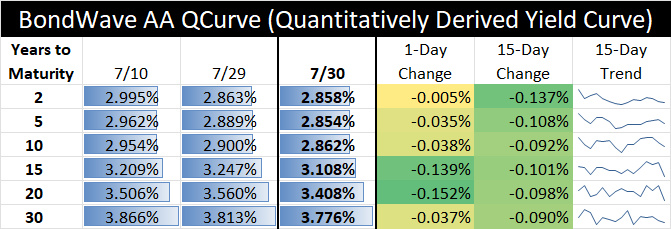
The interest rate table above illustrates recent changes in a sample of AA rated bond trades reported to the Municipal Securities Rulemaking Board’s EMMA® system. Every issuer’s credit is different, and other financing sources may be available. To obtain comprehensive Financial Advisory services for your local government, contact your Ranson Financial Municipal Advisor, Larry Kleeman, or Henry Schmidt.
JoCo homeless shelter plan moves ahead, as ardent backers and opponents weigh in
Concerns about providing homeless services to “illegal aliens” and people from outside Johnson County dominated discussion at the county commission last Thursday about a proposal to open a shelter at a former La Quinta Inn and Suites hotel in Lenexa. After two hours of discussion that also included enthusiastic endorsements of the shelter plan from leaders of the interfaith Good Faith Network, commissioners ultimately voted to approve $3.7 million for renovations and operating costs for the hotel.
Source: Johnson County Post
Small-town Kansan competes in Olympic marathon trials, encourages others to dream big
Kaylee Bogina is from Arma, Kansas and recently competed at the Olympic trials marathon in February. Making it to that point is a huge goal she is proud to check off her list. Her running career began in high school and then continued through college at Adams State. She saw her brother and roommate compete in the trials and made it a goal for herself. “I remember watching them the whole way and thinking just, oh, how cool of an opportunity that they got to go and do that,” Bogina said. “And I think from that moment on, I was kind of like, man, could I do this? I think that’d be something really neat to do, but obviously, 26 miles is a whole different ballgame than what I was doing at the time.” Bogina got involved with a post-collegiate group with coaches at the University of Colorado. “From that moment on, I kind of had more of a purpose and a direction for where I was going, and I felt a lot more confident in getting to my goals that way,” Bogina said. “And so really a lot just changed as soon as I got connected with them, and I really started focusing more on the marathon at that point and had the goal of qualifying for the trials.” Later on, she ran a marathon in California to qualify for the Olympic trials marathon. Her time qualified her for the trials in February 2024. She says she loved experiencing the crowds there to support them and running among the best women in the country. “We’re going to have three great athletes representing us in Paris, and just the fact that I got to be on that start line and I had the same chance as they did is just something I’m really proud of,” Bogina said. Bogina says regardless of where you are from or the circumstances you are in, you can accomplish anything you set your mind to. “I think the fact that I am from a small town, and I grew up in a small farming community, and we didn’t have the best facilities or anything like that, but I just felt so empowered and supported along the way to my goal. I think that is the true, like beauty in everything I was able to do here,” Bogina said. “This little goal that started when I was a freshman now has just like changed my whole life.” Since the trials, Bogina says she has been enjoying time off. Training takes 10 weeks of discipline and commitment, running 90-95 miles a week. “The fact that I get the opportunity to do that and just try for that is really huge for me,” Bogina said. “I don’t think that I’m quite on the level of some of these people that will have the chance to represent our country, and I think just being able to understand that allows me to have so much fun in this sport, still, like I can’t be disappointed with what I do, and I just had the opportunity to chase my dream.” She says she can see herself training again to make it to the next Olympic trials. Even if she never races again, she feels lucky. “I think that whether you get to the highest stage or not, I think just being able to be the best that you can possibly be is so huge. Having huge goals should never be something you should not be proud of having or scared to achieve,” Bogina said. “I think that the best things come from a dream that maybe seems a little far out there or scary or unattainable. It’s like, why not me? I think I would be so unsatisfied if I hadn’t ever had this dream. Someone’s got to do it, so why not me?”
Source: KSN-TV
City of Wichita to change WPD gang database, awaiting court’s decision
After three years, Progeny v. City of Wichita, a lawsuit regarding the Wichita Police Department’s use of a gang list, is awaiting approval. If approved, some names that were incorrectly on the gang list will be removed, and the criteria for the database will change. The lawsuit was brought forward by the American Civil Liberties Union (ACLU) of Kansas and the Kansas Appleseed Center for Law and Justice. The organizations argued that the list violated the 14th and 1st Amendment rights of those on it. Currently, members of the Wichita community do not have to be charged with a crime to be put into the database. It is at the discretion of law enforcement to determine if someone is suspicious of gang activity, and they can decide to enter them in the database. Teresa Woody with the Kansas Appleseed Center says that if the courts approve the settlement, there will be changes to the criteria and notification systems for the database. “The main point of the settlement is to vastly revise the criteria for putting people on the gang list in Wichita,” said Woody. “And to make those criteria related more to criminal activity than just normal activities that a person would do in their day.” She added that being labeled a “gang member” or “gang affiliate” can be detrimental to those on the list. “It basically labels you a criminal without ever having even to be charged with any kind of crime,” Woody said. “And obviously, that can have effects on where you can live and your job.” The final approval hearing is scheduled for Aug. 23 at 1:30 p.m. It will be open to the public and affected individuals can submit a comment or request to speak at the hearing. “It’s an opportunity for people to tell their own stories, explain to the court their experiences of being on the gang list and how deeply it’s affected them,” said Kunyu Ching, staff attorney at Kansas ACLU. “And to weigh in on whether or not they think this settlement is a good one or not.” There is no financial compensation for affected individuals in the settlement. “Our clients, our plaintiffs who have bravely stuck with this case for three years, they were never in it for the money,” Ching said. “(What) we asked for from the court was changes to the policy.” More information can be found at aclukansas.org/wichitaganglist. If you would like to request to speak at the final hearing, email twoody@kansasappleseed.org or kching@aclukansas.org. Submissions will close on Aug. 2.
Source: KSN-TV
City leaders approve pay raise for Topeka Police
City leaders have approved a pay increase to try and stop the police shortage in the Capital City. At Tuesday’s City Council meeting, council members approved a pay increase for the Topeka Police Department (TPD). This competitive pay increase is one way the city is hoping to increase its officer shortage. According to the agreement, a pay increase of 17% will take effect January of 2025, with a 5% increase in 2026 and 2027. “We hope it [increasing pay] brings people on the front and keeps people on the backend,” Topeka Interim Police Chief Jamey Haltom said. The three-year labor agreement between the City of Topeka and the Fraternal Order of Police Lodge No. 3 was approved by District 8 Councilman Spencer Duncan and seconded by District 3 Councilwoman Sylvia Ortiz. The action item was unanimously approved by the Topeka City Council Tuesday evening. Topeka City Manager Robert Perez told 27 News earlier this month that addressing the officer shortage is a high priority. The city’s current contract with the Fraternal Order of Police Union ends in December. According to the city, the union has already ratified a new contract through 2027.
Source: KSNT 27 News
Topeka leaders pass ordinance holding property owners accountable for maintaining ‘dangerous trees’
The City of Topeka passed an item requiring owners of a mobile home property to take on responsibility for removing or pruning “dangerous trees”. Tuesday evening, the Topeka City Council unanimously approved an action item that states the owner of a mobile home property is responsible for removing or trimming any trees that are deemed “dangerous” until they are no longer considered a safety risk, instead of the individuals who reside on the property. District 2 Councilwoman Christina Valdivia-Alcala first introduced this ordinance at the request of a constituent. This comes after a storm knocked down a tree, splitting a Topekans home in half earlier this year.
Source: KSNT 27 News
‘A little explosion of growth,’ Emporia welcomes multiple new stores
Multiple new stores are coming to Emporia in the fall of 2024. Emporia residents can expect a new Ulta Beauty, Old Navy and Five Below to open in the near future. The three stores will be add-ons to the Emporia Pavilion, which has been steadily growing since building a Hobby Lobby back in 2017. Interim President of the Emporia Regional Development Association, Jim Witt, told 27 News, the stores are apart of Emporia’s new incoming era. “Emporia after a period of relatively quiet during the pandemic is starting to really get into the ballgame again,” Witt said. “It’s really on the verge of a little explosion of growth.” The west side of the city will also be seeing new buildings. A new Quick Trip located on West 8th Avenue will soon start construction, along with construction on the Fairfield Inn and Convention Center.
Source: KSNT 27 News
Federal judge issues temporary order blocking enforcement of a Kansas campaign finance law
A federal judge granted an Overland Park nonprofit organization’s request for a temporary restraining order blocking the Kansas Governmental Ethics Commission from enforcing a campaign finance law until a trial on the constitutionality of the state’s definition of a political action committee. U.S. District Court Judge Daniel Crabtree issued the order Wednesday on behalf of Fresh Vision OP, which ran afoul of the state commission in 2021 after sending a mailer endorsing the candidacy of Faris Farassati, a then-Overland Park City Council member campaigning for mayor. Fresh Vision OP posted comparable information on its website. The organization also opposed the use of “tax give aways,” incentives for economic development and tolling on U.S. 69. Fresh Vision OP’s attorneys, including lawyers with the Institute for Free Speech, filed a lawsuit challenging the state’s definition of a PAC. The plaintiff’s attorneys argued the law could be interpreted to include groups such as Fresh Vision OP that were organized primarily for a neighborhood’s benefit, but also periodically endorsed candidates. The lawsuit was designed to protect the free speech rights of Fresh Vision OP and organizations like it, plaintiffs said. Crabtree’s temporary restraining order would allow Fresh Vision OP to resume community advocacy activities without being regulated as a PAC.
Source: Prairie Village Post
City looks to address budget issues caused by years of overspending
The city of Manhattan has found itself in some financial trouble after nearly a decade of spending more than it makes, and city staffers are trying to figure out how to get things under control with budget season around the corner. Last month, city officials last month told commissioners they expect the general fund reserves to drop from $11 million to $6 million by the end of 2024, well below the $10 million threshold above which they’d like to keep the city’s cash reserves. Interim city manager Jason Hilgers said the shortage has been building since 2015. He said the city during that time “had to manage periods where expenses outpaced revenues, which required (the city) to draw down cash reserves to offset the shortfall.” While the city received $15 million-$16 million in federal COVID-19 relief funds in 2020 and 2021 that helped offset revenue declines a bit, that was a one-time influx of funds. Since then, Hilgers said, the city has made efforts to avoid further into debt. “The city has had to make adjustments such as delaying capital improvement projects, reducing equipment and vehicle purchases, and limiting travel and conferences to manage budget shortfalls,” Hilgers said. He added that debt is “not necessarily a negative thing, as it can allow the city to pay for needed infrastructure and improvements over time.” However, the city has opted to be more conservative with its use of debt recently, and Hilgers said the city must “be very cautious about optimistic revenue projections and making necessary expenditure cuts” in the future.
Source: themercury.com
This city will soon decide if golf carts are allowed on streets. See Wichita-area laws
An upcoming decision from a Wichita-area city could make it legal to drive golf carts on neighborhood streets. The new Valley Center ordinance would allow golf carts on streets with a speed limit less than 30 miles per hour. The city council is planning discuss the topic again Aug. 20, said Valley Center’s city administrator, Brent Clark. So what are the golf cart laws in Wichita? According to the city’s ordinance, anyone with a valid license and a golf cart with a Kansas tag and proper lights can drive golf carts on city roads and sidewalks. “When operated on a street or highway which is not closed to vehicular traffic, all vehicles must obey all traffic rules and regulations,” the city’s ordinance reads. If you do not have a valid license, you can only drive a golf cart on private property. Parents can receive citations for letting juveniles drive on city streets without a proper driver’s license. State law says that golf carts can only be driven on public roads or highways between sunrise and sunset, unless equipped with either lights or a “properly mounted slow-moving vehicle emblem.”
Source: Local News | Wichita Eagle
Parsons police take initiative to strengthen community ties
The Parsons Police Department takes a new initiative toward improving relationships with the community. Police officers and members of the community attended the Police 2 Peace community forum held at the Parsons High School theater this evening. Funded by a grant from the U.S. Department of Justice, the national program aims to turn police officers into peace officers by bringing more conversations of empathy and understanding to real-life situations. The community got the chance to listen to speakers from Police 2 Peace as well as ask questions. Those questions included “Will the program help the youth” and “What can we do as a community to help further this program”. The community also got to fill out a survey about changes they want to see and how they feel about the program.
Source: KSNF/KODE
Andover library receives state arts funding
Kansas Lieutenant Governor David Toland recently announced that nearly $1.3 million was given out to 108 recipients in the latest round of the Kansas Arts Commission grant funding. Among those entities receiving grant funding in this cycle was the Andover Public Library, which got $6,393 through an Arts Everywhere grant. Arts Everywhere grants provide funding for programs, exhibition series or other arts and culture projects. The Andover library will be using the grant to help purchase drawing tablets, a new scanner and software, as well as traditional art equipment like easels, for all-ages art classes.
Source: Derby Informer | Area
Park grand opening to be held in Andover
A grand opening ceremony is set to be held for Andover’s 13th Street Sports Park (1008 E. 13th St.) at 6 p.m. July 31, marking the end of an approximately year-long redevelopment process for the park that first opened in the 1980s. Elements of the first two phases to be unveiled include five new ball diamonds, a large destination playground, splash park, pickleball complex and more. The splash pad will start operations in conjunction with the grand opening. Phase three of redevelopment, to be completed in the next year or two, will include a new Andover Community Center building. The first 100 guests to the grand opening will receive a cooling towel. For more information on the park, visit www.andoverks.com/835/13th-Street-Sports-Park.
Source: Derby Informer | Area
Solar benches installed at some Wichita locations
Three solar benches have been installed at a Wichita park and two neighborhood resource centers. This is part of an initiative by the Wichita Public Library to expand wireless access to residents across the city. The benches were installed at Evergreen Park and the Atwater and Colvin neighborhood resource centers. They are equipped with free public Wi-Fi and charging ports powered by solar panels on top. Residents who need to connect to a device can use these benches. Last month, the Wichita Public Library, in partnership with the Wichita Public Library Foundation, received a $289,000 grant from the State of Kansas ADOPT Program to install nine more solar benches in low-income areas, leveraging the Library’s extensive digital reach. This is a response to a situation where thousands of households lack home internet.
Source: 101.3 KFDI
Moundridge police report rescue of child trapped in pipe
Moundridge police have reported a rescue operation that got a 14-month old child out of an underground pipe. Police and rescue crews were called to a location around 2 p.m. Sunday when it was reported that a child was trapped in a 12-inch PVC pipe that was about 12 feet underground. The child was found to be upright at the bottom of the pipe. Moundridge officer Ronnie Wagner was credited with creating a “catch pole” using a smaller PVC pipe and rope, and that was used to lift the child out. The child was shaken but not hurt. The rescue operation took about 20 minutes. In a post on social media, the Police Department expressed thanks to Moundridge EMS and Fire crews that responded to the scene.
Source: 101.3 KFDI
Commerce Announces First Regional Water Project for Rural Kansas
The Kansas Department of Commerce announced today a Community Development Block Grant (CDBG) award for the first regional water project in over a decade. This project will provide improved water access to residents in Coffeyville and Caney. The total cost of the project is $7,894,325, with a $1 million grant from the CDBG program. Additional funding is being provided by the Kansas Department of Health and Environment (KDHE). “This vital and groundbreaking partnership will significantly improve water infrastructure and ensure reliable access to clean water for residents in Caney and Coffeyville, exemplifying the tremendous value of regional collaboration,” Lieutenant Governor and Secretary of Commerce David Toland said. “These efforts directly support the Kansas Water Plan’s goals of addressing water quantity and quality issues, investing in infrastructure and protecting our water sources for generations to come.” This regional water project represents a significant investment in the infrastructure of these communities, ensuring reliable and sustainable water resources long into the future.
Source: Kansas Department of Commerce
Cash Managers’ Interest Rate Quandary
Public cash managers today face a strategic dilemma: They can sit on money market funds, local government investment pools and ultra-short investments like repurchase agreements, all of them still yielding the highest interest rates available today. Or they can look out into 2025 and try to lock in some less spectacular but still healthy longer-term yields in anticipation of lower short-term rates next year, if and when the Federal Reserve cuts its overnight rates on the view that inflation has been tamed. The problem today is that markets have already begun to anticipate a lower-rate environment next year, and thus longer maturities currently carry lower yields. The “give up” trade is hard to explain to those who cannot see beyond their noses. There is more than just the egos of state and local treasurers at stake. Budget officials need accurate projections of interest income from operating funds, and some may even prod their treasurers to lock in rates now to prevent a sharp drop-off in interest income next year. Already, it looks like general fund interest income revenues in 2025 could be down 10 to 15 percent, and it may be even worse where cash reserves and federal grants are being spent this year. Meanwhile, debt managers need to decide when is the best time to sell municipal notes and bonds for both cash flow and capital improvements. With trillions of public-sector budget dollars invested in the money markets and interest income again representing a significant revenue line item, these are not Source: Governing
AWWA, RCAP launch partnership to help small, rural community water service
The American Water Works Association (AWWA) and the Rural Community Assistance Partnership (RCAP) in July announced the renewal of their Cooperative Agreement, reaffirming their commitment to collaborate on improving water infrastructure and services for small and rural communities across the United States. This renewed agreement builds upon a long-standing partnership between the two organizations, leveraging their combined expertise and resources to address critical water challenges faced by rural communities. The partnership will focus on providing technical assistance, training and advocacy support to enhance water system management, promote community resilience, and ensure the protection of public health and the environment. “AWWA is pleased to continue our enduring collaboration with RCAP to support the needs of rural communities across the United States,” said Barb Martin, AWWA’s director of engineering and technical services. “We look forward to working together to address current challenges, while looking ahead to achieve a sustainable and resilient future for rural communities.” The collaboration will also involve knowledge sharing, joint research initiatives, and the development of educational resources to empower water professionals and community leaders. By working together, AWWA and RCAP aim to foster innovation, resilience and equitable solutions in the water sector.
Source: Water Finance & Management
Investors Embrace Bond Funds Before Rates Start to Fall
The stock market may be roaring, but 2024 has been Wall Street’s year of the bond fund. Bonds are paying the highest yields in a generation and interest rates are poised to come down. Meanwhile, a record number of retirees are looking to cut risk in their portfolios. That combination has investors pouring money into both indexed and actively managed funds. Wall Street is seeing dollar signs. U.S.-listed fixed-income exchange-traded funds have taken in nearly $150 billion through late July, a record through this point in a year. When looking at mutual funds and ETFs together, taxable bond funds were responsible for nearly 90% of net U.S. fund inflows in the first half, according to Morningstar. After more than a decade of paltry bond yields, and just two years removed from the worst year for bonds on record, the combination of high rates and falling inflation offers investors a rare opportunity for investment income. Rick Rieder, who oversees more than $2 trillion as BlackRock’s chief investment officer for fixed income, is calling the current period “the golden age of fixed income.” A crucial factor shifting bond prices is investors’ expectations for short-term interest rates. When the Federal Reserve began to raise rates in 2022, investors flocked to cash-like investments. Now, as Wall Street bets that rate cuts later this year are all but certain, investors are looking toward bonds instead, grabbing for yields that have already started to descend as bond prices rise. “We’re seeing people move out of cash and into bonds,” Rieder said. “Cash has been flipping a lot of yield, but now there’s a sense that the Fed is going to start lowering rates and that opportunity won’t be there anymore.”
Bond funds have been a bright spot for a money-management industry that has struggled to contend with the growth of passive investing and a steep fall in management fees. While investors have largely begun to shun actively managed stock funds, bond pickers are thriving.
Source: WSJ.com: World News
This week’s meeting of Fed officials will be one of the most consequential in a while, even if the central bankers aren’t likely to cut interest rates this time and instead look ahead to September.
While Federal Reserve officials aren’t likely to change interest rates in the coming week, their meeting will nonetheless be one of the most consequential in a while. At each of their four meetings this year, interest-rate cuts have been a question for later. This time, though, inflation and labor-market developments should allow officials to signal a cut is very possible at their next meeting, in September. As a result, the coming week’s meeting, which wraps up Wednesday, could resolve the trade-off Chair Jerome Powell has been weighing between the risks of cutting rates too soon and waiting too long, in favor of acting sooner.
Source: WSJ.com: World News
Municipal Bond Trends for July 29, 2024
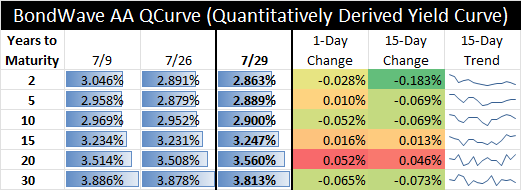
The interest rate table above illustrates recent changes in a sample of AA rated bond trades reported to the Municipal Securities Rulemaking Board’s EMMA® system. Every issuer’s credit is different, and other financing sources may be available. To obtain comprehensive Financial Advisory services for your local government, contact your Ranson Financial Municipal Advisor, Larry Kleeman, or Henry Schmidt.
Could a sales tax in Sedgwick County reduce property taxes?
Voters in Sedgwick County could be asked next year to support a new sales tax that would fund arts, culture and recreation programming. … Funding those programs through a sales tax instead would allow the county to lower its property tax levy by between two and a half and three mills, likely starting in 2026 or 2027. Commissioners want to present voters with a ballot question about a sales tax no later than fall 2025.
Source: Local News | Wichita Eagle
Wichita police quietly tested gunshot-detection tech for 2 years. Now they’re ready to expand it.
The Wichita Police Department plans to purchase around 144 gunshot sensors it’s tested since February 2022, officials said during a town hall meeting in June. Other than a brief mention of it when police talked about failures of the previous gunshot system in February 2023, which was the first time city and elected officials learned police had been testing the technology for more than a year, it was the first time the department spoke publicly about testing the controversial technology. The gunshot technology being implemented in Wichita has been controversial in other cities, including lawsuits, concerns about police bias and voice detection, and the question of whether or not the system detects gunshots accurately. Chief Joseph Sullivan, who inherited the Flock Safety’s Raven gunshot sensors from his predecessor, blamed the lack of transparency on a “glitch in communication” by the previous administration. He said that the department would be more transparent in the future, including about testing products, adding that when the Raven gunshot sensors go live, there will be a dashboard for people to see alerts and outcomes. “We want you to see and we want to see, is it working, is it not working?” Sullivan said during the June 8 meeting.
Source: Wichita Eagle
Could a sales tax in Sedgwick County reduce property taxes?
Voters in Sedgwick County could be asked next year to support a new sales tax that would fund arts, culture and recreation programming. The Sedgwick County Zoo, Exploration Place science museum, the Kansas African American Museum and the county parks department are all set to take cuts in next year’s proposed county budget. Funding those programs through a sales tax instead would allow the county to lower its property tax levy by between two and a half and three mills, likely starting in 2026 or 2027. Commissioners want to present voters with a ballot question about a sales tax no later than fall 2025. Establishing an eighth of a cent sales tax for cultural arts and rec funding would generate around $18 million in revenue based on current sales tax data — roughly the same amount the county now spends annually on quality of life programming. “I would like to say we would never fund those things ever again through property taxes,” Commissioner Jim Howell said at a staff meeting earlier this week. “They would be forever funded through sales tax.” The county tax proposal comes as the state is reducing and then eliminating by Jan. 1 its sales tax on food bought at grocery stores. Meanwhile, a major tax cut compromise reached between Gov. Laura Kelly and Republican legislators in June did little to provide property tax relief, but lawmakers have vowed to take the issue up again next year. A county sales tax ballot proposal would likely have an ending date, giving voters an option in five years to renew the funding mechanism or revert back to using property taxes.
Source: Wichita Eagle
Rural Towns Are Aging, Cash-Strapped and in Desperate Need of Workers
The challenge of both finding and affording workers faces small governments scattered around the U.S., and often leaves those still there to pick up the slack. … Rural areas have long struggled to hang onto—or recruit—young residents launching their careers. Small-town officials say they face particular hurdles when it comes to offering competitive salaries to compete for workers.
Source: Wall Street Journal
Municipal Bond Trends for July 26, 2024
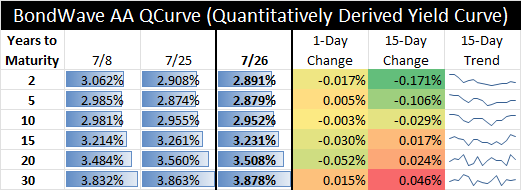
The interest rate table above illustrates recent changes in a sample of AA rated bond trades reported to the Municipal Securities Rulemaking Board’s EMMA® system. Every issuer’s credit is different, and other financing sources may be available. To obtain comprehensive Financial Advisory services for your local government, contact your Ranson Financial Municipal Advisor, Larry Kleeman, or Henry Schmidt.
Commerce Awards $380,000 for Rural Counties to Market ROZ Program
Lieutenant Governor and Secretary of Commerce David Toland today announced $380,000 has been awarded to 40 Kansas counties in the first round of Rural Opportunity Zone (ROZ) Local Marketing Grants. The funds are intended to help counties market the unique ROZ financial incentives available to new residents: Student loan repayment assistance and/or 100% state income tax credit. Counties that have annually contributed and supported the matching requirement of the program will receive between $5,000 and $15,000 to better support and promote their program. Funding will assist the counties and local partner organizations as they develop customized marketing strategies best suited for their community. “There is not a one-size-fits-all solution when effectively marketing what each unique Kansas community has to offer its residents,” Lieutenant Governor and Secretary of Commerce David Toland said. “The ROZ marketing grant will provide support to showcase each community’s potential to be that perfect place for someone relocating to Kansas.”
Source: Kansas Commerce
‘Them vs. us’: Lawrence community members identify barriers between police and themselves
A diverse group of community members shared their perspectives on Lawrence police Saturday, voicing concerns ranging from how officers could show more compassion and preparedness in crises to making downtown feel safer. Several dozen community members gathered at Lawrence High School for a partnership workshop hosted by the Lawrence Police Department and the U.S. Department of Justice. The two-part workshop aims to “improve trust and develop partnerships between police and community members. Participants split into six small groups to identify the positives and negatives of the LPD’s interactions with the community, ultimately narrowing it down to three “barriers.” A second session next weekend will focus on solutions. Facilitators wanted groups to be organized “homogeneously.” One included law enforcement and city employees, and another included members of civil rights advocacy organizations, for instance. Groups identified points ranging from positive and upbeat moments such as citywide celebrations to critical conversations about crisis control. At the end of the workshop, people in attendance voted on the top five most pressing issues by placing dot stickers on pages where each group listed the top barriers they identified. The No. 1 issue, community members voted, was “A sense of them vs. us.”
Source: Lawrence Times
Wichita police officers get new body cameras
The Wichita Police Department has been issuing new body cameras to all commissioned officers, and most officers have now received them. Police Captain Aaron Moses said officers will have a choice between a head-mounted and a body-mounted camera. He said the new cameras have a wider angle and a clearer picture along with better audio. There has been automatic activation of the camera when a taser is deployed, and Moses said the next steps will be to have automatic activation when the light bar is activated on a patrol car or when a firearm is pulled from its holster. Supervisors will be able to livestream video from officers in the field in certain situations. Moses said every commissioned officer will get a body-worn camera. After all field services employees have received cameras, the investigations employees will get cameras and eventually the police chief will get a camera as well.
Source: KFDI